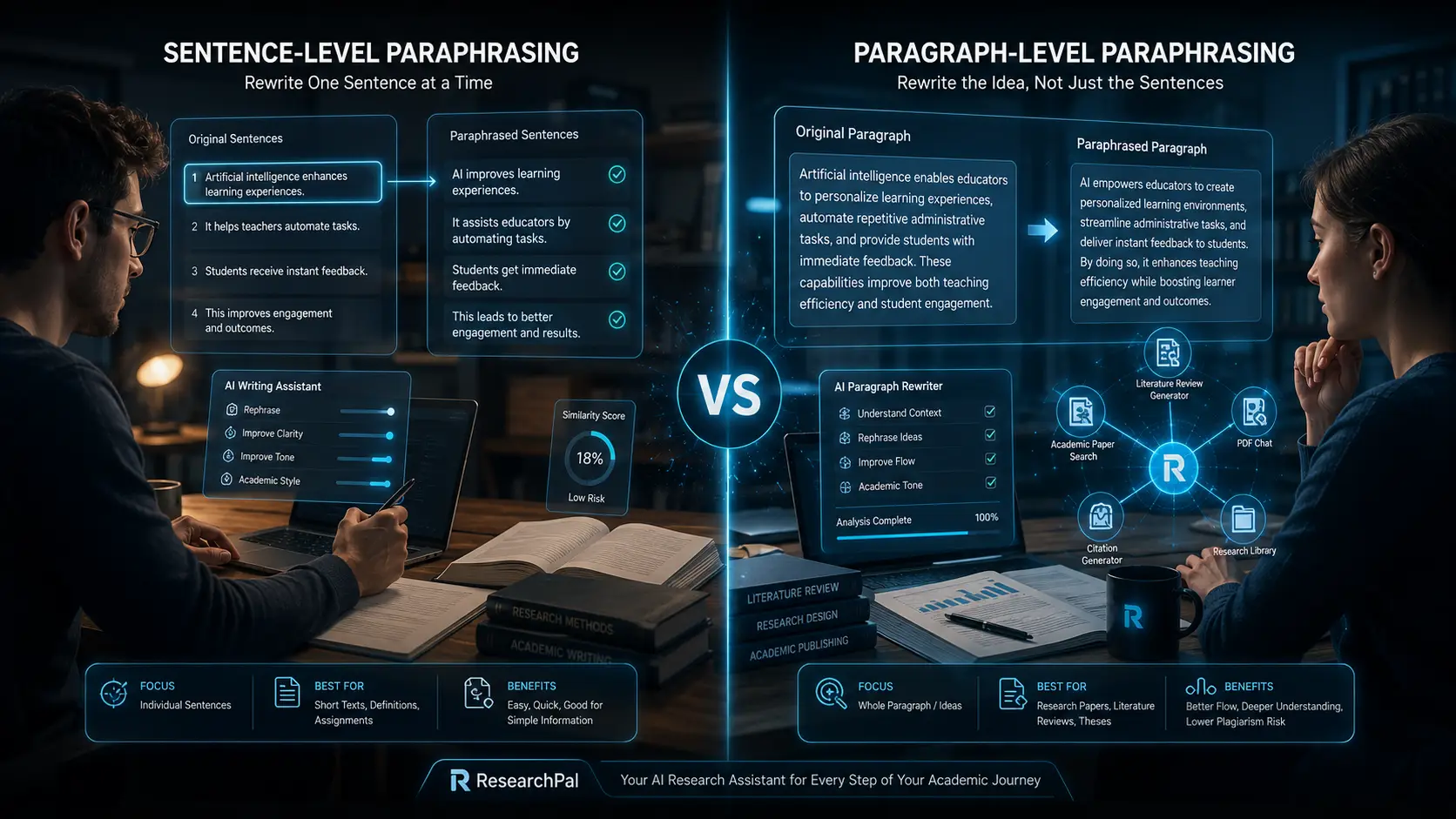
Paraphrasing is one of the most essential skills in academic writing. Whether you’re preparing a university assignment, writing a literature review, or publishing a research paper, you’ll often need to explain ideas from existing sources using your own words while preserving the original meaning. However, not all paraphrasing methods produce the same results. Some writers rewrite one sentence at a time, while others rewrite entire paragraphs to create a more natural flow. Both approaches have their advantages, but choosing the right one depends on your writing goals, the complexity of the source material, and the type of document you’re creating. So, which method is better?
In this guide, we’ll compare sentence-level and paragraph-level paraphrasing, explain when to use each approach, and help you decide which technique works best for students, researchers, and professional writers.
Quick Answer
Sentence-level paraphrasing focuses on rewriting individual sentences, making it ideal for simple assignments, definitions, and short passages. Paragraph-level paraphrasing rewrites an entire paragraph while preserving the overall meaning, creating smoother, more natural academic writing. For research papers and literature reviews, paragraph-level paraphrasing is generally the better approach because it improves readability and demonstrates a deeper understanding of the source material.
What Is Sentence-Level Paraphrasing?
Sentence-level paraphrasing means rewriting one sentence at a time while maintaining the meaning of that individual sentence.
Most beginners naturally use this method because it feels easier to manage.
Example
Original
Artificial intelligence is transforming higher education by improving personalized learning experiences.
Sentence-Level Paraphrase
Personalized learning in higher education is improving as artificial intelligence becomes more widely adopted.
The meaning remains the same, but the wording and sentence structure have changed.
Advantages of Sentence-Level Paraphrasing
Sentence-level paraphrasing works well because it:
- Is easy to learn.
- Requires less rewriting.
- Works well for short quotations.
- Helps simplify complex sentences.
- Is useful for assignments and reports.
For students who are still developing their academic writing skills, sentence-level paraphrasing provides a manageable starting point.
Limitations of Sentence-Level Paraphrasing
Although useful, this approach also has limitations.
Many writers unintentionally:
- Keep the original sentence structure.
- Replace only a few words with synonyms.
- Create repetitive writing.
- Produce paragraphs that sound disconnected.
This is one of the main reasons universities warn students against “patchwriting,” where rewritten sentences remain too similar to the original source.
What Is Paragraph-Level Paraphrasing?
Paragraph-level paraphrasing involves reading an entire paragraph, understanding its overall message, and then rewriting the complete idea using your own words, structure, and writing style.
Instead of rewriting one sentence after another, you focus on communicating the author’s overall argument.
Example
Original Paragraph
Artificial intelligence enables educators to personalize learning experiences, automate repetitive administrative tasks, and provide students with immediate feedback. These capabilities improve both teaching efficiency and student engagement.
Paragraph-Level Paraphrase
Educational institutions are increasingly using AI to create more personalized learning environments while reducing administrative workloads. By automating routine tasks and delivering faster feedback, AI allows educators to spend more time supporting students and improving learning outcomes.
Notice that:
- The paragraph has been completely reorganized.
- New sentence structures are used.
- The flow feels more natural.
- The original meaning remains unchanged.
Whether you’re rewriting a single sentence or an entire paragraph, ResearchPal’s free paraphrasing tool can help generate a clearer version while preserving the intended meaning.
Advantages of Paragraph-Level Paraphrasing
Paragraph-level paraphrasing offers several benefits.
Better Readability
Instead of sounding like several rewritten sentences joined together, the writing flows naturally from one idea to the next.
Demonstrates Deeper Understanding
Rewriting an entire paragraph requires understanding how the ideas connect rather than simply replacing words.
This demonstrates stronger critical thinking and comprehension.
Stronger Academic Writing
Researchers often paraphrase entire paragraphs when writing:
- Literature reviews
- Discussion sections
- Research summaries
- Systematic reviews
This creates more cohesive and professional writing.
Lower Risk of Accidental Plagiarism
Because the entire paragraph is reorganized, there is less chance of copying the original sentence structure too closely.
Sentence-Level vs Paragraph-Level Paraphrasing
| Feature | Sentence-Level | Paragraph-Level |
|---|---|---|
| Difficulty | Easy | Moderate |
| Time Required | Low | Higher |
| Reading Flow | Moderate | Excellent |
| Academic Quality | Good | Excellent |
| Plagiarism Risk | Higher | Lower |
| Best for Research Papers | Limited | Yes |
| Demonstrates Understanding | Moderate | Strong |
| Suitable for Literature Reviews | Limited | Excellent |
Which Method Is Better for Students?
For undergraduate assignments, sentence-level paraphrasing is often enough when explaining definitions, concepts, or short pieces of information.
However, students writing research-based assignments should begin practicing paragraph-level paraphrasing as early as possible because it develops stronger academic writing habits.
Which Method Is Better for Researchers?
Researchers rarely paraphrase individual sentences in isolation.
Instead, they need to synthesize information from multiple papers, compare findings, identify research gaps, and explain complex ideas clearly.
Paragraph-level paraphrasing supports this process by helping researchers integrate evidence naturally into literature reviews and research discussions.
For this reason, it is generally the preferred approach for master’s students, PhD candidates, and academic authors.
Common Mistakes to Avoid
Whether you paraphrase sentences or entire paragraphs, avoid these common mistakes:
Only Replacing Synonyms
Changing a few words does not create an effective paraphrase.
Preserving the Original Structure
If your rewritten version closely mirrors the source, it may still be considered plagiarism.
Changing the Original Meaning
Accuracy is more important than creativity. Your paraphrase should communicate the author’s ideas—not introduce new ones.
Forgetting Citations
Even a perfectly rewritten paragraph still requires proper citation because the ideas belong to the original author.
Practical Tips for Better Paraphrasing
To improve the quality of your paraphrasing:
- Read the entire section before rewriting.
- Focus on ideas rather than individual words.
- Change the sentence structure naturally.
- Use vocabulary that fits your own writing style.
- Review your version against the original to ensure accuracy.
- Always provide appropriate citations.
These practices help produce writing that is clear, original, and academically credible while reducing the risk of accidental plagiarism.
When Should You Use Sentence-Level Paraphrasing?
Sentence-level paraphrasing is the better choice when you’re working with short, independent pieces of information that don’t require extensive context. It allows you to rewrite a single idea quickly while maintaining its original meaning.
It works particularly well for:
- Definitions
- Statistics
- Short quotations
- Assignment questions
- Presentation slides
- Business reports
For example, if you’re explaining a single concept in a classroom assignment, rewriting one sentence at a time is usually sufficient.
However, relying exclusively on sentence-level paraphrasing in research papers may produce writing that feels fragmented and repetitive.
When Should You Use Paragraph-Level Paraphrasing?
Paragraph-level paraphrasing is the preferred approach whenever you’re discussing complex ideas that span multiple sentences.
This includes:
- Literature reviews
- Journal articles
- Research papers
- Theses
- Dissertations
- Systematic reviews
- Academic reports
Instead of treating every sentence independently, paragraph-level paraphrasing helps you explain the author’s complete argument in your own words.
This produces smoother transitions, stronger logical flow, and more professional academic writing.
Which Method Do Journal Editors Prefer?
Journal editors rarely evaluate paraphrasing sentence by sentence.
Instead, they assess whether authors:
- Demonstrate a genuine understanding of previous research.
- Present ideas in a clear academic voice.
- Maintain logical flow.
- Accurately represent the original findings.
- Properly cite all sources.
Paragraph-level paraphrasing naturally supports these expectations because it encourages researchers to synthesize ideas rather than simply rewrite isolated sentences.
How AI Is Changing Paraphrasing
Modern AI tools have transformed academic writing by making paraphrasing faster and more accessible.
Instead of manually rewriting every sentence, researchers can use AI to:
- Improve readability.
- Strengthen academic tone.
- Simplify complex language.
- Rewrite paragraphs naturally.
- Maintain consistency across documents.
However, AI should always be treated as a writing assistant rather than an automatic replacement for critical thinking.
Researchers remain responsible for verifying accuracy, preserving meaning, and providing proper citations.
ResearchPal vs Traditional Paraphrasing Tools
Many AI writing tools focus exclusively on rewriting text.
ResearchPal takes a broader approach by supporting the entire academic research workflow.
Feature Comparison
| Feature | ResearchPal | Typical AI Paraphrasing Tool |
|---|---|---|
| AI Paraphrasing | ✅ Yes | ✅ Yes |
| Academic Tone Optimization | ✅ Advanced | ⚠️ Basic |
| Literature Review Generation | ✅ Yes | ❌ No |
| Academic Paper Search | ✅ Yes | ❌ No |
| PDF Chat | ✅ Yes | ❌ No |
| Citation Generator | ✅ Yes | ⚠️ Limited |
| Research Library Management | ✅ Yes | ❌ No |
| Paper Insights | ✅ Yes | ❌ No |
| End-to-End Research Workflow | ✅ Complete | ❌ No |
Why ResearchPal Is Different
While many AI writing tools help rewrite text, ResearchPal is designed specifically for academic research.
Researchers can:
Improve Academic Writing
Rewrite sentences and paragraphs while maintaining a formal academic tone.
Generate Literature Reviews
Analyze multiple research papers and organize findings into structured literature reviews.
Search Academic Papers
Discover scholarly publications directly within the platform.
Chat with PDFs
Upload research papers and ask questions about methodologies, findings, limitations, and conclusions.
Generate Citations
Create properly formatted citations while keeping references organized.
Manage Research Libraries
Store and organize research papers across multiple projects without switching between different applications.
By combining these capabilities, ResearchPal helps students and researchers spend less time managing tools and more time focusing on research.
Best Practices for Effective Paraphrasing
Whether you’re rewriting one sentence or an entire paragraph, these best practices can improve the quality of your work.
Understand Before You Rewrite
Never paraphrase text you don’t fully understand.
Take time to identify the author’s main argument before attempting to rewrite it.
Focus on Ideas, Not Words
Instead of replacing vocabulary, think about how you would naturally explain the same concept to another student or researcher.
Preserve Every Important Detail
Your paraphrase should communicate exactly the same message without adding or removing information.
Maintain Your Own Writing Style
Good paraphrasing blends naturally into the rest of your document rather than sounding copied or artificially rewritten.
Always Cite the Original Source
Paraphrasing changes the wording—not the ownership of the idea.
Proper citation remains essential.
Final Verdict
Both sentence-level and paragraph-level paraphrasing have important roles in academic writing.
Sentence-level paraphrasing works well for short passages, definitions, and introductory assignments where individual ideas need to be rewritten clearly.
Paragraph-level paraphrasing, however, provides a stronger foundation for research papers, dissertations, literature reviews, and journal articles because it improves flow, demonstrates critical understanding, and creates more natural academic writing.
Rather than choosing one method exclusively, experienced writers use both depending on the context.
When combined with responsible AI assistance and careful citation practices, these techniques help produce writing that is original, accurate, and academically credible.
Why Students and Researchers Choose ResearchPal
ResearchPal supports every stage of academic writing by helping users:
- Paraphrase text naturally.
- Improve academic tone.
- Generate literature reviews.
- Search scholarly papers.
- Chat with PDFs.
- Generate citations.
- Organize research libraries.
- Analyze methodologies, findings, and limitations.
Instead of relying on multiple disconnected tools, students and researchers can complete their work within one integrated AI-powered research platform.
Key Takeaways
- Sentence-level paraphrasing is best for short, isolated pieces of information.
- Paragraph-level paraphrasing produces stronger academic writing and better flow.
- Research papers and literature reviews benefit most from paragraph-level rewriting.
- AI can improve paraphrasing efficiency, but human review is essential.
- ResearchPal extends beyond paraphrasing by supporting literature reviews, academic paper search, PDF analysis, citation management, and complete research workflows.
From The Web
- Integrating sources by paraphrasing, summarising, and quoting
https://learningessentials.auckland.ac.nz/writing-effectively/paraphrasing-summarising/
- Paraphrasing: What It Is and How to Do It?
https://searchatlas.com/blog/what-is-paraphrasing
Frequently Asked Questions
For most academic writing, paragraph-level paraphrasing is generally more effective because it improves readability, demonstrates a deeper understanding of the source, and reduces the likelihood of closely following the original sentence structure. ResearchPal helps researchers paraphrase entire paragraphs while maintaining academic tone and preserving the original meaning, making it particularly useful for literature reviews, research papers, and dissertations.
Paragraph-level paraphrasing can reduce the risk of accidental plagiarism because it encourages writers to reorganize ideas rather than simply replace words in individual sentences. However, proper citation is still essential, regardless of how extensively the text has been rewritten. ResearchPal helps users produce more natural academic paraphrases while reminding them that citations remain a critical part of responsible research and academic integrity.
Yes. Modern AI writing tools can paraphrase complete paragraphs while improving readability and academic tone. However, researchers should always review AI-generated content to ensure it accurately reflects the original meaning and includes proper citations. ResearchPal combines AI-powered paragraph paraphrasing with academic writing assistance, allowing users to refine their work while also accessing literature reviews, academic paper search, PDF chat, and citation management from a single platform.
ResearchPal is more than an AI paraphrasing tool. It is a comprehensive AI-powered research assistant designed specifically for students and researchers. In addition to helping users rewrite sentences and paragraphs while preserving the original meaning, ResearchPal offers literature review generation, academic paper search, AI Chat with PDFs, citation generation, research library management, paper insights, and academic writing enhancement. By bringing these capabilities together, ResearchPal supports the complete research journey—from discovering evidence to preparing publication-ready manuscripts.
Yes. While ResearchPal includes advanced AI-powered paraphrasing, it also helps improve academic writing by refining tone, enhancing clarity, organizing research projects, generating citations, analyzing research papers, and assisting with literature reviews. This integrated approach enables researchers to maintain consistency and quality throughout the entire writing process rather than relying on separate tools for each task.

