Three months into a thesis, the picture often looks like this. Sixty PDFs sit in a downloads folder. A dozen have highlights. Notes are split between a notebook and two apps, and the reference list stops halfway down.
You have read a lot. You still can’t explain, in two minutes, what the literature agrees on, where it splits, and what nobody has tested yet.
A research dossier is built to close that gap. It brings your sources, the evidence you took from them, and your own analysis into one organized file tied to a single research question.
This guide explains what belongs in a research dossier and how it differs from a literature review. It also includes a worked example, a template, and a ten-step process for building your own.
What Is a Research Dossier?
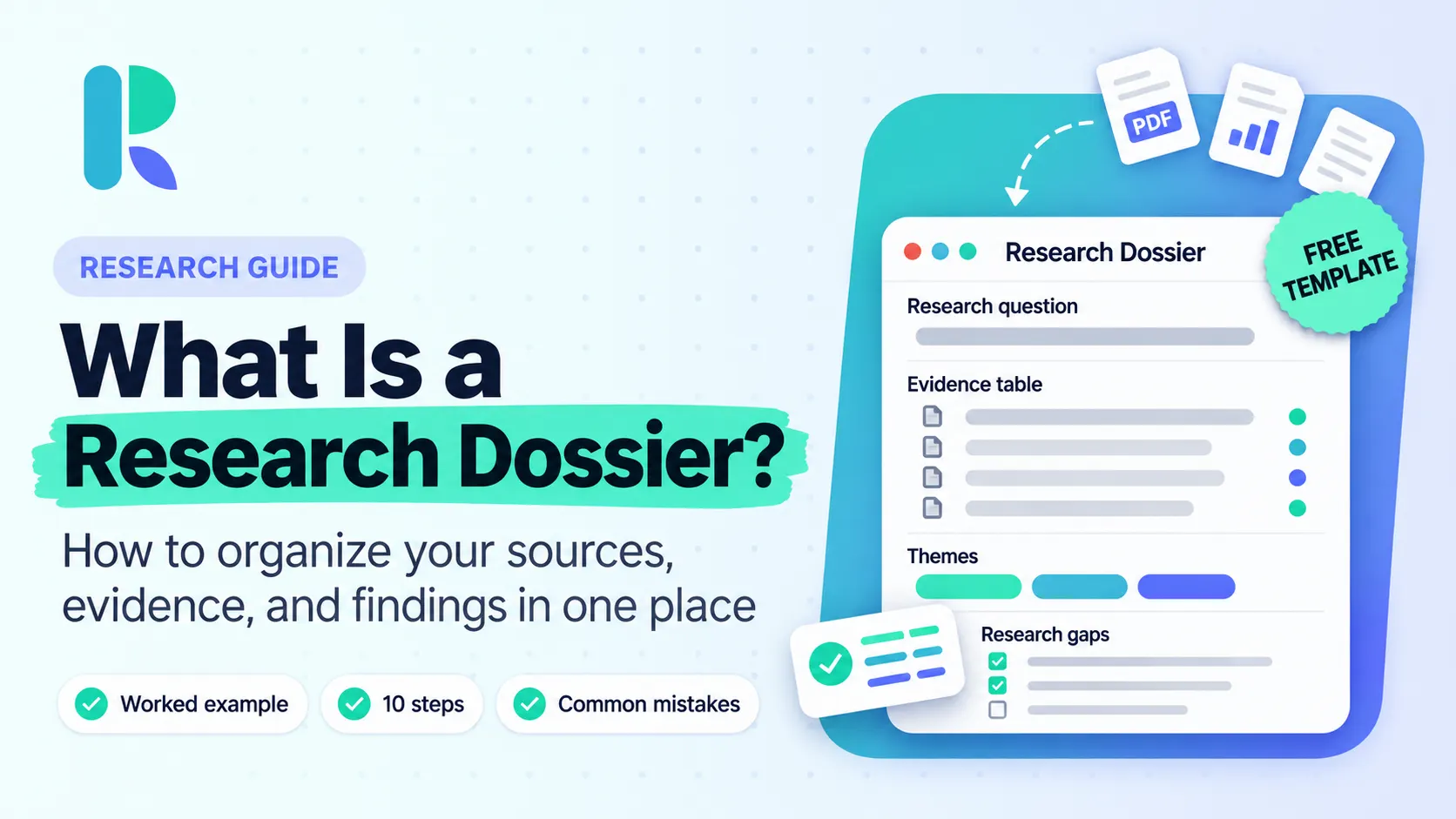
A research dossier is an organized working file that holds everything you have learned about one research question. It records the sources you selected, the evidence each one offers, how the studies compare, and what remains unanswered. Its purpose is to turn a pile of reading into a position you can explain and defend.
The word itself is general. Merriam-Webster defines a dossier as “a file containing detailed records on a particular person or subject.” In research, the subject is your question.
No style manual defines the academic research dossier in one fixed way, and the label covers more than one thing:
- As a course assignment. The International Baccalaureate’s Classical Languages course, for example, has students compile and annotate seven to nine primary sources in answer to a research question. Some college writing courses use the name for a packet that combines an introduction, a research plan, and an annotated bibliography.
- As a researcher’s working file. This is the meaning used in this guide: your own record of sources, evidence, and synthesis for a thesis, dissertation, or project.
- As a name for other documents. Faculty assemble promotion dossiers to document their research record, and drug developers compile regulatory dossiers. Both follow separate rules and fall outside this guide.
Who uses a working dossier? Undergraduates preparing a capstone, master’s and PhD students building toward a thesis, research assistants briefing a supervisor, and faculty entering a new area. In each case, it keeps information from many sources organized around one question.
Why Is a Research Dossier Important in Academic Research?
The value shows up at specific points in a project.
- Thesis and dissertation preparation. A dissertation runs for years. The dossier records why each source was included or dropped, so a scope decision from month two is still recoverable in month twenty.
- Literature review development. Because the dossier is already organized by theme, each theme becomes raw material for a section of the review. You draft from your notes instead of rereading sixty papers.
- Research proposal preparation. A proposal has to show a gap and justify a method. The dossier’s gap list and methods comparison supply both.
- Coursework and lab projects. The same discipline works at a smaller scale. A ten-source dossier for a term paper can be set up in one sitting.
- Research collaboration. A shared dossier shows a co-author, supervisor, or new research assistant the state of the evidence quickly. It also makes disagreements specific, because you argue about a row in a table.
- Long-term research documentation. Sources get reused across chapters, articles, and grant applications. Dated search and update logs show what you searched, when, and what you kept.
What Should a Research Dossier Include?
The components of a research dossier depend on your discipline, your project requirements, and what you plan to do with the file. A history dossier may lean on archival sources and page-level quotations. A psychology dossier may be mostly a table of designs, samples, and results.
Check your department’s or supervisor’s requirements first. Treat the list below as a starting structure, not a mandatory standard.
| Component | What it records |
|---|---|
| Title and scope | Topic and boundaries: population, period, place, source types, and exclusions |
| Central research question | The one question every entry must help answer |
| Research objectives | What the dossier should let you do, such as compare methods or locate a gap |
| Overview (executive summary) | About half a page on what the evidence shows so far; written last and revised often |
| Academic sources and references | Each source with a full citation, a DOI or stable link, and the reason it was included |
| Key findings and evidence | The main results of each source, with page numbers for anything you may quote |
| Research methodologies | Design, sample, measures, and analysis, so you can judge how much weight a finding deserves |
| Common themes and patterns | Findings grouped across sources |
| Conflicting findings | Where studies disagree, and possible reasons |
| Research gaps and unanswered questions | What has not been studied, or not studied well |
| Limitations | Weaknesses in the sources and in your own search |
| Citation details | A reference list in the style your institution requires |
Two parts do most of the work. The evidence table (sources, findings, and methods) is where you record. The synthesis (themes, conflicts, and gaps) is where you think.
Research Dossier Example: Understanding Its Structure
The example below is illustrative. The topic is a real area of study, but Studies A through E are invented placeholders, not published papers. Their “findings” exist only to show how a research dossier structure works, so do not cite them.
Working title: The Impact of Social Media Use on Academic Performance Among University Students
Question, scope, and objectives
- Research question: How is time spent on social media related to academic performance among undergraduates, and does the purpose of use change that relationship?
- Scope: Peer-reviewed empirical studies and reviews, in English, from the past ten years, with undergraduate samples and performance measured by GPA or course grades. Excluded: secondary school samples, studies of general internet or gaming use, and opinion pieces.
- Objectives: Summarize the direction of reported associations, compare how studies measure use and performance, and list what remains untested.
Evidence table
| Source | Design and sample | How use was measured | Performance measure | Main finding | Key limitation |
|---|---|---|---|---|---|
| Study A | Cross-sectional survey at one public university | Self-reported daily hours | Self-reported GPA | More hours, slightly lower GPA | Self-report on both measures; no causal claim |
| Study B | Two-semester longitudinal survey | Self-reported hours, split into academic and social use | Registrar GPA | Social use linked to lower GPA; academic use was not | One institution; dropout between waves |
| Study C | Two-week phone-log study | Logged app time | Course grades | Use during class and study hours predicted lower grades; total time did not | Small sample; short window |
| Study D | Semi-structured interviews | Students’ own accounts | Perceived performance | Group chats described as helpful, feeds as distracting | Perceptions, not grades |
| Study E | Systematic review | Mixed | Mixed | Small negative association overall, with wide variation | Mostly cross-sectional evidence |
Synthesis notes
Themes. Three patterns cut across the sources. Purpose of use matters more than total time (B, D, E). Timing matters, especially use during class or study hours (C). Measurement shapes results: self-reported hours and grades (A) are weaker evidence than logged time and registrar records (B, C).
Conflicting findings. Study A links total hours to lower GPA. Study C finds no link with total time once timing is counted. One explanation is that A’s self-reported hours bundle in-class scrolling with evening leisure use, so the two studies may be measuring different things.
A synthesis paragraph in the dossier might read: “Across these sources, total time on social media is a weak predictor of grades. The clearer signal is what students do and when. Social use during class or study hours is linked to lower performance (B, C), while academic use is not (B, D).”
Potential research gaps, based on these five placeholder sources only:
- Few studies pair logged usage with registrar grades across a full academic year.
- Graduate and part-time students are largely missing from the samples.
- Direction is untested. Students who are already struggling may turn to social media more.
References. In a real dossier, each study appears here as a complete reference with its DOI.
A research dossier template you can copy
- Title, author, start date, and date last updated
- Research question and objectives
- Scope: inclusion and exclusion criteria
- Search log: databases, search terms, dates, and results kept
- Overview: what the evidence shows so far
- Evidence table: one row per source
- Themes: one subsection per theme, each with a synthesis paragraph
- Conflicting findings and possible explanations
- Research gaps and open questions
- Limitations of the evidence and of your search
- Reference list
- Update log
How to Create a Research Dossier Step by Step
The ten steps run roughly in order, but expect to loop back. A paper you read in step 5 will often send you back to adjust the scope you set in step 1.
Step 1: Define your research topic and scope
Write the topic in one sentence. Then set boundaries: population, time period, place, languages, and types of sources. Write down what you are leaving out as well. Scope is the test every source has to pass. Without it, the dossier grows without becoming more useful.
Outcome: a short scope statement with inclusion and exclusion criteria.
Step 2: Establish your research questions and objectives
Turn the topic into one central question and, if needed, two or three sub-questions. George Mason University’s Writing Center describes a good research question as clear, focused, and too complex for a yes, a no, or a quick fact to settle. Add objectives that say what the dossier must let you do. This guide to writing clear research questions goes deeper.
Outcome: one question and a short list of objectives at the top of the file.
Step 3: Search for relevant academic sources
Search at least two databases suited to your field, plus your library catalog. Build search strings from your key concepts and their synonyms. Then follow the reference lists of strong papers backward and their “cited by” lists forward.
Log every search: database, terms, date, and results kept. Systematic reviewers report this formally with the PRISMA 2020 checklist and flow diagram, but a simple log is enough here. These literature search tips cover search strings in more detail.
Outcome: a candidate list of sources and a search log you could repeat.
Step 4: Evaluate the credibility and relevance of each source
Screen titles and abstracts against your scope, then look harder at what survives. The CRAAP test from the Meriam Library at California State University, Chico is a quick frame: currency, relevance, authority, accuracy, and purpose.
For journal articles, also check whether the methods can support the claims and whether the paper has been retracted. The Retraction Watch database, now openly available through Crossref, is one place to look. Record why you excluded each source. This guide to finding good sources for research covers the checks in more detail.
Outcome: an included list and an excluded list with reasons.
Step 5: Extract important information from research papers
Read every included paper with the same questions in mind and record the answers in your evidence table. Useful fields are the research question, design, sample, measures, main findings, limitations, and suggested future research. Consistent fields make comparison possible later.
Put direct quotations in quotation marks with page numbers, and label paraphrases as paraphrases. The Harvard Guide to Using Sources recommends this habit to keep source wording out of your own drafts.
Outcome: one completed row per source.
Step 6: Organize findings into relevant themes
Reread the findings column and give each finding a short label. Group the labels into three to six themes that bear on your question. A synthesis matrix helps here. Stanford’s Teaching Writing program describes it as a chart that relates sources to one another by theme, topic, or keyword. This walkthrough of a literature review matrix shows how to build one.
Outcome: a theme list with the relevant sources attached to each theme.
Step 7: Compare findings across different studies
Within each theme, line up what the studies found and ask why the results differ. Look at sample, setting, measures, design, and date. Give more weight to stronger designs, and say that you did. Then write a short synthesis paragraph for the theme in your own words. This step separates a dossier from a stack of summaries.
Outcome: one synthesis paragraph per theme.
Step 8: Identify research gaps and conflicting evidence
List the disagreements you cannot explain, the populations or settings nobody has studied, and the “future research” suggestions that recur across papers. Treat each gap as provisional until you have searched for it directly. An apparent gap is often just a paper you have not found yet. This research gap guide explains the main gap types.
Outcome: a short list of conflicts and candidate gaps, each tied to specific sources.
Step 9: Organize citations and references
Capture full citation details on the day you add a source, not in the week you submit. Use a reference manager, store the DOI, and check imported records against the paper itself. Keep the list in the style your department requires, and watch for these common citation errors.
Outcome: a complete reference list that matches your evidence table.
Step 10: Compile and review your research dossier
Assemble the sections in order and write the overview last. Then test the result. Can you answer your research question from the dossier alone, without reopening the papers? Spot-check several claims against the originals, ask a supervisor or peer to read it, and date the version in your update log.
Outcome: a dated version of the dossier that you can build a proposal or chapter from.
Research Dossier vs. Literature Review vs. Annotated Bibliography
All three involve reading sources, which is why they get confused. They differ in purpose and in who reads them.
| Feature | Research dossier | Literature review | Annotated bibliography |
|---|---|---|---|
| Main purpose | Organize what is known about one question so you can plan and write | Give readers a synthesized account of published work on a topic | List sources, each with a short summary and evaluation |
| Organization | By section: scope, evidence table, themes, gaps, references | By theme, trend, method, or chronology, in continuous prose | Source by source, usually alphabetical |
| Type of information included | Citations, extracted data, method notes, quotations, synthesis notes, and logs | Summary and synthesis of sources with citations; no raw notes | A citation plus an annotation of about a paragraph |
| Level of synthesis | Moderate to high, in note form, and still changing | High; sources are related to one another and to an organizing idea | Low; each source is treated separately |
| Intended use | Planning, drafting, and supervision meetings | Submitted or published as part of a thesis, article, or proposal | An early check on sources, often for an instructor |
| Working document or formal deliverable | Working document, occasionally graded as coursework | Formal deliverable | Either; often an early graded assignment |
The UNC Writing Center draws the central line clearly. A literature review is organized around ideas, while an annotated bibliography moves through sources one at a time. Purdue OWL explains that an annotation may summarize a source, assess it, or reflect on its use. Cornell University Library puts a typical annotation at about 150 words.
So the research dossier vs. literature review question comes down to audience. You write the dossier for yourself and the review for readers.
How a dossier relates to proposals, reports, and papers
- A research proposal argues for a study that has not been done yet. Its background and gap statement come from the dossier. See this guide on how to write a research proposal.
- A research report presents the methods and results of a completed study or project, often for a funder or an organization. The dossier supplies context, not results.
- A research paper makes an original argument or reports original findings. It usually contains a short literature review of its own.
The dossier sits upstream of all three. It feeds them and does not replace them.
How to Organize Academic Sources and Research Findings Effectively
Good organization is mostly a handful of small rules applied every time.
- Give PDFs one home and one naming pattern. Something like
FirstAuthorYear_Keyword.pdfsorts well and is easy to search. MIT Libraries advises settling folder and file-naming rules at the start of a project and putting key details in the file name. - Record source information at the moment of capture. Use the same fields each time: citation, DOI or link, date added, status, and a one-line note on relevance.
- Categorize with tags, not deep folders. A paper can belong to two themes but only one folder. Tag by theme, method, and status.
- Compare findings in a spreadsheet. Keeping the evidence table in a sheet lets you sort and filter by design, year, or theme.
- Track citations in one library per project. Retyping references by hand invites errors.
- Keep two kinds of notes apart. Separate “what the source says” from “what I think,” and attach the source and page number to both.
- Remove duplicate sources. The same paper often arrives twice, as a preprint and a published version or from two databases. Compare DOIs first, then titles. Zotero, for instance, compares titles, DOIs, and ISBNs, and recommends merging over deleting so tags and collections survive.
- Keep research documentation current. Set a fixed slot, even twenty minutes a week, to log new sources. Save search alerts in your main databases and date every update.
For a fuller setup, see this guide to building an organized research library.
Common Mistakes to Avoid When Preparing a Research Dossier
- Collecting sources before defining the scope. Write inclusion and exclusion criteria first, and test every new source against them.
- Using unreliable sources. Prefer peer-reviewed work, evaluate everything else explicitly, and check for retractions.
- Summarizing without synthesizing. After every few papers, write one sentence that connects them: “A and C agree that…, while B differs because…”
- Ignoring conflicting evidence. Give disagreements their own section. A dossier in which every source agrees usually means the search was too narrow.
- Failing to record citation details. No source enters the evidence table without a full reference and a DOI or stable link.
- Confusing the dossier with a finished literature review. Notes are not prose for readers. When you draft the review, select, rewrite, and build an argument.
- Drawing conclusions the evidence cannot support. Tie each claim in the overview to named sources, and match your wording to the designs. Correlational studies justify “is associated with,” not “causes.”
- Failing to update the dossier. Date every version, and rerun your saved searches before milestones such as a proposal defense or chapter submission.
How Research Tools Can Help With Research Dossier Preparation
Software handles the mechanical parts of a dossier well: finding candidate papers, pulling the same fields from each one, and keeping references in order. Setting the scope, weighing evidence, and deciding what a disagreement means stay with you.
ResearchPal brings several of these mechanical jobs into one workspace. Here is how its features map to the steps above:
- Discovering papers. Search Papers filters results by date range, publication type, and open access, and saves selected papers to your library.
- Understanding long documents. Chat With PDF answers questions about one paper at a time and points to the relevant passage, so you can check each answer.
- Extracting and comparing findings. Paper Insights pulls out fields such as methods, results, limitations, and contributions. It compares up to three papers side by side, depending on your plan, and exports to Excel or CSV. That export is a useful start for an evidence table.
- Preparing a literature review. The Literature Review Generator drafts a citation-backed review from a research question, which is useful as a first map of a topic.
- Organizing citations and materials. The Citation Generator formats references in APA, MLA, Harvard, Chicago, or BibTeX. The Research Library stores your uploads and imports papers from Zotero and Mendeley.
None of these tools hands you a finished dossier, and ResearchPal is no exception. Fully automated research dossier generation, from any AI tool, is best treated as a rough first draft. Check extracted findings against the paper, confirm that every reference points to a real publication, and write the synthesis yourself.
If you want help finding, reading, and organizing papers while you build your dossier, explore ResearchPal’s features. A free plan is available.
Frequently Asked Questions About Research Dossiers
What is the main purpose of a research dossier?
It keeps the sources, evidence, and analysis for one research question in a single file. That lets you see what is known, disputed, and missing before you write.
What should be included in a research dossier?
Include the research question and scope, a source list with full references, an evidence table, themed synthesis notes, conflicting findings, gaps, and limitations. Longer projects also need search and update logs.
How long should a research dossier be?
There is no standard length. A term-paper dossier may be a few pages plus a table, while a doctoral one can run to dozens of pages. Judge it by whether it answers your question.
How many sources should a research dossier contain?
No fixed number applies. It depends on your level, your field, and how much has been published. Follow your department’s guidance, and stop when new papers only repeat themes you have already recorded.
Is a research dossier the same as a literature review?
No. A dossier is a working file for you and your team. A literature review is finished prose for readers. A well-kept dossier makes the review faster to write because the themes and comparisons already exist.
Can students create a research dossier for a thesis?
Yes. Start it when you start reading, bring it to supervisor meetings, and draw your proposal and literature review chapter from it. Ask whether your program has a required format.
What is the best format for a research dossier?
The best format is the one you will keep updating. A common setup is a document for the scope, overview, and synthesis, a spreadsheet for the evidence table, and a reference manager for citations.
How often should a research dossier be updated?
Update it whenever you add or exclude a source, and review it on a schedule, such as monthly during active research. Rerun your saved searches before major milestones and log the date.
Can a research dossier help identify research gaps?
Yes. Once findings are grouped by theme and laid out by method and population, missing evidence and unexplained disagreements become visible. Confirm each candidate gap with a targeted search before you design a study around it.
What tools can help organize a research dossier?
A reference manager such as Zotero or Mendeley handles citations, a spreadsheet holds the evidence table, and a document editor holds the synthesis. Research platforms such as ResearchPal can help with finding papers and extracting key details.
Conclusion: Build the Dossier Before You Write
A folder of saved papers shows what you have collected. A research dossier shows what you have understood: which studies matter, how they compare, where they disagree, and what is still open. That is the point of organizing academic research systematically. Built early and updated regularly, a dossier shortens every later task, from the proposal to the final discussion chapter.
Start small. Write one question and one scope statement, then put five sources into an evidence table.
ResearchPal can help with the groundwork of finding papers, extracting methods and findings, and keeping references in order, while the judgment stays with you. Try ResearchPal with the next five papers you add to your dossier.
Sources
- Merriam-Webster. Dossier.
- Trafford, S. Reflections on the new International Baccalaureate Diploma Classical Languages Syllabus. Journal of Classics Teaching, 24(47).
- The Writing Center, University of North Carolina at Chapel Hill. Literature Reviews.
- Purdue Online Writing Lab. Annotated Bibliographies.
- Cornell University Library. How to Prepare an Annotated Bibliography.
- The Writing Center, George Mason University. How to Write a Research Question.
- PRISMA. PRISMA 2020 statement.
- Meriam Library, California State University, Chico. Evaluating Information: Applying the CRAAP Test.
- Crossref. Retraction Watch.
- Harvard College Writing Program. Harvard Guide to Using Sources: How to Avoid Plagiarism.
- Stanford University, Teaching Writing. Synthesis Matrix.
- MIT Libraries. Organize your files.
- Zotero. Duplicate Detection.

