Writing a literature review is one of the most important parts of academic research. Whether you’re preparing a university assignment, master’s dissertation, PhD thesis, or journal article, a strong literature review demonstrates your understanding of existing research and explains how your study contributes to the field.
However, many students struggle with literature reviews because they don’t know where to begin.
Should you summarize every research paper? How many sources should you include? How do you identify research gaps? And how can you organize findings from different studies into a coherent academic discussion?
The key is understanding that a literature review is more than a collection of research paper summaries.
A strong literature review evaluates existing evidence, compares research findings, identifies patterns and disagreements, and establishes the foundation for your research question.
In this guide, you’ll learn how to write a literature review step by step, understand its structure, avoid common mistakes, and use AI research tools responsibly to support your academic work.
Quick Answer: How Do You Write a Literature Review?
To write a literature review, start by defining your research topic and question. Search for relevant academic publications, evaluate their quality, organize the evidence into themes, compare findings and methodologies, identify research gaps, and develop a structured discussion supported by accurate citations.
The recommended process is:
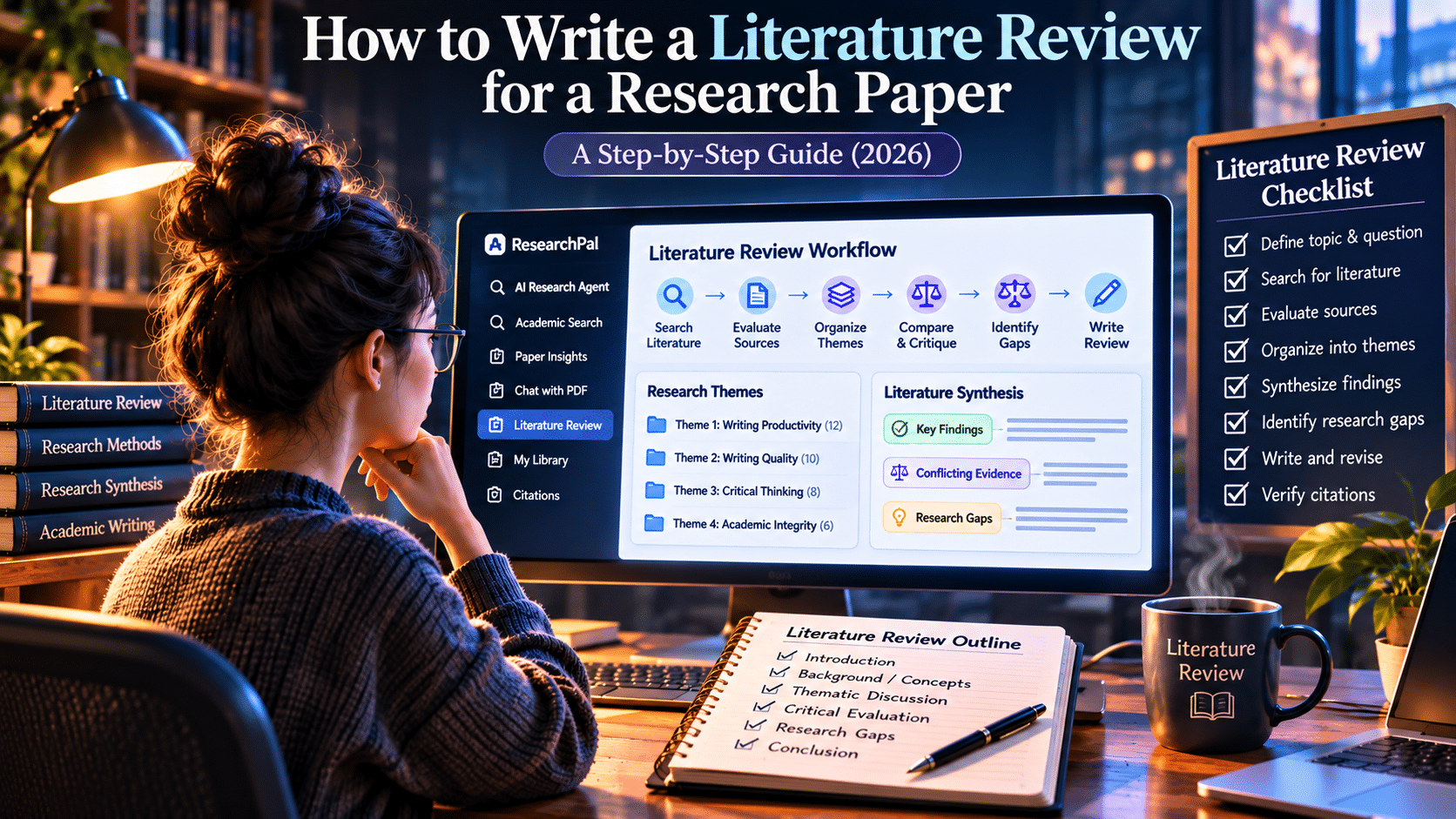
Define Topic → Search Literature → Evaluate Sources → Organize Themes → Compare Studies → Identify Gaps → Write Review → Verify Citations
A good literature review does not simply describe what individual researchers have written. It explains what the existing body of research collectively reveals about a topic.
What Is a Literature Review?
A literature review is a structured and critical examination of existing academic research related to a particular topic or research question.
Its purpose is to establish what researchers already know, identify areas of agreement and disagreement, evaluate the strengths and limitations of existing studies, and explain why further investigation may be necessary.
A literature review can appear as:
- A section of a research paper
- A chapter of a master’s dissertation
- Part of a PhD thesis
- A standalone review article
- A component of a research proposal
- A systematic or scoping review
Although the structure varies by discipline and review type, the central objective remains the same: to develop an evidence-based understanding of the existing literature.
Literature Review vs Research Paper
A research paper generally presents an original investigation, argument, or analysis.
A literature review focuses on examining and synthesizing existing research.
For example, a research paper might investigate whether generative AI affects undergraduate students’ writing performance.
Its literature review would examine previous studies on AI-assisted writing, learning outcomes, student independence, and related educational theories.
The review provides the academic context for the new investigation.
Why Is a Literature Review Important?
A well-written literature review serves several purposes.
Establishes Existing Knowledge
It helps researchers understand what has already been investigated.
Identifies Research Gaps
It highlights questions that remain insufficiently answered or areas where evidence is limited.
Prevents Unnecessary Duplication
It helps researchers distinguish their proposed contribution from existing work.
Develops a Theoretical Foundation
It connects the research problem to relevant concepts, models, and theories.
Supports Research Methodology
Previous studies can inform decisions about research design, measurement, sampling, and analysis.
Strengthens Academic Arguments
A literature review provides evidence that supports the rationale for a new study.
How to Write a Literature Review: 10 Steps
The following process can help you develop a clear, organized, and academically credible literature review.
Step 1: Choose and Narrow Your Research Topic
Begin with a research area that interests you.
For example:
Broad topic: Artificial intelligence in education
This topic covers too many different technologies, educational settings, and outcomes.
A more focused topic might be:
Generative AI and academic writing among undergraduate students
You can narrow the topic further by identifying:
- The population
- The technology or intervention
- The outcome
- The educational context
- The time period
A focused topic makes it easier to identify relevant literature and develop a coherent argument.
Step 2: Develop a Clear Research Question
Your research question determines what evidence belongs in the review.
For example:
How does generative AI influence academic writing skills among undergraduate university students?
This question identifies the central concepts that will guide your literature search.
A useful question should be sufficiently specific to guide the review while remaining broad enough to allow meaningful investigation.
Step 3: Search for Relevant Academic Literature
Once your question is defined, begin searching for relevant academic publications.
Common research sources include:
- Google Scholar
- PubMed for relevant health and biomedical topics
- Scopus
- Web of Science
- University library databases
- Subject-specific repositories
- Academic books and conference proceedings
Use different combinations of keywords to improve coverage.
For example:
("generative AI" OR ChatGPT OR "large language models") AND ("academic writing" OR "writing skills") AND (undergraduate OR "university students")
Search strategies should be adapted to the database and discipline.
Step 4: Evaluate the Quality and Relevance of Sources
Not every publication should be included in your review.
Evaluate each source according to:
Relevance: Does the study address your research question?
Methodology: Is the research design appropriate for the question investigated?
Evidence quality: Are the methods and conclusions adequately supported?
Publication context: Is the source appropriate for your field and purpose?
Limitations: What factors affect the interpretation of its findings?
Recency: Is the publication sufficiently current for the topic, while still accounting for foundational research?
Do not automatically exclude older studies. Seminal publications may be essential for understanding the development of a field.
Step 5: Read and Extract Important Information
Reading every paper without recording its important details can make later comparison difficult.
Create a structured research notes table.
| Information | What to record |
|---|---|
| Author and year | Bibliographic details |
| Research objective | Main purpose of the study |
| Methodology | Research design |
| Sample | Participants or dataset |
| Key findings | Main reported results |
| Limitations | Important weaknesses |
| Relevance | Connection to your research question |
This information will help you compare studies systematically.
AI-assisted paper analysis can support extraction, but important details should be verified against the original publications.
Step 6: Organize the Literature Into Themes
One of the most important steps is grouping related studies into meaningful categories.
For a literature review on generative AI and academic writing, potential themes might include:
Theme 1: AI-Assisted Writing Productivity
Studies investigating whether AI tools affect writing efficiency or task completion.
Theme 2: Writing Quality and Feedback
Research examining grammar, clarity, organization, and revision.
Theme 3: Critical Thinking and Independent Writing
Studies investigating student reasoning, independence, and reliance on AI assistance.
Theme 4: Academic Integrity
Research examining authorship, disclosure, originality, and responsible AI use.
These are illustrative categories. Actual themes should emerge from the literature you have reviewed.
Step 7: Compare and Critically Analyze Studies
A literature review should not become a sequence of disconnected summaries.
Instead, examine relationships between studies.
Ask:
- Which studies report similar findings?
- Which studies disagree?
- Do they use comparable methodologies?
- Are their populations different?
- Are the same outcomes being measured?
- How do limitations affect interpretation?
For example, one hypothetical study might examine writing-task performance, while another investigates students’ perceived confidence.
Although both address AI-assisted writing, their outcomes are different.
A critical review explains this distinction rather than treating the findings as directly comparable.
Step 8: Identify Research Gaps
Research gaps may emerge from recurring limitations or questions that remain insufficiently investigated.
Common types include:
Methodological gaps: Limited use of certain research designs.
Population gaps: Underrepresentation of particular groups.
Geographical gaps: Limited evidence from certain regions.
Theoretical gaps: Insufficient development or testing of explanations.
Evidence gaps: Inconsistent or inconclusive findings.
Longitudinal gaps: Limited research examining outcomes over extended periods.
A potential gap should be verified through additional targeted literature searching.
Do not assume that a gap exists simply because it was absent from your initial search results.
Step 9: Develop a Literature Review Outline
Before writing full paragraphs, organize your discussion.
A typical structure includes:
Introduction: Introduce the topic, research question, scope, and purpose.
Background: Explain relevant concepts and theories.
Thematic Discussion: Compare and synthesize the literature around major themes.
Critical Evaluation: Discuss methodological strengths, weaknesses, and disagreements.
Research Gaps: Identify unresolved questions supported by the evidence.
Conclusion: Summarize the state of knowledge and explain the implications for future research.
Your exact structure may differ depending on your institution’s requirements.
Step 10: Write, Revise, and Verify Your Literature Review
Begin writing using the themes and evidence you’ve organized.
Each paragraph should contribute to your central argument.
A useful paragraph structure is:
Topic Sentence → Supporting Evidence → Comparison → Critical Analysis → Link to Research Question
After drafting, review the text for:
- Logical organization
- Accurate representation of findings
- Appropriate academic language
- Clear transitions
- Balanced treatment of evidence
- Correct citations
- Unsupported claims
- Repetition
Verify references and quotations against the original sources.
Literature Review Structure With Examples
Understanding the structure of a literature review makes the writing process easier.
Introduction
The introduction establishes the topic, purpose, and scope.
Illustrative example:
“The growing use of generative artificial intelligence in higher education has created new questions about its role in academic writing. This literature review examines research on AI-assisted writing among undergraduate students, focusing on writing performance, feedback, learner independence, and academic integrity.”
Main Body
The main body organizes evidence into themes.
Each theme should compare and evaluate relevant studies.
Avoid discussing every publication separately unless there is a clear reason to do so.
Critical Discussion
The critical discussion explains methodological differences, contradictory evidence, and limitations.
For example:
“Studies examining writing performance and those investigating student perceptions provide different types of evidence. These differences should be considered before drawing conclusions about the educational effects of AI-assisted writing.”
Conclusion
The conclusion summarizes what the literature establishes, what remains uncertain, and how the review informs the research question.
It should not introduce unsupported findings or entirely new arguments.
Literature Review Example: Summary vs Synthesis
One of the most common mistakes is confusing summarizing with synthesizing.
Weak Approach: Individual Summaries
“Study A examined student writing performance. Study B investigated student confidence. Study C explored student experiences with AI writing tools.”
This provides information but does not explain the relationships between studies.
Stronger Approach: Evidence Synthesis
“Research on AI-assisted academic writing can be organized around performance, student perceptions, and learning experiences. Because these outcomes are examined using different methods, the studies contribute complementary forms of evidence. A comprehensive interpretation should consider these methodological differences rather than treating all findings as equivalent.”
These examples are illustrative and do not represent actual published studies.
The second approach is stronger because it connects the evidence and explains its significance.
Types of Literature Reviews
Different research projects require different review approaches.
Narrative Literature Review
A narrative review provides a critical discussion of literature around a topic.
It is often organized thematically or conceptually.
Systematic Literature Review
A systematic review uses predefined methods to identify, select, appraise, and synthesize evidence addressing a focused question.
It requires transparent documentation of the review process.
Scoping Review
A scoping review maps the available literature, identifies major concepts, and examines the breadth of evidence within a research area.
Integrative Review
An integrative review brings together different types of evidence or research approaches to develop a broader understanding of a topic.
Critical Review
A critical review emphasizes evaluating existing arguments, assumptions, methodologies, and interpretations.
The appropriate review type depends on the research question and academic requirements.
How Many Sources Should a Literature Review Include?
There is no universal number of sources for a literature review.
The appropriate number depends on:
- Academic level
- Research question
- Assignment length
- Discipline
- Review type
- Available literature
- Institutional requirements
A short undergraduate assignment may require fewer sources than a doctoral thesis or systematic review.
However, the quality, relevance, and coverage of the evidence matter more than reaching an arbitrary number of citations.
Follow your instructor’s or journal’s specific requirements when provided.
How to Use AI to Write a Literature Review Responsibly
AI research tools can support several stages of literature-review development.
The most useful approach is to use AI for research assistance rather than relying on it to generate an entire review without verification.
Finding Relevant Papers
AI-assisted academic search can help researchers explore publications related to their research questions.
Understanding Complex Papers
AI tools can help explain difficult concepts and summarize sections of research papers.
Extracting Research Findings
Structured extraction can help organize methodologies, samples, findings, and limitations.
Comparing Multiple Studies
AI can assist in identifying similarities and differences across papers.
Organizing Research Themes
AI can suggest thematic groupings based on the available evidence.
Improving Academic Writing
Writing assistance can help improve clarity, structure, and readability.
Managing Citations
Citation tools can assist with formatting references in styles such as APA, MLA, Chicago, Harvard, and BibTeX.
Researchers should always verify bibliographic information and source-to-claim accuracy.
How ResearchPal Helps With Literature Reviews
ResearchPal provides a connected academic research environment designed to support researchers through different stages of their work.
Academic Search
Discover relevant academic publications and explore literature connected to your research question.
AI Research Agent
The <Link url=”https://researchpal.co/ai-agent“>ResearchPal AI Research Agent</Link> supports multi-step academic research workflows involving discovery, analysis, and synthesis.
Paper Insights
Examine structured information from academic papers, including research methods, findings, and limitations.
Chat With PDF
Ask focused questions about research documents and investigate specific sections of papers.
Literature Review Tools
Organize research evidence and support the development of structured literature-review content.
Research Library
Maintain a collection of relevant papers and research materials for continued use.
Citation Generator
Prepare references in commonly used academic citation styles and verify them against the original sources.
A practical workflow is:
Academic Search → Paper Insights → PDF Analysis → Evidence Comparison → Literature Review → Citation Verification
Common Literature Review Mistakes to Avoid
Summarizing Every Paper Separately
A literature review should synthesize evidence rather than simply list individual studies.
Using Irrelevant Sources
Every included publication should contribute meaningfully to the research question or necessary background.
Ignoring Contradictory Evidence
Strong reviews acknowledge disagreement and investigate possible explanations.
Relying Only on Recent Publications
Recent studies matter, but foundational research may also be essential.
Failing to Evaluate Research Quality
A published finding should not be accepted uncritically.
Making Unsupported Research Gap Claims
Potential gaps require targeted searches and evidence-based justification.
Using AI-Generated Citations Without Checking
AI tools can produce incorrect bibliographic details or unsupported references.
Writing Without a Clear Structure
An outline helps maintain logical flow and reduces repetition.
Best Practices for Writing a High-Quality Literature Review
A strong literature review should be:
Focused: Clearly connected to a research question.
Comprehensive enough for its purpose: Covers relevant evidence within a defined scope.
Critical: Evaluates research rather than merely describing it.
Thematic: Organizes studies around meaningful concepts.
Balanced: Represents both supporting and contradictory evidence.
Transparent: Makes the review’s scope and approach understandable.
Well-cited: Connects important claims to appropriate sources.
Original in synthesis: Develops an interpretation based on the reviewed evidence.
For systematic reviews, follow the relevant methodological and reporting standards, such as <Link url=”https://www.prisma-statement.org/“>PRISMA</Link> where applicable.
Frequently Asked Questions
What is a literature review in research?
A literature review is a critical examination and synthesis of existing academic publications related to a research topic or question. It explains what is known, where studies agree or disagree, and what questions remain unresolved.
How do you start writing a literature review?
Start by defining a focused research question, identifying search terms, finding relevant academic sources, and organizing the literature into themes before drafting.
What are the main parts of a literature review?
A typical literature review includes an introduction, background or conceptual framework, thematic discussion, critical analysis, research gaps, and conclusion. The exact structure depends on the review type.
How long should a literature review be?
The length depends on the assignment, academic level, discipline, and research project. Follow your institution’s requirements rather than using a fixed word count.
How many research papers should I include?
There is no universal number. Include enough relevant and credible sources to address your research question and meet any specified academic requirements.
What is the difference between a literature review and a summary?
A summary describes the content of a source. A literature review compares, evaluates, and synthesizes multiple sources to explain the broader state of knowledge.
Can AI write a literature review?
AI can assist with searching, summarizing, extracting evidence, comparing studies, organizing themes, and drafting. Researchers must verify sources, evaluate the evidence, and follow applicable academic integrity policies.
How do you identify research gaps in a literature review?
Compare existing studies, examine limitations, investigate contradictions, identify understudied areas, and conduct additional searches to confirm whether potential gaps remain unresolved.
What is the best structure for a literature review?
A common structure includes an introduction, conceptual background, thematic synthesis, critical evaluation, research gaps, and conclusion. Adapt it to the research question and review methodology.
How can ResearchPal help write a literature review?
ResearchPal supports academic paper discovery, Paper Insights, PDF interaction, literature-review workflows, research organization, and citation generation. These tools can assist researchers in developing evidence-based reviews.
Final Thoughts
Learning how to write a literature review is an essential academic skill.
A strong literature review does more than collect published research. It connects evidence, evaluates methodologies, identifies disagreements, and explains what existing studies collectively reveal.
The most effective process is:
Define → Search → Evaluate → Organize → Compare → Synthesize → Write → Verify
AI research tools can help make several stages more manageable, but academic judgment remains essential.
Whether you’re writing your first university literature review or preparing a doctoral thesis, focus on developing a clear, evidence-based argument rather than simply increasing the number of citations.
A great literature review does not simply explain what researchers have published. It explains what the research means, how the evidence connects, and why the next study matters.

