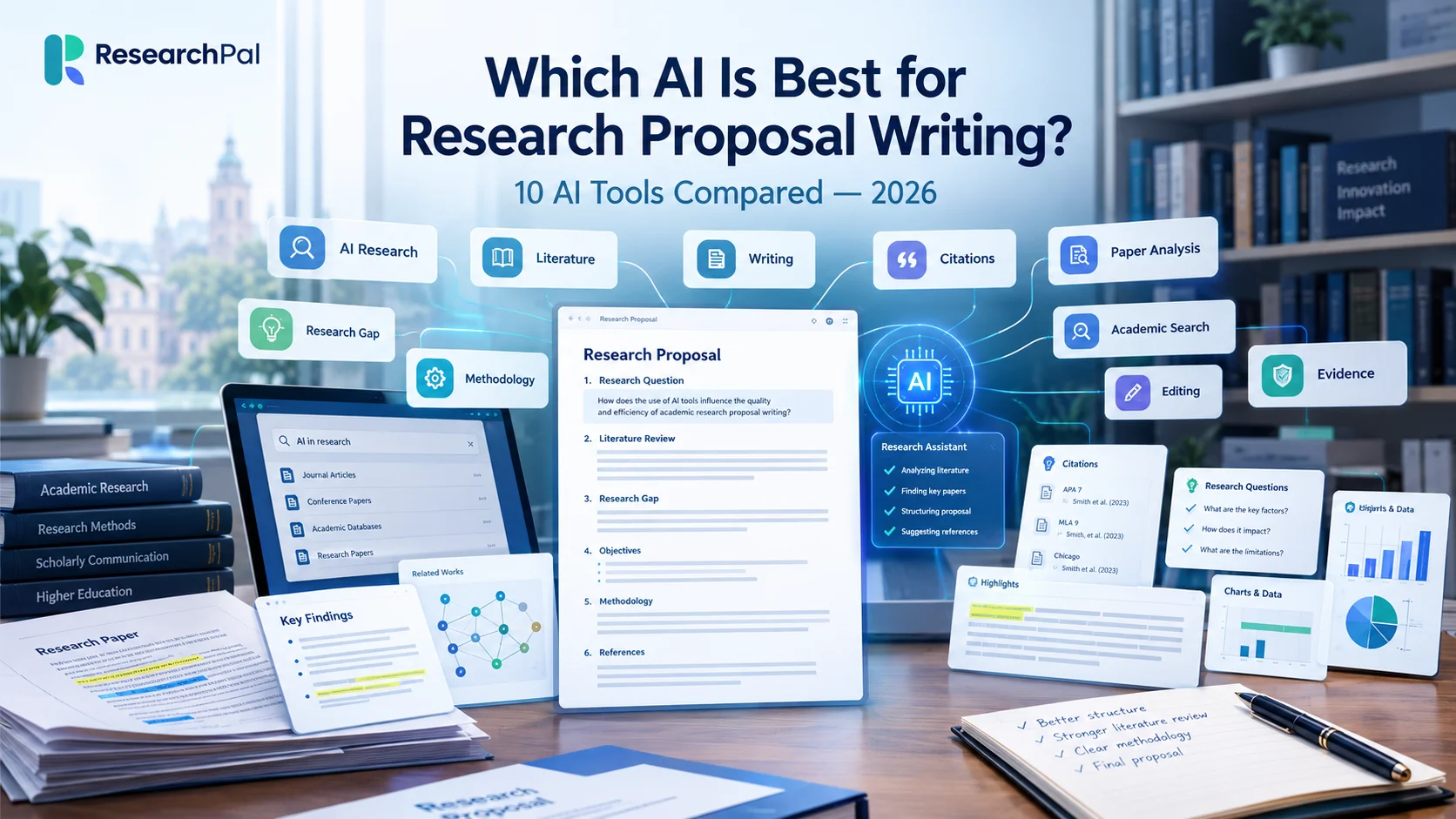
Writing a research proposal requires much more than producing well-structured academic sentences. You need to define a research problem, understand existing literature, identify a meaningful research gap, develop research questions and objectives, select an appropriate methodology, support important claims with reliable sources, and present everything in a coherent academic structure.
That is why choosing an AI tool for research proposal writing can be difficult.
Some AI tools are excellent at drafting and rewriting. Others are designed around academic literature search, evidence synthesis, paper analysis, citations, or research organization. A tool that is useful for brainstorming may not be the best choice for finding scholarly evidence or building a defensible research proposal.
So, which AI is best for research proposal writing in 2026?
For researchers who want an end-to-end academic workflow, ResearchPal is the strongest overall option in this comparison. It combines academic search, paper analysis, literature reviews, research-gap discovery, proposal drafting, citations, document analysis, and academic writing assistance in one research-focused workspace.
However, that does not mean it is the best tool for every individual task. ChatGPT, Claude, Paperpal, Jenni AI, Elicit, Consensus, SciSpace, Perplexity, and Scite each have strengths that can make them useful in different stages of research.
This guide compares 10 AI tools specifically for research proposal writing, rather than simply ranking general-purpose AI writing assistants.
Quick Answer: Which AI Is Best for Research Proposal Writing?
If you want one tool to support the largest part of the research proposal workflow, ResearchPal is the best overall choice.
Here is how the tools compare by their strongest use case:
| AI Tool | Best For | Overall Proposal Use |
|---|---|---|
| ResearchPal | End-to-end academic research and proposal workflow | Best overall |
| ChatGPT | Brainstorming, drafting and general research assistance | Best general-purpose AI |
| Claude | Long-form reasoning and document work | Best for long-form drafting |
| Paperpal | Academic writing and editing | Best academic writing assistant |
| Jenni AI | Academic drafting and citation-assisted writing | Best academic drafting |
| Elicit | Literature discovery and evidence synthesis | Best for literature research |
| Consensus | Evidence-based research questions | Best for evidence discovery |
| SciSpace | Research papers and PDF analysis | Best for paper analysis |
| Perplexity | Broad web research and source discovery | Best for initial web research |
| Scite | Citation context and literature evaluation | Best for citation analysis |
The important distinction is that these tools are not interchangeable.
If your main task is drafting paragraphs, a general AI assistant may be enough. If you need to build a proposal from academic evidence, however, you need a workflow that connects research discovery, literature analysis, gap identification, proposal structure, writing, and citations.
How We Compared the Best AI Tools for Research Proposal Writing
A meaningful comparison needs to evaluate more than how natural an AI-generated paragraph sounds.
For this comparison, the tools are evaluated against the main stages involved in preparing an academic research proposal.
Research Proposal Drafting
A useful research proposal writing AI should be able to assist with:
- Proposal outlines
- Research background
- Problem statements
- Research questions
- Research objectives
- Hypotheses
- Significance of the study
- Scope and limitations
- Methodology sections
- Expected outcomes
- Research timelines
ResearchPal’s current product information specifically lists AI-assisted research proposal drafting, alongside a broader research workflow that includes literature reviews, research questions, research-gap finding and methodology assistance.
Literature Research
A proposal needs a foundation in existing scholarship.
We therefore consider whether a tool can help researchers:
- Find relevant academic papers
- Search by research question
- Discover related studies
- Summarize papers
- Compare findings
- Extract methodologies and limitations
- Identify possible research gaps
- Organize research sources
Citation and Reference Support
AI-generated academic writing becomes much less useful if the underlying references are unreliable.
The comparison therefore considers:
- Citation generation
- In-text citations
- Reference formatting
- Citation styles
- Source traceability
- Citation organization
- Ability to work with real research papers
Academic Writing Quality
The tools are also considered for:
- Academic tone
- Clarity
- Structure
- Grammar
- Paraphrasing
- Concision
- Section development
- Revision
Research Workflow
The strongest tools should reduce the need to move repeatedly between separate platforms.
A useful research workflow looks like:
Research question → academic search → literature → evidence → research gap → objectives → methodology → proposal → citations → revision
This is where specialized research platforms can have an advantage over general writing assistants.
Accuracy and Researcher Control
No AI tool should be treated as an independent academic authority.
Researchers still need to verify:
- Sources
- Citations
- Research findings
- Statistics
- Methodological recommendations
- Claims about previous studies
- Research gaps
AI can accelerate research work, but the researcher remains responsible for the accuracy and originality of the final proposal.
10 Best AI Tools for Research Proposal Writing in 2026
1. ResearchPal — Best AI for End-to-End Research Proposal Writing
ResearchPal is the strongest overall option in this comparison for researchers who want proposal writing connected to the rest of their academic workflow.
Rather than treating proposal writing as a standalone text-generation task, ResearchPal combines research discovery, paper analysis, literature review, research planning, writing, and citation workflows.
Its current product information includes Research Proposal, Research Question Refiner, Research Gap Finder, Methodology Advisor, literature reviews, Paper Insights, citation tools, document chat, and AI writing features.
Why ResearchPal Stands Out for Research Proposal Writing
A research proposal often begins long before the first paragraph is written.
You may start with a broad topic, search for relevant studies, discover conflicting findings, identify limitations in previous work, refine your research question, and only then start structuring the proposal.
ResearchPal is designed around that connected workflow.
For example, a researcher can move through a process such as:
- Define a broad research topic.
- Search academic papers.
- Save relevant studies.
- Analyze papers and their limitations.
- Identify possible research gaps.
- Refine the research question.
- Develop research objectives.
- Plan the methodology.
- Draft the proposal.
- Add and manage citations.
- Revise the academic writing.
That workflow is particularly useful for students who otherwise need separate tools for academic search, PDF analysis, writing, and citation management.
Research Proposal Features
ResearchPal currently supports AI-assisted research proposal drafting and also provides tools that can support the research work behind the proposal.
Its research workspace includes capabilities for:
- Research proposal drafting
- Research question refinement
- Research-gap discovery
- Methodology guidance
- Academic paper search
- Literature review generation
- Paper insights
- PDF/document analysis
- Citation generation
- Citation management
- Academic writing enhancement
- Research project organization
The platform’s current pricing information also lists a free plan and dedicated research proposal functionality, while higher plans provide expanded research and writing capabilities.
Literature Research Before Proposal Writing
A strong proposal should be grounded in relevant research rather than generated from a blank prompt.
ResearchPal’s academic search allows researchers to search scholarly literature, save papers, and continue working with those sources. Its Paper Insights workflow can then help researchers examine findings, methodologies, limitations, and other information relevant to proposal development.
This matters because the literature review is often where the justification for a new study begins.
Finding a Research Gap
One of the most important parts of a proposal is explaining what existing research has not adequately addressed.
A research gap may involve:
- An understudied population
- An unexplored geographic context
- A methodological limitation
- Conflicting findings
- An outdated dataset
- An unanswered research question
- A theoretical limitation
AI can help identify possible gaps, but researchers should verify them against the literature before presenting them as established facts.
ResearchPal’s current feature set includes a Research Gap Finder designed specifically for this stage.
Citations and References
ResearchPal also connects proposal writing with citation management.
Its current product information supports citation generation in formats including APA, Harvard, MLA, Chicago, and BibTeX.
That makes it easier to move from source discovery to cited academic writing without manually rebuilding every reference.
Pros
- Built specifically around academic research workflows
- Combines research and writing
- Supports literature reviews
- Helps analyze research papers
- Includes research-gap and research-question tools
- Supports research proposal drafting
- Includes citation tools
- Supports PDF/document research
- Provides a free starting plan
Cons
- Researchers still need to verify AI-generated claims and citations
- Users looking only for general writing assistance may prefer a simpler general-purpose AI tool
- Advanced research workflows may require a paid plan
Best For
Students, PhD researchers, academics, and research teams that want one connected workflow from literature discovery to proposal writing.
Verdict
Best overall AI for research proposal writing in 2026.
ResearchPal is particularly strong when the task is not simply “write my proposal,” but rather:
“Help me research, structure, support, and refine my proposal.”
Ready to turn your research idea into a stronger proposal?
ResearchPal brings academic search, paper analysis, research gaps, methodology support, proposal writing, and citations into one research-focused workflow.
2. ChatGPT — Best General-Purpose AI for Research Proposal Drafting
ChatGPT is one of the most flexible options for brainstorming and drafting a research proposal.
It can help researchers turn a broad research idea into a structured outline, generate alternative research questions, improve a problem statement, explain methodological concepts, reorganize sections, and revise academic writing.
OpenAI’s current guidance also describes research workflows in ChatGPT that can help users move from questions to evidence-backed insights, compare sources, and create structured outputs with citations.
What ChatGPT Can Help With
Researchers can use ChatGPT to:
- Brainstorm research topics
- Refine research questions
- Generate proposal outlines
- Draft background sections
- Improve problem statements
- Develop objectives
- Explain research methodologies
- Rewrite academic passages
- Summarize supplied documents
- Review proposal structure
- Improve clarity and coherence
Strengths
The biggest advantage is flexibility.
You can provide a research idea and ask for several possible directions, compare methodologies, simulate supervisor feedback, or ask the model to critique a draft.
Limitations
ChatGPT is a general-purpose AI system rather than a proposal-specific research platform.
Researchers should therefore pay particular attention to source verification, citation accuracy, and whether a generated research gap is actually supported by current literature.
Best For
Researchers who want a flexible AI assistant for brainstorming, drafting, reasoning, revision, and general research support.
Verdict
Best general-purpose AI for research proposal drafting and iterative refinement.
3. Claude — Best for Long-Form Research Proposal Reasoning
Claude is another strong general-purpose option for researchers working with long documents and complex writing tasks.
Its Research capability can conduct multiple searches and build an investigation across sources, while Claude can also help users analyze, reorganize, and revise substantial amounts of text.
What Claude Can Help With
- Proposal brainstorming
- Long-form drafting
- Document analysis
- Structural revision
- Research synthesis
- Methodology discussion
- Academic editing
- Research planning
Strengths
Claude can be useful when you already have substantial material and need help organizing it into a coherent proposal.
For example, you could provide a collection of notes, a draft literature review, research objectives, and methodological ideas and ask for a structured proposal framework.
Limitations
Like other general-purpose AI systems, Claude should not replace independent verification of scholarly sources or methodological decisions.
Best For
Researchers working with long documents who want strong reasoning and writing assistance.
Verdict
Best suited to long-form proposal development and document-based reasoning.
4. Paperpal — Best for Academic Writing and Proposal Editing
Paperpal focuses more specifically on academic writing than many general-purpose AI assistants.
For researchers who already have a proposal but need to improve grammar, clarity, academic style, and readability, an academic writing platform can be particularly useful.
What Paperpal Can Help With
- Academic language editing
- Grammar correction
- Paraphrasing
- Sentence refinement
- Academic tone
- Research writing
- Citation-related workflows
- Manuscript and document improvement
Strengths
Its academic focus makes it particularly relevant during the editing and polishing stage.
Limitations
It is less appropriate to think of an academic editor as a replacement for the entire research process.
Finding a research gap, selecting a defensible methodology, and deciding what your study should contribute still require substantive research judgment.
Best For
Researchers who already have proposal material and want to improve its academic presentation.
Verdict
A strong choice for academic writing and proposal refinement.
5. Jenni AI — Best for Academic Drafting
Jenni AI is designed around academic and long-form writing workflows.
It can help researchers move from an outline or idea toward a structured academic draft, while citation and research features can support the writing process.
What Jenni AI Can Help With
- Academic drafting
- Research writing
- Outlining
- Citations
- Paraphrasing
- Document development
- Writing continuation
Strengths
Jenni can be useful when the main challenge is turning research notes into readable academic prose.
Limitations
Proposal writing still depends on the quality of the research behind the writing. A polished paragraph does not automatically make a research question original or a methodology appropriate.
Best For
Students and researchers who want AI assistance while drafting academic documents.
Verdict
A useful academic writing option, particularly for drafting and citation-assisted writing.
6. Elicit — Best AI for Literature Research Before Writing a Proposal
Elicit is better understood as a research and evidence-synthesis tool than as a conventional AI proposal writer.
Its Reports workflow is designed around research questions and literature synthesis, including stages for identifying, screening, assessing, and synthesizing studies.
That makes it valuable at the stage before proposal drafting.
How Elicit Helps Proposal Writers
Suppose your proposed topic is:
“How does AI-assisted learning affect university students’ academic performance?”
Before writing the proposal, you need to know:
- What has already been studied?
- Which populations have been investigated?
- What methodologies have researchers used?
- What findings agree or conflict?
- What limitations appear repeatedly?
- What questions remain unanswered?
This is where literature-focused tools such as Elicit can be useful.
Strengths
- Literature discovery
- Evidence extraction
- Research synthesis
- Structured review workflows
- Research-question-driven searching
Limitations
Elicit is not the most natural choice if you want one workspace for the entire journey from research discovery to proposal drafting and citation management.
Best For
Researchers whose biggest challenge is understanding existing literature before deciding what proposal to write.
Verdict
One of the strongest options for literature research and evidence synthesis.
7. Consensus — Best for Evidence-Based Research Questions
Consensus is designed around research questions and evidence from academic literature.
It can be useful when you want to investigate what published research says about a particular question before building your proposal.
Example
Instead of asking:
“Write me a proposal about social media and academic performance.”
A better research workflow is to investigate questions such as:
“What does existing research say about the relationship between social media use and academic performance among university students?”
The resulting evidence can help you determine whether your proposed topic is sufficiently specific and whether a meaningful research question remains.
Strengths
- Research-question-oriented search
- Evidence discovery
- Academic literature
- Fast synthesis of research findings
Limitations
Consensus is more useful for evidence discovery than for building every section of a complete research proposal.
Best For
Researchers who need evidence to refine a research question or establish the background for a proposal.
Verdict
Best used as an evidence-discovery tool within a larger proposal workflow.
8. SciSpace — Best for Research Paper and PDF Analysis
Many researchers already have papers they need to understand before writing a proposal.
SciSpace is particularly relevant when your workflow depends heavily on reading and interacting with research papers and PDFs.
What SciSpace Can Help With
- Understanding research papers
- Asking questions about PDFs
- Summarizing academic material
- Exploring research literature
- Extracting useful information from papers
Why This Matters for Proposals
A proposal should demonstrate knowledge of existing research.
Instead of asking AI to invent a literature review from general knowledge, you can work from actual papers and use document-analysis tools to understand:
- Research objectives
- Methodology
- Findings
- Limitations
- Theoretical frameworks
- Data sources
Strengths
- PDF-focused workflow
- Paper analysis
- Literature understanding
- Interactive document research
Limitations
Its strongest value is paper analysis rather than being a complete proposal-management environment.
Best For
Researchers who have a large collection of academic PDFs and need help understanding them.
Verdict
Best for paper and PDF analysis as part of proposal preparation.
9. Perplexity — Best for Initial Web Research
Perplexity can be useful during the early exploration stage of a research project.
It can help researchers investigate unfamiliar topics, discover sources, compare information, and develop initial research directions.
Useful Proposal Tasks
- Topic exploration
- Background research
- Current information
- Initial source discovery
- Question refinement
- Research brainstorming
Important Limitation
A web search result is not automatically a scholarly source.
For a university research proposal, researchers should distinguish between:
- Peer-reviewed academic papers
- Government publications
- Institutional reports
- Scholarly books
- Reputable datasets
- News and general websites
Perplexity can help you explore a topic, but you should evaluate the underlying sources before citing them in a proposal.
Best For
Initial research and broad information discovery.
Verdict
Useful for exploration, but it should not replace dedicated academic literature research.
10. Scite — Best for Citation Context and Literature Evaluation
Scite serves a different purpose from most AI writing tools.
Instead of focusing primarily on generating paragraphs, it helps researchers understand how scholarly publications are cited and discussed in subsequent research.
This can be valuable when evaluating whether a source provides strong support for a claim.
Useful Proposal Tasks
- Citation discovery
- Citation context
- Literature evaluation
- Finding supporting or contrasting research
- Investigating how publications are referenced
Why Citation Context Matters
Suppose a paper is frequently cited.
That alone does not tell you whether later researchers support its findings.
Understanding the context around citations can provide a more nuanced view of the literature.
Limitations
Scite is a specialized research tool rather than a complete proposal-writing workspace.
Best For
Researchers who want deeper insight into citation relationships and the research conversation around particular publications.
Verdict
Best as a citation-analysis component of a larger research workflow.
AI Tools for Research Proposal Writing Compared
The following comparison focuses specifically on proposal-related tasks rather than generic AI writing ability.
| Feature | ResearchPal | ChatGPT | Claude | Paperpal | Jenni | Elicit | Consensus | SciSpace | Perplexity | Scite |
|---|---|---|---|---|---|---|---|---|---|---|
| Proposal outline | ✓ | ✓ | ✓ | ✓ | ✓ | Limited | Limited | Limited | ✓ | Limited |
| Proposal drafting | ✓ | ✓ | ✓ | ✓ | ✓ | Limited | Limited | Limited | ✓ | Limited |
| Research questions | ✓ | ✓ | ✓ | ✓ | ✓ | ✓ | ✓ | ✓ | ✓ | ✓ |
| Research-gap support | ✓ | ✓ | ✓ | Limited | Limited | ✓ | ✓ | ✓ | ✓ | ✓ |
| Academic paper search | ✓ | ✓ | ✓ | ✓ | ✓ | ✓ | ✓ | ✓ | Partial | ✓ |
| Literature review | ✓ | ✓ | ✓ | ✓ | ✓ | ✓ | Partial | Partial | Partial | ✓ |
| Paper/PDF analysis | ✓ | ✓ | ✓ | ✓ | ✓ | ✓ | Partial | ✓ | Partial | ✓ |
| Citation support | ✓ | ✓ | ✓ | ✓ | ✓ | ✓ | ✓ | ✓ | ✓ | ✓ |
| Academic editing | ✓ | ✓ | ✓ | ✓ | ✓ | Limited | Limited | Partial | ✓ | Limited |
| Research workflow | ✓ | Partial | Partial | Partial | Partial | ✓ | Partial | Partial | Partial | Partial |
| Proposal-specific workflow | ✓ | Partial | Partial | Partial | ✓ | Limited | Limited | Limited | Limited | Limited |
Feature availability changes frequently, so researchers should check the provider’s current documentation before making a purchase decision.
Which AI Tool Is Best for Different Research Proposal Tasks?
There is no single winner for every stage of proposal development.
Best AI for Research Proposal Outlines
ResearchPal, ChatGPT, Claude, and Jenni AI are strong options for creating proposal structures.
ResearchPal has an advantage when the outline needs to connect directly to academic research, literature, research gaps, and citations.
Best AI for Research Proposal Topics
General-purpose AI tools can help brainstorm ideas, but topic selection should be based on the literature and the feasibility of conducting the proposed study.
ResearchPal can be useful when topic brainstorming is combined with academic paper search and research-gap exploration.
Best AI for Writing a Problem Statement
ChatGPT, Claude, ResearchPal, and Jenni AI can help turn research notes into a structured problem statement.
The important part is supplying evidence and clearly explaining what problem existing research has not adequately addressed.
Best AI for Research Questions
ResearchPal is particularly useful when question refinement is connected to research-gap discovery.
ChatGPT and Claude can also generate and critique alternative research questions.
Best AI for Research Objectives
Most strong general-purpose writing models can help turn research questions into objectives.
However, researchers should check that each objective is specific, measurable where appropriate, achievable within the study design, and aligned with the methodology.
Best AI for Literature Review for a Research Proposal
ResearchPal and Elicit are particularly useful because literature discovery and synthesis are central to their workflows.
ResearchPal is more suitable when you want literature research to continue into proposal drafting and citation management.
Best AI for Finding Research Gaps
ResearchPal and literature-focused research tools such as Elicit can help identify possible gaps.
But a research gap should never be accepted simply because an AI tool labels it a gap. You need to inspect the underlying studies and determine whether the gap is genuinely meaningful.
Best AI for Research Proposal Methodology
ResearchPal, ChatGPT, and Claude can help researchers explore methodological options.
However, methodology should be selected according to the research question, discipline, available data, population, ethical requirements, and research design—not simply because an AI recommends it.
Best AI for Research Proposal Citations
ResearchPal, Paperpal, Jenni AI, and specialized citation/research tools can help generate and organize citations.
Always verify the source details before submission.
Best AI for Editing a Research Proposal
Paperpal, ChatGPT, Claude, ResearchPal, and Jenni AI can all assist with editing.
The best choice depends on whether you need general language editing or editing integrated with the research workflow.
What Should You Look for in an AI for Research Proposal Writing?
Before choosing a research proposal writing AI, evaluate the tool against the actual requirements of your project.
1. Academic Source Quality
The tool should help you work with reliable scholarly literature rather than encouraging unsupported claims.
2. Citation Accuracy
Check whether references are traceable to real sources.
Never assume an AI-generated citation is correct simply because it looks academically formatted.
3. Literature Search Capability
A strong research workflow should help you find literature relevant to your research question.
4. Research-Gap Identification
The tool should help you investigate gaps rather than simply generate generic statements such as “more research is needed.”
5. Proposal Structure
Look for support for the sections your institution or funding organization actually requires.
6. Methodology Support
AI can help explain research designs and compare methodological approaches, but final methodological decisions should remain under researcher control.
7. Academic Writing Quality
The tool should improve clarity without removing the researcher’s own reasoning and voice.
8. Document and PDF Support
If your proposal depends heavily on existing papers, document analysis can save substantial time.
9. Researcher Control
The researcher should be able to inspect, edit, replace, and verify AI-generated material.
10. Pricing and Free Access
Consider how often you will use the tool and which features are included in its free plan.
ResearchPal currently offers a free plan alongside paid plans, while its pricing page lists proposal writing, literature reviews, research-gap discovery, methodology assistance, paper analysis, citations, and other research features across its plans.
Can AI Write a Complete Research Proposal?
Yes, AI can help generate substantial portions of a research proposal, but that does not mean you should submit an AI-generated proposal without extensive human review.
A research proposal represents an argument about why a study should be conducted.
That argument requires decisions about:
- What problem matters
- What is already known
- What remains uncertain
- What contribution the study could make
- Which research questions are appropriate
- Which methodology can answer those questions
- How the research will be conducted ethically
AI can help structure and develop these elements, but it cannot transfer responsibility for those decisions away from the researcher.
What AI Can Help With
AI is useful for:
- Brainstorming
- Outlining
- Literature discovery
- Summarizing papers
- Comparing studies
- Identifying possible research gaps
- Drafting sections
- Improving academic language
- Generating citation formats
- Reviewing structure
What Researchers Should Control
Researchers should remain responsible for:
- Original research ideas
- Final research questions
- Interpretation of literature
- Methodological decisions
- Source verification
- Data interpretation
- Ethical considerations
- Final claims
- Academic integrity
A good workflow treats AI as a research and writing assistant, not as the author of the study.
How to Use AI to Write a Research Proposal
Using AI effectively starts before the drafting stage.
Step 1: Define the Research Problem
Start with a specific problem rather than asking an AI tool to invent an entire research project.
Explain the field, population, context, and problem you are interested in.
Step 2: Explore the Existing Literature
Search academic databases and research tools for studies related to the topic.
At this stage, focus on understanding what has already been investigated.
Step 3: Identify the Research Gap
Compare studies and look for:
- Missing populations
- Missing contexts
- Methodological weaknesses
- Contradictory results
- Outdated evidence
- Unanswered questions
Use AI to generate hypotheses about possible gaps, then verify those gaps manually.
Step 4: Develop Research Questions
Turn the research gap into one primary question and, where appropriate, supporting questions.
A good question should be answerable using the proposed research design.
Step 5: Define Research Objectives
Each objective should contribute directly to answering the research question.
Avoid objectives that sound impressive but cannot realistically be completed.
Step 6: Choose the Methodology
Decide whether qualitative, quantitative, mixed-methods, experimental, observational, or another design is appropriate.
AI can help compare approaches, but your research question should drive the methodology.
Step 7: Build the Proposal Structure
Most proposals contain some variation of:
- Title
- Introduction/background
- Problem statement
- Literature review
- Research gap
- Research questions
- Objectives
- Methodology
- Significance
- Ethical considerations
- Timeline
- References
Your university or funding body may require a different structure, so always follow its guidelines.
Step 8: Draft Each Section
Use AI to improve clarity and structure while supplying the actual research evidence yourself.
Step 9: Add and Verify Citations
Check every important source.
Confirm that:
- The paper exists
- The authors are correct
- The publication year is correct
- The claim actually appears in the source
- The citation style is correct
Step 10: Review the Complete Proposal
Read the proposal as an argument.
Ask:
Does the literature justify the problem?
Does the research gap justify the research question?
Do the objectives answer the research question?
Does the methodology answer the objectives?
Does the expected contribution follow logically from the proposed study?
This alignment is more important than how polished the AI-generated prose sounds.
AI Research Proposal Writing: What AI Should and Shouldn’t Do
AI Should Help With
- Brainstorming
- Research organization
- Literature discovery
- Summarization
- Comparison
- Proposal outlining
- Draft development
- Editing
- Citation organization
- Research-gap exploration
Researchers Should Remain Responsible For
- Original ideas
- Research questions
- Interpretation
- Methodology
- Source verification
- Ethical decisions
- Data collection
- Analysis
- Final academic claims
The distinction is simple:
AI can accelerate the process. The researcher remains responsible for the research.
Is It Ethical to Use AI for Research Proposal Writing?
Using AI in academic research is not automatically ethical or unethical. The answer depends on how it is used and what the relevant institution, department, journal, funder, or supervisor permits.
Researchers should check their institution’s current AI policy before using AI in assessed or formally submitted work.
Several issues deserve attention.
Authorship
A researcher should not treat AI-generated text as independent scholarly authorship.
Disclosure
Some institutions, journals, and funders may require disclosure of AI assistance.
Originality
AI should not be used to fabricate research ideas, findings, citations, data, or evidence.
Citation Responsibility
The researcher remains responsible for ensuring that references actually support the claims being made.
Confidential Information
Do not upload confidential research data, unpublished manuscripts, participant information, proprietary documents, or other restricted material to an AI service unless you are authorized to do so and understand the applicable data terms.
Human Oversight
AI-assisted academic writing should remain subject to human review.
The safest approach is to use AI to support research work while maintaining control over the intellectual decisions behind the proposal.
Common Mistakes When Using AI to Write a Research Proposal
1. Asking AI to Write the Entire Proposal in One Prompt
A single prompt rarely provides enough research context to produce a strong, discipline-specific proposal.
Break the workflow into research, analysis, planning, drafting, and revision.
2. Using Unverified Citations
Never assume an AI-generated reference is real.
Verify every important source.
3. Accepting an AI-Generated Research Gap
“Few studies have examined…” is not evidence.
Search the literature and determine whether the claimed gap actually exists.
4. Letting AI Choose the Methodology Without Critical Review
A methodology needs to fit the research question, data, population, constraints, and discipline.
5. Using Generic Research Questions
A proposal should address a specific research problem.
Generic questions often produce generic research.
6. Ignoring University Requirements
A proposal for a Master’s dissertation may have different requirements from a PhD proposal, grant proposal, or undergraduate research project.
7. Treating Web Sources as Scholarly Evidence
General web pages can be useful for background information, but they should not automatically replace peer-reviewed literature or authoritative sources.
8. Submitting AI-Generated Text Without Review
Even grammatically perfect text can contain inaccurate claims, weak reasoning, irrelevant material, or unsupported conclusions.
Which AI Is Best for Research Proposal Writing in 2026?
After comparing the tools according to research-proposal requirements rather than general AI popularity, the answer depends on what you need.
Best Overall: ResearchPal
ResearchPal is the strongest overall choice when you want research discovery, literature analysis, research-gap identification, proposal drafting, methodology support, writing assistance, and citations connected in one workflow.
Best General-Purpose AI: ChatGPT
Best when you need flexible brainstorming, drafting, analysis, revision, and general research assistance.
Best for Long-Form Reasoning: Claude
Best when you have large amounts of material and need help developing or restructuring a complex proposal.
Best for Academic Writing: Paperpal
Best when your proposal is already drafted and needs academic language improvement and editing.
Best for Academic Drafting: Jenni AI
Best for researchers who want AI assistance while developing academic documents.
Best for Literature Research: Elicit
Best for searching, screening, extracting, and synthesizing academic evidence.
Best for Evidence-Based Questions: Consensus
Best for investigating what existing research says about a particular question.
Best for Paper and PDF Analysis: SciSpace
Best for understanding and interacting with research papers and documents.
Best for Web Research: Perplexity
Best for initial topic exploration and broad source discovery.
Best for Citation Analysis: Scite
Best for understanding citation relationships and the context surrounding scholarly claims.
The Bottom Line
If your goal is simply to generate academic-sounding paragraphs, several general-purpose AI tools can help.
But if you are asking:
“Which AI is best for research proposal writing?”
the better question is:
“Which AI can support the research process behind the proposal as well as the writing itself?”
That is where ResearchPal stands out.
A strong research proposal begins with evidence. You need to understand existing literature, identify a meaningful research gap, formulate focused questions, select an appropriate methodology, and connect every part of the proposal logically.
ResearchPal brings those activities into one research-focused workflow, allowing you to move from research question → academic evidence → research gap → proposal structure → writing → citations without constantly switching between unrelated tools.
If you are preparing a thesis, dissertation, grant proposal, or academic research project, you can start with ResearchPal’s free plan and explore the research workflow before deciding whether you need its advanced capabilities.
Frequently Asked Questions
Which AI is best for research proposal writing?
ResearchPal is the strongest overall choice for researchers who want research discovery, literature review, research-gap identification, proposal drafting, citations, and academic writing support in one workflow. ChatGPT and Claude are strong general-purpose alternatives, while Elicit and Consensus are particularly useful for literature and evidence research.
What is the best AI tool for writing a research proposal?
The best tool depends on the stage of your research. For an end-to-end workflow, ResearchPal is a strong choice. For general drafting, ChatGPT or Claude may be preferable. For literature research, Elicit is particularly useful, while Paperpal is more focused on academic writing and editing.
Can AI write a research proposal?
Yes. AI can help draft substantial parts of a research proposal, including the outline, background, research questions, objectives, literature synthesis, and methodology discussion. However, researchers must verify sources, refine the argument, select the methodology, and review the final proposal themselves.
What is the best free AI for research proposal writing?
Several AI tools offer free access with limitations. ResearchPal currently provides a free plan with access to core research capabilities. The best free option depends on whether your priority is proposal drafting, literature research, paper analysis, citations, or academic editing.
Is ChatGPT good for writing research proposals?
Yes. ChatGPT can be useful for brainstorming, outlining, drafting, revising, explaining methodologies, and improving academic writing. Its usefulness increases when you provide verified research sources and specific instructions instead of asking it to generate an entire proposal without evidence.
Can AI help me find a research gap?
Yes. AI can compare studies, summarize limitations, identify recurring themes, and suggest areas that may deserve further investigation. However, an AI-suggested gap should always be checked against the current literature before you present it as a genuine research gap.
Which AI is best for research proposal literature review?
ResearchPal and Elicit are strong options for this stage. Elicit focuses heavily on literature search and evidence synthesis, while ResearchPal connects literature research with paper analysis, research-gap discovery, writing, and citations.
Can AI generate citations for a research proposal?
Yes. Several AI research and academic writing tools can generate citations. However, citation formatting and citation accuracy are different things. Always verify that the source exists and actually supports the claim for which you are citing it.
Is it okay to use AI to write a research proposal?
AI use may be permitted in some academic settings and restricted or regulated in others. Check the rules of your university, department, supervisor, funder, or other relevant institution. Regardless of policy, researchers should maintain responsibility for the originality, accuracy, methodology, evidence, and final content of their proposal.
How do I use AI without compromising academic integrity?
Use AI for tasks such as brainstorming, organization, literature discovery, summarization, editing, and research assistance while retaining control over your research decisions. Verify citations, avoid fabricated evidence, protect confidential information, follow institutional policies, and disclose AI use when required.
Final Takeaway
The best AI for research proposal writing is not necessarily the tool that produces the most polished paragraph.
A strong proposal depends on the entire research workflow behind that paragraph.
You need reliable literature, a defensible research gap, focused questions, appropriate objectives, a suitable methodology, accurate citations, and a clear academic argument.
For researchers who want those stages connected, ResearchPal is the strongest overall option in this comparison. General-purpose tools such as ChatGPT and Claude remain valuable for flexible drafting and reasoning, while specialized platforms such as Elicit, Consensus, SciSpace, Paperpal, and Scite can be especially useful for specific research tasks.
The most effective approach is therefore to choose AI based on what part of the research proposal you need help with—and how much of the workflow you want one platform to handle.

