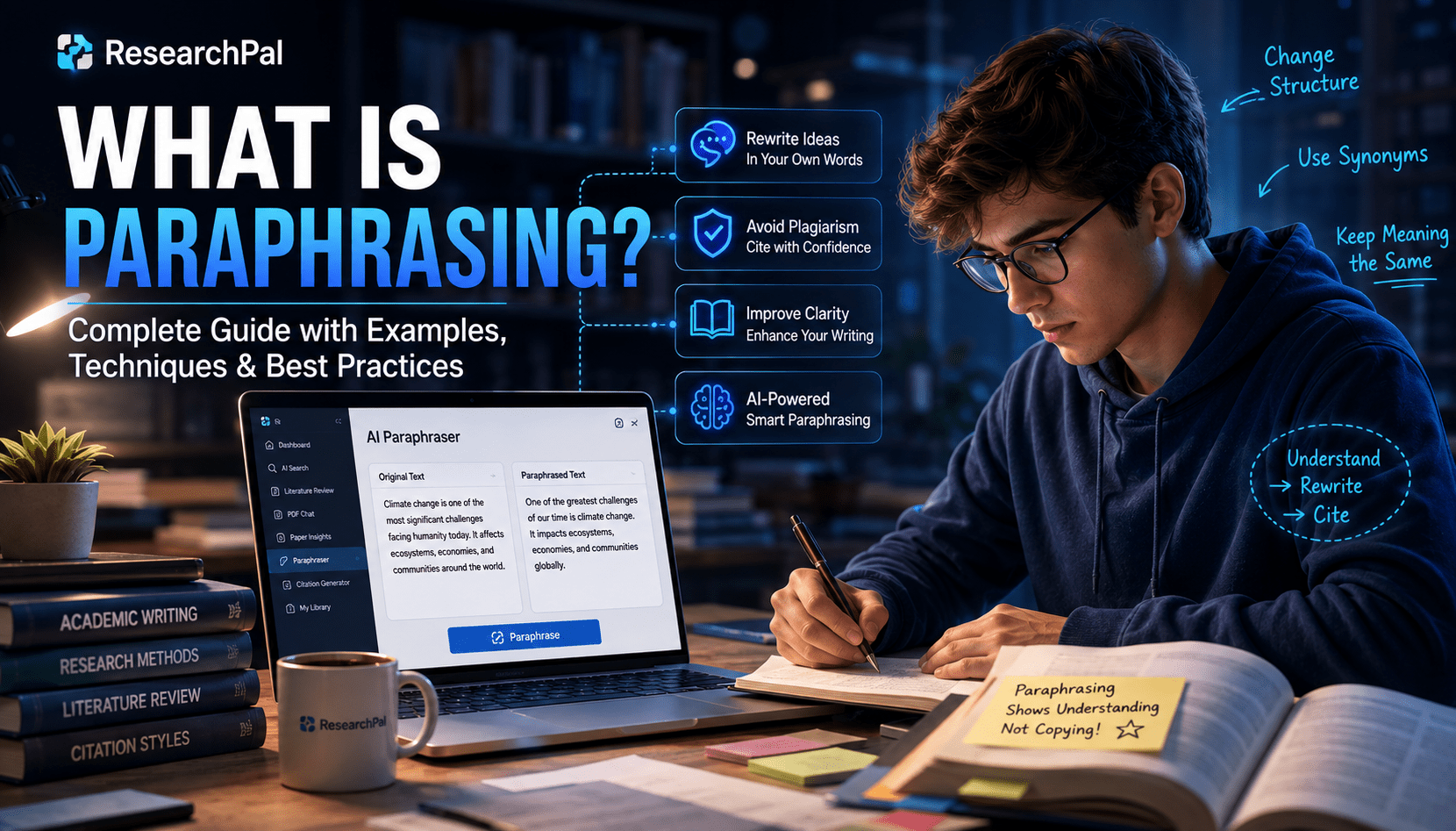
Paraphrasing is one of the most valuable skills in academic writing, research, and professional communication. Whether you’re writing a school essay, preparing a university assignment, conducting a literature review, or publishing research, you’ll frequently need to explain someone else’s ideas in your own words while preserving their original meaning. Many students mistakenly believe that paraphrasing simply means replacing a few words with synonyms. In reality, effective it requires a genuine understanding of the source material, reorganizing ideas, changing sentence structures, and expressing concepts naturally without altering the author’s intended message. Done correctly, it demonstrates comprehension, improves readability, and helps integrate evidence into your own writing while maintaining academic integrity. With the rapid growth of AI writing tools, paraphrasing has become faster than ever. However, simply accepting AI-generated text without reviewing it can introduce inaccuracies, awkward wording, or unintended changes in meaning. The most effective approach combines AI assistance with careful human review.
In this complete guide, you’ll learn what paraphrasing is, why it matters, practical techniques, real-world examples, common mistakes to avoid, and how ResearchPal helps students and researchers paraphrase more effectively while supporting the entire academic writing process.
What Is Paraphrasing? Quick Overview
Paraphrasing is the process of expressing another author’s ideas using your own words and sentence structure while preserving the original meaning. It is an essential academic writing skill that improves readability, demonstrates understanding, and helps integrate research naturally into essays, assignments, dissertations, and literature reviews.
What You’ll Learn
- What paraphrasing is
- Why paraphrasing matters
- How to paraphrase correctly
- Examples of effective paraphrasing
- Common mistakes to avoid
- AI paraphrasing best practices
Why It Matters
Good paraphrasing reduces accidental plagiarism, improves academic writing, demonstrates subject understanding, and helps students communicate research more naturally while maintaining proper citations.
Who Should Read This Guide?
- High school students
- College and university students
- Master’s and PhD researchers
- Academic writers
- Educators
- Research professionals
How ResearchPal Helps
Unlike standalone paraphrasing tools, ResearchPal combines AI-powered paraphrasing with Academic Search, Literature Review Generator, Writing Enhancer, Text Tuner, Citation Generator, PDF Chat, Paper Insights, and Research Library management—supporting the complete academic research workflow from discovery to publication.
Key Takeaways
- Paraphrasing rewrites ideas while preserving their original meaning.
- Effective paraphrasing changes vocabulary, sentence structure, and writing flow.
- Proper citation is still required after paraphrasing.
- AI can improve paraphrasing efficiency but should always be reviewed by the writer.
- ResearchPal combines paraphrasing with research, citations, literature reviews, and academic writing tools in one platform.
Quick Answer
Paraphrasing means rewriting another person’s ideas using your own words without changing the original meaning. It differs from quoting because you do not copy the exact wording, and it differs from summarizing because you retain a similar level of detail. ResearchPal helps students paraphrase responsibly while supporting literature reviews, citations, academic paper search, PDF analysis, and AI-assisted writing.
Quick Answer
Paraphrasing means rewriting another author’s ideas using your own words and sentence structure without changing the original meaning. It differs from quoting because you are not copying the exact wording, and it differs from summarizing because you retain the original level of detail. Effective it helps improve readability, demonstrate understanding, and reduce the risk of plagiarism while still requiring proper citation.
What Is Paraphrasing?
Paraphrasing is the process of restating information from a source in a new way while keeping the original meaning intact. Rather than copying sentences word for word, you explain the same concept using different vocabulary, sentence structures, and organization. Successful paraphrasing requires more than replacing individual words with synonyms. It involves understanding the author’s ideas first and then expressing those ideas naturally in your own writing style.
For example, a researcher may describe a study’s findings using different wording while accurately representing the original conclusions. This allows the information to fit smoothly into a literature review or discussion without relying heavily on direct quotations.
If you want to rewrite your own text while preserving its original meaning, try ResearchPal’s free AI paraphrasing tool to rephrase sentences, paragraphs, essays, and academic content.
Why Is Paraphrasing Important?
Paraphrasing plays a central role in academic writing because it allows you to integrate evidence while maintaining your own voice.
Demonstrates Understanding
When you paraphrase effectively, you show that you understand the original material rather than simply copying it.
Improves Readability
Paraphrased content blends more naturally with your own writing, creating a smoother reading experience.
Supports Academic Integrity
Proper paraphrasing, combined with accurate citations, helps acknowledge the original author’s contribution and reduces the likelihood of accidental plagiarism.
Strengthens Literature Reviews
Researchers often need to compare findings from multiple studies. Paraphrasing makes it easier to synthesize ideas instead of relying on numerous direct quotations.
Benefits of Paraphrasing
Learning to paraphrase effectively offers several advantages:
- Makes academic writing more original.
- Improves clarity and flow.
- Demonstrates critical thinking.
- Reduces overuse of direct quotations.
- Helps explain complex ideas in simpler language.
- Supports stronger literature reviews.
- Encourages deeper engagement with research sources.
For students and researchers, paraphrasing is not just a writing technique—it is an essential research skill.
How to Paraphrase Correctly
Following a structured process helps produce accurate and natural paraphrases.
Step 1: Read Carefully
Read the original passage several times until you understand the author’s main idea.
Step 2: Identify the Key Message
Focus on the central concept rather than individual words or phrases.
Step 3: Set the Source Aside
Avoid looking at the original text while drafting your paraphrase. This encourages genuinely original wording.
Step 4: Rewrite Naturally
Use your own vocabulary and sentence structure while preserving the original meaning.
Step 5: Compare with the Original
Check that your version accurately reflects the source without copying distinctive wording or structure.
Step 6: Add a Citation
Even when the wording is entirely your own, the underlying idea still belongs to the original author and should be cited appropriately.
Real Paraphrasing Examples
Example 1
Original
Regular physical activity improves cardiovascular health and reduces the risk of chronic diseases.
Paraphrased
Engaging in consistent exercise supports heart health while lowering the likelihood of developing long-term medical conditions.
Example 2
Original
Artificial intelligence is transforming higher education through personalized learning.
Paraphrased
Higher education is increasingly using artificial intelligence to deliver more personalized learning experiences.
Example 3
Original
Climate change affects biodiversity across terrestrial and marine ecosystems.
Paraphrased
Both land-based and marine ecosystems are experiencing changes in biodiversity because of climate change.
Example 4
Original
Students who actively participate in classroom discussions often achieve better learning outcomes.
Paraphrased
Learners who regularly contribute during class discussions tend to develop stronger academic understanding.
Example 5
Original
Machine learning algorithms improve their performance by learning from data over time.
Paraphrased
As they process increasing amounts of data, machine learning models become more effective at making predictions.
Example 6
Original
Digital libraries have expanded access to scholarly information worldwide.
Paraphrased
Researchers and students around the world now have greater access to academic resources because of digital libraries.
Example 7
Original
Early diagnosis significantly increases the success of many medical treatments.
Paraphrased
Detecting diseases at an early stage often improves treatment outcomes.
Example 8
Original
Renewable energy reduces dependence on fossil fuels.
Paraphrased
Using renewable energy sources helps decrease reliance on fossil fuels.
Example 9
Original
Cloud computing enables organizations to scale computing resources efficiently.
Paraphrased
Organizations can expand their computing capacity more efficiently through cloud-based infrastructure.
Example 10
Original
Strong communication skills improve collaboration among multidisciplinary research teams.
Paraphrased
Effective communication helps researchers from different disciplines work together more successfully.
Common Paraphrasing Mistakes
Many writers unintentionally weaken their paraphrases by making one or more of the following mistakes:
Replacing Only a Few Words
Changing a handful of words while keeping the original sentence structure is not effective paraphrasing.
Changing the Meaning
A paraphrase should communicate the same idea as the original source. Introducing new interpretations or omitting key information can distort the author’s message.
Forgetting the Citation
Even when the wording is completely original, the underlying idea still requires proper attribution.
Overusing Synonyms
Replacing every word with a synonym often creates awkward or unnatural writing. Focus on restructuring ideas instead of simply swapping vocabulary.
Copying Sentence Structure
Even if the words change, keeping the same sentence structure too closely can still resemble the original source.
Best Paraphrasing Techniques
Effective paraphrasing is a skill that improves with practice. Rather than simply replacing individual words with synonyms, skilled writers use a combination of techniques to produce clear, natural, and academically appropriate writing.
Below are some of the most effective paraphrasing techniques used by students and researchers.
1. Change the Sentence Structure
One of the easiest ways to create a natural paraphrase is by reorganizing the sentence.
Original
Researchers found that sleep improves memory retention.
Paraphrased
Memory retention improves when researchers observe sufficient sleep among participants.
Changing the structure while preserving the meaning makes the writing more original.
2. Use Appropriate Synonyms
Replacing keywords with suitable alternatives can help create variation, but avoid changing technical terminology or overusing synonyms.
Original
The experiment demonstrated significant improvements.
Paraphrased
The study showed considerable improvements.
The meaning remains the same while the wording becomes more natural.
3. Change Active Voice to Passive Voice
Switching between active and passive voice can create a noticeably different sentence.
Original
Researchers analyzed the collected data.
Paraphrased
The collected data were analyzed by the researchers.
Use this technique selectively, as excessive passive voice can reduce readability.
4. Break Long Sentences
Long academic sentences can often be divided into shorter, clearer statements.
Original
The researchers collected survey responses, analyzed the data, and identified several important trends that influenced future policy recommendations.
Paraphrased
The researchers first collected survey responses. They then analyzed the data and identified several important trends that informed future policy recommendations.
5. Combine Related Ideas
Sometimes several short sentences can be merged into one coherent statement.
This creates smoother academic writing while maintaining the original meaning.
6. Focus on the Main Idea
Instead of rewriting every sentence individually, understand the overall concept before writing your own version.
This approach produces more natural paraphrases and demonstrates genuine comprehension.
Sentence-Level vs Paragraph-Level Paraphrasing
Students often ask whether they should paraphrase one sentence at a time or rewrite an entire paragraph.
The answer depends on the purpose of the writing.
Sentence-Level Paraphrasing
Sentence-level paraphrasing is useful when:
- Explaining a single definition
- Discussing one research finding
- Referencing a short quotation
- Clarifying one specific concept
Advantages include:
- Faster rewriting
- Simpler editing
- Easier citation management
However, rewriting individual sentences can sometimes preserve too much of the original structure.
Paragraph-Level Paraphrasing
Paragraph-level paraphrasing focuses on understanding an entire section before rewriting it.
Advantages include:
- Better flow
- More natural writing
- Stronger academic voice
- Reduced similarity
- Better synthesis of research
This technique is especially useful when writing:
- Literature reviews
- Research papers
- Dissertations
- Thesis chapters
- Systematic reviews
For most academic writing, paragraph-level paraphrasing is generally the better choice because it encourages deeper understanding rather than simple word substitution.
Paraphrasing vs Quoting vs Summarizing
Although these terms are often confused, they serve different purposes.
| Technique | Purpose | Detail Level | Citation Required |
|---|---|---|---|
| Paraphrasing | Rewrite ideas using your own words | Similar to original | Yes |
| Quoting | Use the author’s exact words | Identical | Yes |
| Summarizing | Present only the main points | Much shorter | Yes |
Use Paraphrasing When
- Explaining research findings
- Integrating evidence naturally
- Maintaining your own writing style
Use Quoting When
- Exact wording is important
- Defining concepts
- Presenting memorable statements
Use Summarizing When
- Reviewing several studies
- Providing background information
- Explaining lengthy material briefly
Academic writing often combines all three techniques.
Can AI Help with Paraphrasing?
Artificial intelligence has made paraphrasing much faster and more accessible. AI tools can suggest alternative wording, improve readability, and help restructure sentences while preserving the intended meaning.
However, AI-generated paraphrases should always be reviewed carefully.
Students should check for:
- Accuracy
- Academic tone
- Grammar
- Technical terminology
- Preservation of meaning
- Proper citations
AI should support critical thinking—not replace it.
How ResearchPal Helps with Paraphrasing
While many AI tools focus only on rewriting text, ResearchPal is designed to support the complete academic writing process.
AI Paraphrasing
ResearchPal helps rewrite sentences and paragraphs while maintaining the intended meaning and improving readability.
Writing Enhancer
The Writing Enhancer improves:
- Grammar
- Academic tone
- Sentence clarity
- Readability
- Overall writing quality
Text Tuner
Different assignments require different writing styles.
ResearchPal’s Text Tuner helps adjust text for:
- Formal academic writing
- Concise explanations
- Improved clarity
- Better engagement
Literature Review Generator
Instead of paraphrasing one paper at a time, ResearchPal helps synthesize information from multiple academic sources into structured literature reviews.
Academic Search
Students can search millions of scholarly papers directly within ResearchPal, making it easier to discover reliable sources before paraphrasing.
PDF Chat
Upload research papers and ask questions about:
- Methodology
- Results
- Findings
- Limitations
- Conclusions
Understanding a paper thoroughly leads to stronger paraphrasing.
Paper Insights
ResearchPal automatically extracts:
- Research objectives
- Methods
- Key findings
- Contributions
- Limitations
These insights help students understand research before rewriting it.
Citation Generator
Good paraphrasing still requires proper attribution.
ResearchPal simplifies this process by generating citations in multiple academic styles, helping students maintain academic integrity.
Research Library
Keep papers, notes, citations, and projects organized in one place, making it easier to revisit sources while writing.
Best Practices for Effective Paraphrasing
To produce high-quality academic writing, follow these best practices:
- Read the source until you fully understand it.
- Rewrite ideas without looking directly at the original text.
- Focus on meaning rather than individual words.
- Use natural language instead of excessive synonyms.
- Change both vocabulary and sentence structure.
- Compare your version with the original to check for unintended similarity.
- Cite every paraphrased idea appropriately.
- Review AI-generated paraphrases before using them.
Consistent practice will improve both writing quality and confidence.
Final Thoughts
Paraphrasing is much more than replacing words with synonyms. It is a critical academic skill that demonstrates understanding, improves readability, and helps integrate evidence into your own writing while maintaining academic integrity.
Whether you’re preparing a classroom essay, a literature review, or a journal article, learning to paraphrase effectively will strengthen your writing and reduce the risk of accidental plagiarism.
Modern AI tools can make the process faster, but the best results come from combining AI assistance with careful human review.
For students and researchers who want more than a standalone paraphrasing tool, ResearchPal provides an integrated academic research platform that combines AI-powered paraphrasing, academic paper search, Literature Review Generator, PDF Chat, Paper Insights, Citation Generator, Research Library, Writing Enhancer, and Text Tuner—helping you move from research to final submission more efficiently.
From The Web
- 25 Examples of Paraphrasing to Help You Write in Your …
- Top 7 Tried and Tested Paraphrasing Techniques
Frequently Asked Questions About Paraphrasing
Everything students and researchers need to know about paraphrasing, academic writing, plagiarism prevention, AI writing tools, and ResearchPal.
Paraphrasing is the process of rewriting another author’s ideas using your own words and sentence structure while preserving the original meaning. Proper paraphrasing improves readability, demonstrates understanding, and still requires appropriate citation. ResearchPal helps students paraphrase accurately while supporting literature reviews, academic search, citation generation, and AI-assisted writing.
Paraphrasing allows students to explain research naturally while avoiding excessive quotations. It demonstrates comprehension, supports academic integrity, improves writing flow, and reduces the risk of accidental plagiarism. ResearchPal helps streamline this process through AI-powered writing tools.
No. Even after paraphrasing, the original author’s ideas must still be cited. Good paraphrasing reduces textual similarity but does not remove the need for proper attribution. ResearchPal combines paraphrasing with citation generation to support responsible academic writing.
Yes. AI can rewrite sentences and paragraphs while improving readability and structure. However, users should always review AI-generated text for accuracy, academic tone, and preservation of the original meaning. ResearchPal provides AI-powered paraphrasing together with writing enhancement and academic research tools.
Paraphrasing restates ideas using different wording while maintaining nearly the same level of detail. Summarizing condenses information into shorter key points. ResearchPal supports both through its Writing Enhancer and Literature Review Generator.
For most academic writing, paragraph-level paraphrasing is generally more effective because it promotes deeper understanding, smoother writing, and lower textual similarity. ResearchPal supports both sentence-level and paragraph-level paraphrasing while preserving the intended meaning.
Read carefully, understand the source, rewrite without looking directly at the original text, compare both versions, and always cite the source. Practicing regularly and using ResearchPal’s AI Writing Enhancer and Text Tuner can further improve paraphrasing quality.
ResearchPal combines AI-powered paraphrasing with Academic Search, PDF Chat, Paper Insights, Literature Review Generator, Citation Generator, Writing Enhancer, Text Tuner, and Research Library management. Instead of being just a paraphrasing tool, it supports the complete academic research workflow from discovering literature to writing and citation management.

