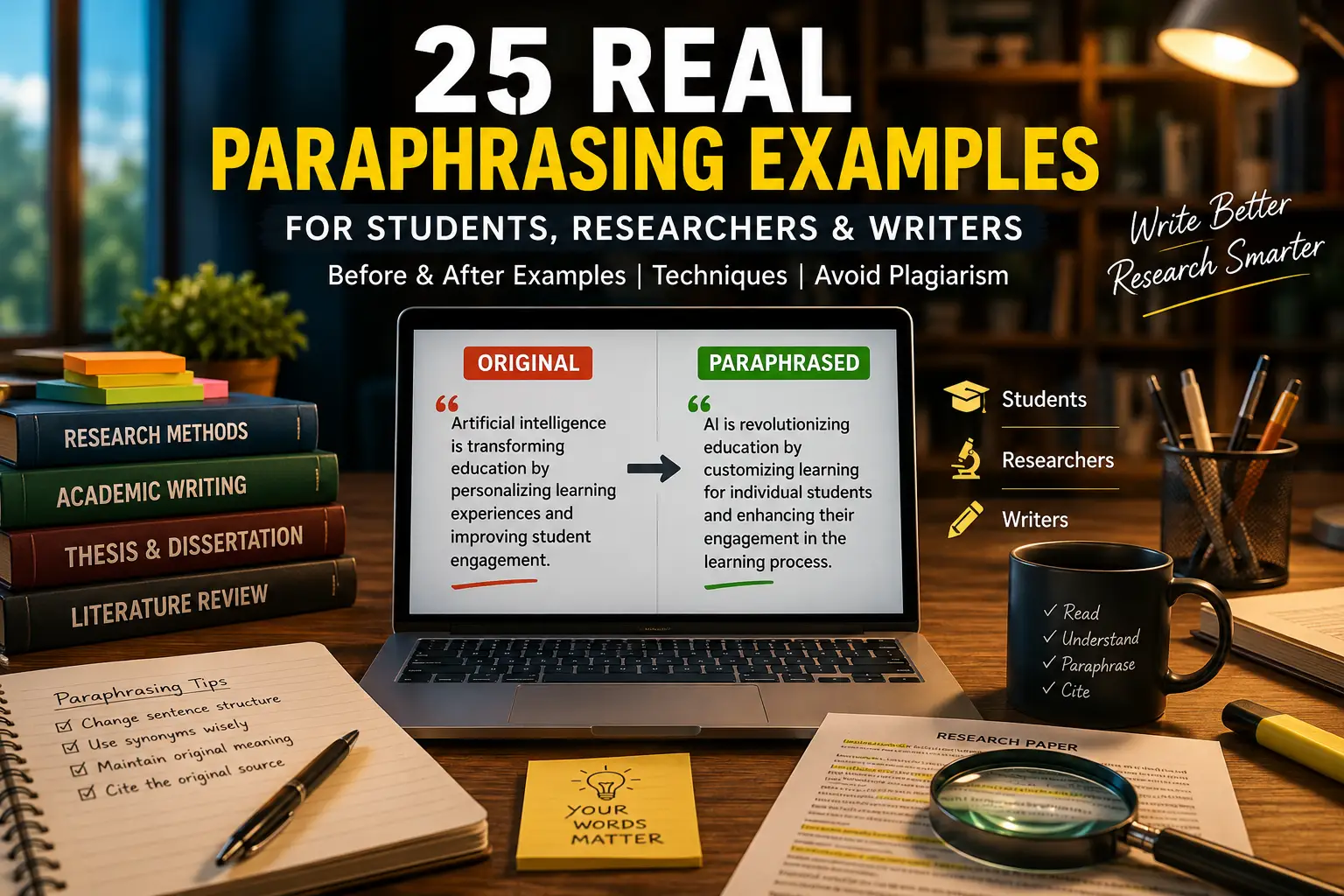
Imagine you’ve spent hours researching credible sources for your assignment or research paper. Now comes one of the most challenging parts—explaining those ideas in your own words without changing their meaning or accidentally committing plagiarism. This is where paraphrasing becomes an essential academic skill. Whether you’re a university student writing essays, a researcher preparing a journal article, or a professional creating reports, knowing how to paraphrase effectively helps you communicate ideas clearly while maintaining academic integrity. The problem is that many people believe paraphrasing simply means replacing a few words with synonyms. In reality, effective paraphrasing requires you to completely restructure sentences, preserve the original meaning, and properly acknowledge the source. In this comprehensive guide, you’ll find 25 real paraphrasing examples covering essays, research papers, literature reviews, dissertations, business writing, technical documents, and everyday writing. Each example includes the original sentence, an improved paraphrased version, and a brief explanation of why the rewrite works.
You’ll also discover common paraphrasing mistakes, practical techniques used by experienced academic writers, and how AI-powered research assistants like ResearchPal can help improve your writing while keeping you in control of the final content.
Whether you’re paraphrasing one sentence or an entire research paper, this guide will help you produce writing that is clearer, more original, and easier to read.
Quick Answer: What Is Paraphrasing?
Paraphrasing is the process of expressing someone else’s ideas using your own words, sentence structure, and writing style while preserving the original meaning and properly citing the source.
Unlike copying text or replacing a few words with synonyms, effective paraphrasing demonstrates genuine understanding of the material. It changes how information is presented without changing what the information means.
Good paraphrasing improves readability, helps avoid plagiarism, and allows you to integrate research naturally into your own writing.
Want to practice these techniques on your own writing? Use ResearchPal’s free AI paraphrasing tool to rewrite sentences and paragraphs while keeping the original meaning.
Why Is Paraphrasing Important?
Paraphrasing is more than an academic requirement—it’s a valuable communication skill.
Students use it to write essays and assignments, researchers rely on it when reviewing literature, and professionals use it to summarize reports and communicate complex information more effectively.
When done correctly, paraphrasing helps you:
- Demonstrate a clear understanding of the source material.
- Avoid accidental plagiarism.
- Create a consistent writing style throughout your document.
- Explain complex ideas in simpler language.
- Integrate evidence naturally into essays and research papers.
- Improve the readability and flow of your writing.
For researchers, strong paraphrasing is especially important because literature reviews often require summarizing findings from dozens or even hundreds of academic papers. Rather than copying passages, researchers must present previous work in a way that supports their own analysis while giving proper credit to the original authors.
When Should You Paraphrase Instead of Quote?
One of the most common questions students ask is whether they should paraphrase or quote directly.
As a general rule, paraphrase when you want to explain an author’s ideas in your own style while maintaining the original meaning. This is ideal for literature reviews, research discussions, essays, reports, and most academic writing.
Use direct quotations only when the author’s exact wording is important, such as legal definitions, historical statements, or particularly memorable phrases.
For example, if a research paper explains a scientific concept, paraphrasing allows you to present the information in language that fits naturally with the rest of your paper. If the paper contains a unique definition that must remain unchanged, quoting the original wording is usually the better option.

