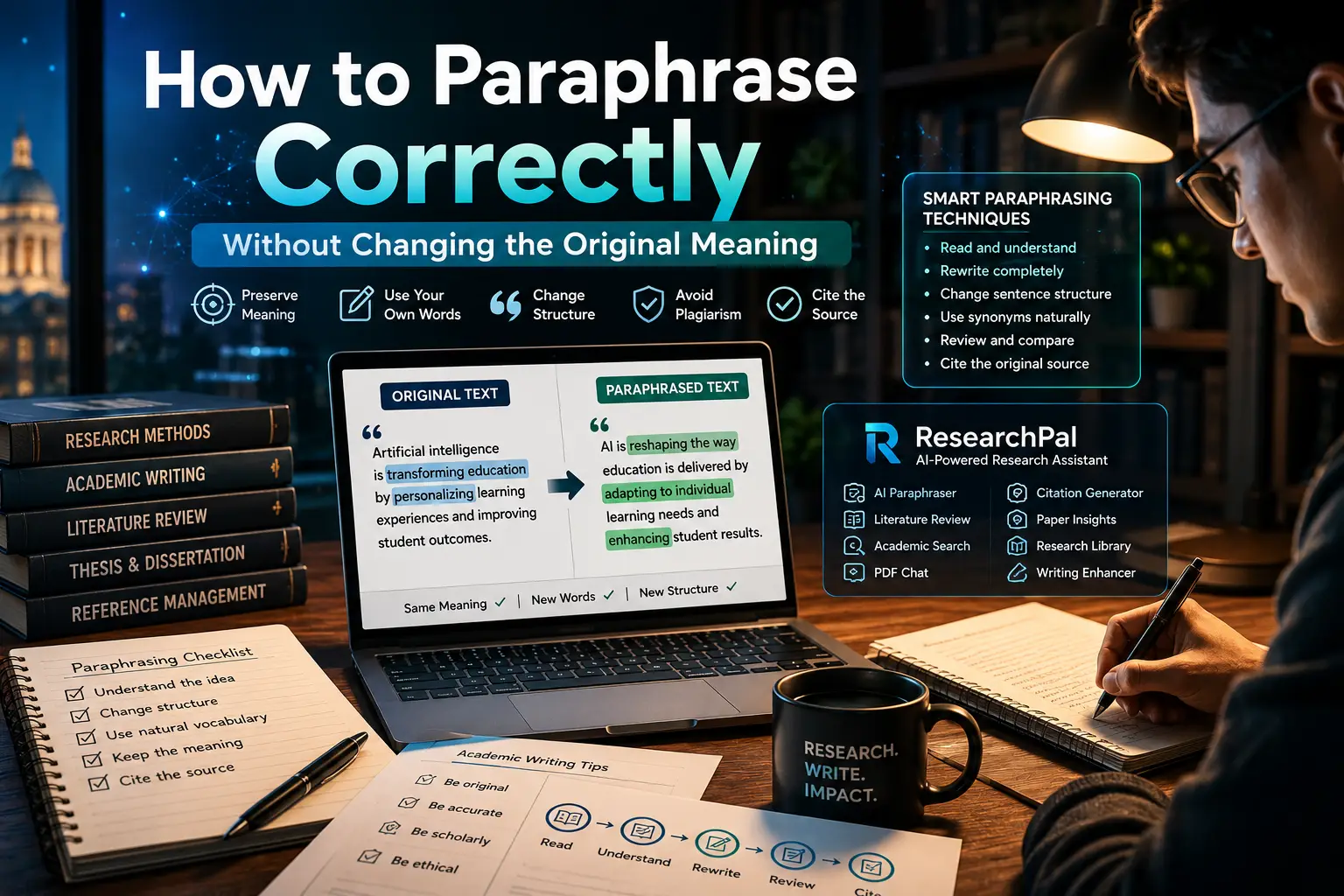
Paraphrasing is one of the most valuable skills in academic writing. Whether you’re writing an essay, a research paper, a thesis, or a business report, you’ll often need to explain someone else’s ideas in your own words. The challenge is rewriting the text without changing its original meaning. Many students believe paraphrasing simply means replacing a few words with synonyms. Unfortunately, this approach often leads to poor writing and, in some cases, accidental plagiarism. Effective paraphrasing requires you to fully understand the original content, restructure the sentence, and communicate the same idea naturally while giving proper credit to the source.
In this guide, you’ll learn how to paraphrase correctly without changing the original meaning, discover practical techniques used by experienced researchers, and explore how AI-powered writing tools such as ResearchPal can help improve your writing while maintaining academic integrity.
Quick Answer
To paraphrase correctly without changing the original meaning, first understand the source completely, then rewrite the idea using your own sentence structure and vocabulary while preserving the author’s intended message. Always compare your version with the original and cite the source appropriately.
What Is Paraphrasing?
Paraphrasing means expressing another author’s ideas using your own words while keeping the original meaning intact. Unlike direct quotations, paraphrasing allows you to integrate research naturally into your writing without copying the exact wording.
A successful paraphrase should:
- Preserve the original meaning.
- Use different sentence structures.
- Replace wording naturally instead of relying only on synonyms.
- Fit the style of your own writing.
- Include proper citations.
For students and researchers, paraphrasing demonstrates a genuine understanding of the material rather than simply repeating what another author has written.
Read more about What Paraphrasing Is?
Why Preserving the Original Meaning Matters
Changing the wording is easy. Preserving the meaning is the real challenge.
If your paraphrase changes the author’s intended message, you risk:
- Misrepresenting research findings.
- Drawing incorrect conclusions.
- Weakening your academic credibility.
- Introducing factual errors into your work.
This is especially important when writing literature reviews, systematic reviews, dissertations, or journal articles where accuracy is essential.
Step 1: Read Until You Understand the Idea
Before rewriting anything, read the original text carefully.
Instead of focusing on individual words, ask yourself:
- What is the author actually saying?
- What is the main message?
- What evidence supports this idea?
If you cannot explain the idea without looking at the original sentence, you probably don’t understand it well enough to paraphrase it effectively.
Step 2: Put the Original Text Aside
Once you’ve understood the content, avoid looking at the original while rewriting.
This encourages you to express the idea naturally instead of unconsciously copying the author’s sentence structure.
Many experienced academic writers read a paragraph, close the source, and then rewrite the concept entirely from memory before checking for accuracy.
Step 3: Rewrite the Entire Sentence Structure
One of the biggest mistakes is keeping the same structure while replacing a few words.
Poor Example
Original
Artificial intelligence is transforming healthcare by improving diagnostic accuracy.
Poor Paraphrase
Artificial intelligence is changing healthcare by improving diagnosis accuracy.
Although a few words have changed, the structure remains almost identical.
Better Example
Healthcare providers are increasingly using AI technologies to make diagnoses more accurate and improve patient outcomes.
This version changes both the wording and sentence structure while preserving the original meaning.
Step 4: Use Natural Vocabulary
Replacing every word with a synonym rarely produces good writing.
Instead of focusing on individual words, think about how you would naturally explain the same idea to another student or researcher.
For example:
Instead of:
“The study demonstrates…”
You might write:
- The research shows…
- The findings indicate…
- The investigation suggests…
- The results reveal…
Notice that the entire sentence evolves rather than relying on one-to-one word substitutions.
Step 5: Compare Your Version With the Original
After writing your paraphrase, compare it with the source.
Ask yourself:
- Does it communicate exactly the same idea?
- Have I accidentally changed any facts?
- Is the wording sufficiently different?
- Does the sentence sound natural?
This final review is one of the easiest ways to catch mistakes before submitting your work.
Common Mistakes When Paraphrasing
Many writers unknowingly weaken their work by making these common mistakes:
Only Replacing Synonyms
Changing a handful of words while keeping the original structure is not true paraphrasing and may still be considered plagiarism.
Changing the Meaning
Some writers simplify ideas so much that the author’s original point is lost.
Forgetting Citations
Even though you’ve rewritten the sentence, the underlying idea still belongs to the original author and must be cited.
Overusing AI Without Review
AI writing tools can save time, but researchers should always verify that the rewritten content accurately reflects the original source.
How AI Can Help You Paraphrase Better
If you want to apply these principles while rewriting your own text, ResearchPal’s free AI paraphrasing tool can help you rephrase sentences and paragraphs while maintaining the original meaning.
However, AI should be viewed as a writing assistant rather than a replacement for critical thinking.
Platforms like ResearchPal support researchers throughout the writing process by combining AI-powered paraphrasing with literature review generation, academic paper discovery, PDF analysis, citation management, and research library organization.
Unlike standalone paraphrasing tools, ResearchPal integrates rewriting into a complete academic workflow, helping researchers maintain consistency across their projects while preserving originality and proper citation practices.
Best Practices for Accurate Paraphrasing
To consistently produce high-quality paraphrases:
- Understand the source before rewriting.
- Rewrite ideas instead of individual words.
- Change the sentence structure naturally.
- Preserve every important detail.
- Review your paraphrase against the original.
- Always cite the source.
- Use AI responsibly and verify every suggestion.
Following these practices will improve both the quality of your writing and your confidence when working with academic sources.
Final Thoughts
Learning how to paraphrase correctly without changing the original meaning is an essential skill for students, researchers, and professional writers. Good paraphrasing demonstrates understanding, improves readability, and helps maintain academic integrity.
While AI tools can make rewriting faster, the responsibility for preserving accuracy and meaning always belongs to the writer.
By combining careful reading, thoughtful rewriting, and responsible use of AI-powered platforms like ResearchPal, you can produce clear, original, and academically credible writing that meets university and journal standards.
For practical rewriting, you can also try ResearchPal’s AI paraphrasing tool for academic writing.
About ResearchPal
ResearchPal is an AI-powered research assistant designed to help students and researchers throughout the entire academic workflow. In addition to AI-powered paraphrasing, it offers literature review generation, academic paper search, PDF chat, citation generation, research library management, and paper analysis—allowing researchers to work more efficiently from idea to publication.
From The Web
- How to Paraphrase Essays and Research Papers Effectively: Step-by-Step Guide
https://paperpal.com/blog/researcher-resources/how-to-paraphrase-essays-and-research-papers
- How to Paraphrase | Step-by-Step Guide & Examples
https://www.scribbr.com/working-with-sources/how-to-paraphrase
ResearchPal helps students and researchers produce clearer, more natural academic writing by combining AI-powered paraphrasing with a complete research workflow. Users can rewrite text in an academic tone, generate literature reviews, search scholarly papers, analyze PDFs, manage citations, and organize research libraries—all from a single platform.
By integrating these features, ResearchPal helps researchers spend less time switching between tools and more time producing high-quality, original academic work.
The best tool depends on your needs. If you only need sentence rewriting, many AI writing tools can help. However, researchers often need much more than paraphrasing.
ResearchPal is designed specifically for academic workflows. In addition to AI-powered paraphrasing, it helps users:
Improve academic writing.
Generate structured literature reviews.
Search millions of academic papers.
Chat with PDFs to extract insights.
Generate and manage citations.
Organize research papers in a personal library.
Analyze methodologies, findings, and research gaps.
Instead of switching between multiple applications, researchers can manage their entire research process within one platform.
Yes. AI can make paraphrasing faster and improve readability, grammar, and academic tone. However, researchers and students should always review AI-generated content to ensure it accurately represents the original source. AI should be used as a writing assistant rather than a replacement for critical thinking.
ResearchPal goes beyond basic paraphrasing by combining AI-powered rewriting with literature review generation, academic paper search, PDF chat, citation generation, and research library management. This allows researchers to improve their writing while keeping their entire research workflow in one platform.

