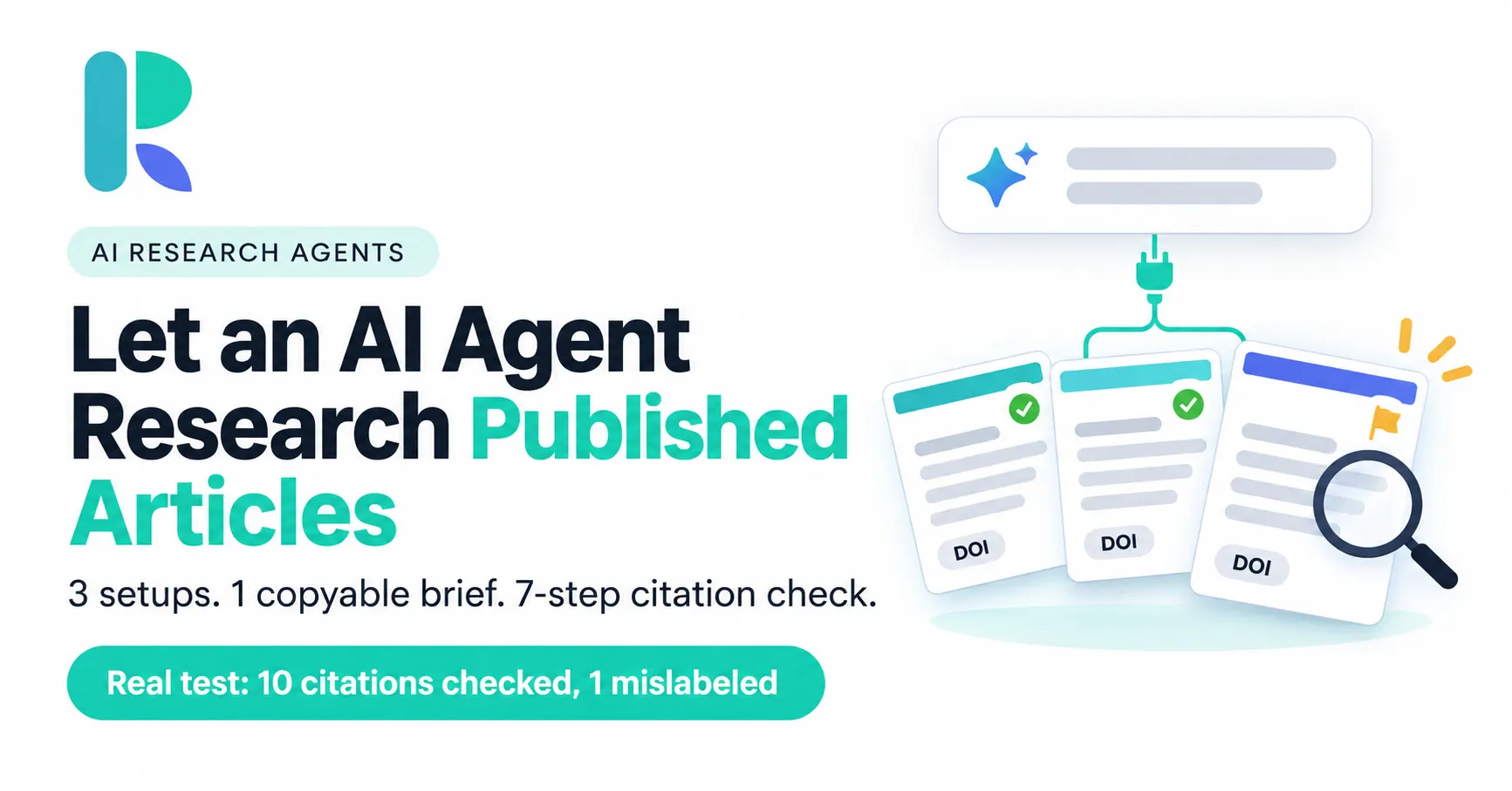
Last updated: November 25, 2026. How we tested: we ran one real agent session with the ResearchPal connector on that date and checked its output by hand.
An AI agent can research published articles only when it is connected to a source of real papers. Without that connection, it writes from memory and may hand you references that do not exist.
This guide shows you how to let an AI agent research published articles in three ways. The simplest is a ready-made research agent. The most flexible is a connector you add to Claude or ChatGPT.
You will finish with a working setup, a brief you can copy, and a checklist for every citation the agent returns. We also ran a real test and report what held up and what did not.
Quick Answer: Three Ways to Give an AI Agent Real Papers
Give the agent a source it can search. You can use a research agent that already searches papers, connect Claude or ChatGPT to a paper database, or hand the agent PDFs you are allowed to share. Then tell it what to look for, and check every citation it gives back.
| Route | What the agent can read | Setup effort | Best for |
|---|---|---|---|
| 1. A research agent | The product’s own paper index, plus files you add | Sign up and start a chat | Students and researchers who want one workspace |
| 2. A connector in Claude or ChatGPT | What the connected database offers, often abstracts and open full text | A few clicks and a sign-in | People who already work in Claude or ChatGPT |
| 3. Your own PDFs | Only the files you upload | Upload the files | Paywalled papers you have the right to share, or a fixed reading list |

Why a Chatbot Alone Cannot Research Published Articles
A chatbot with no connected source does not look anything up. It predicts likely text from its training data, and a reference list is text like any other.
The cost is measurable. William Walters and Esther Wilder asked ChatGPT for 84 short literature reviews and checked all 636 citations. They report that 55% of the GPT-3.5 citations and 18% of the GPT-4 citations were fabricated (Scientific Reports, 2023).
An AI research agent differs in one respect: it can call tools. It runs a search, reads what comes back, and decides the next step. For the longer definition, see what an AI research agent is.
We also explain how a research agent differs from a chatbot in a separate post. The rest of this guide is about the tools you give the agent.
What an AI Agent Is Allowed to Read and Quote
An agent may read what its source is licensed to show, and that is usually less than the full paper.
Most connectors return titles, authors, abstracts, and links. Full text arrives only when the paper is open access or the provider has an agreement with the publisher. The PubMed connector in Claude, for example, offers full text “when available in PMC.”
Free to read does not mean free to reuse. PubMed Central’s FAQ says not all of its articles are available for reuse and that many are under copyright. The license sits on each article record.
Open licenses are the clearest case. Under CC BY, anyone may copy, share, and adapt the work, including for commercial purposes, if they credit the author. NC limits use to noncommercial purposes. ND forbids sharing changed versions.
Creative Commons adds a caution: much of how AI systems use content falls outside what its licenses can govern.
Paywalled PDFs from your library need a check before you upload them. American University Library tells its users that licensed electronic resources may not be uploaded into any AI tool, with an exception for open access material. The University of Waterloo Libraries says most library resources cannot be shared with generative AI tools, and its catalog shows an “AI Use” field for each license. Your library may differ, so ask.
When a paper is paywalled, look for an open copy first. We list the legal routes in our guide on how to find a legal open access copy.
This section reports what the named sources say. It is not legal advice.
Route 1: Use a Research Agent That Already Searches Papers
This is the shortest route. The agent and the paper index come as one product, so you have nothing to connect.
ResearchPal’s AI Research Agent is one example. You start from a research question, find papers, run Paper Insights on the ones you select, question a paper through PDF chat, and save sources to your library.
The Free plan includes 5 agent chats and 15 credits a month. The Standard plan removes the chat limit. These figures were on the pricing page in November 2026.
Other research agents follow the same pattern. We compare six of them in our list of the best AI research agents for academic work.
If you are still choosing between tool types, start with our guide to the best AI tool for research.
The limit of this route is scope. The agent searches its own index, so a paper the index lacks will not appear. Run one search in a second database before you call a topic covered.

Route 2: Connect Claude or ChatGPT to a Paper Database
A connector lets the assistant you already use search a paper database from inside the chat.
What a Connector Is
Most connectors are built on the Model Context Protocol (MCP), an open standard for connecting AI applications to outside systems. A database owner builds one MCP server, and any compatible assistant can use it. Aaron Tay of SMU Libraries compares it to USB-C for AI models.
The names vary. Claude calls them connectors. ChatGPT calls them apps and, since July 9, 2026, lists them in its Plugin directory.
Set It Up in Claude
These steps follow Claude’s help center as of November 2026.
- In a chat, click the “+” button in the lower-left corner, or type “/”.
- Hover over Connectors and choose Manage connectors.
- Click the “+” next to Connectors to browse the directory.
- Pick a connector, read what it can do, and click Connect.
- Sign in to the service if it asks.
- Back in the chat, open “+” again, hover over Connectors, and switch the connector on.
If a connector is not in the directory, you can add it by address. Choose Add, then Custom, then Web, and paste the server URL. Free Claude plans allow one custom connector. Anthropic states that it has not verified custom servers, so add only those from organizations you trust.
ResearchPal’s connector works this way. Once connected, the assistant can search papers, check a claim against published studies, and format a citation. In our test, a search and a claim check cost 2 credits each, and a citation cost 1.

Set It Up in ChatGPT
These steps follow OpenAI’s help center as of November 2026.
- Open Settings and choose Plugins.
- Select the app, or the plugin that includes it.
- Select Install plugin if it appears, then Connect, and sign in.
- In a chat, mention the app with @, or pick it from the “+” menu.
Older guides that say “Apps” or “Connectors” describe the same feature under an earlier name. Adding a server by URL is different. OpenAI lists developer mode and custom MCP apps for Business, Enterprise, and Edu workspaces, so individual plans depend on what the directory offers.

Connectors Compared
We checked each row against the provider’s own page on November 25, 2026.
| Connector | What it searches | Full text or abstracts | Account needed | Where to add it |
|---|---|---|---|---|
| ResearchPal | ResearchPal’s index of peer-reviewed papers | Title, authors, summary, DOI, and a free PDF link where one exists | ResearchPal account. Tools use credits. | [CONFIRM] |
| PubMed (made by Anthropic) | PubMed citations and PubMed Central | Full text when available in PMC | No sign-in | Claude directory |
| Consensus | Its index of scientific research | Links to open full text where licensing permits | None for 3 papers per search. A free account returns 10 by default. | Claude directory and ChatGPT |
| Scite | Full-text literature and its Smart Citations | Searches full text and returns passages | Paid plan or free trial | ChatGPT, Claude, and Copilot |
A connector is only as good as the database behind it. Our comparison of research paper search engines by field shows which databases cover which subjects.
Two limits apply to this route. Connectors change often, so a menu or plan limit in this section may differ when you read it. And each connector you switch on widens what the assistant can reach. SMU Libraries warns that unused servers also crowd the assistant’s working memory and lower answer quality.
Route 3: Give the Agent Your Own PDFs
Choose this route when the papers you need sit behind a paywall you have legal access to, or when your reading list is already fixed.
The agent reads only what you upload, so nothing off-topic gets in. In ResearchPal, uploaded papers sit in your library, where the agent and the connector can both read them. The Free plan holds up to 5 PDFs.
The trade-off is coverage. The agent cannot tell you what you have missed, because it sees no paper outside your folder. The license question from earlier also applies here in full. Check your library’s terms before you upload a publisher’s PDF to any AI tool.
A Brief You Can Copy: Tell the Agent What to Do
An agent does better work from a written brief than from a one-line question. Copy this and fill in the brackets.
Research question: [one sentence]
Scope: [who was studied, setting, years, languages]
Include: [study types, such as experiments, reviews, meta-analyses]
Exclude: [such as clinical groups, children, preprints]
Sources: Use only the connected paper database. Do not cite from memory.
Output: One table with these columns: authors, year, title, journal,
DOI or link, study type, who was studied, main finding, and the exact
sentence from the paper that supports the finding.
Flags: Mark any paper with no DOI or link. Mark any paper whose
participants differ from the scope.
Stop rule: Stop after [20] papers or [5] searches, whichever comes first.
If you cannot find something, write "not found." Do not guess.
The scope and exclusion lines matter most. In our test, the first search returned five papers. One studied adults with HIV, and one was about a different teaching method.
The “exact sentence” column gives you something to check against the paper. The stop rule keeps your credits and your time under control.
A Worked Example: We Let an AI Agent Research Published Articles
We ran this test on November 25, 2026. The agent was Claude, connected to the ResearchPal connector on a Pro account.
The question: does retrieval practice improve long-term retention more than restudying in university students?
| Step | What the agent ran | What came back | Credits |
|---|---|---|---|
| 1 | Paper search, 2015 to 2026, journal articles and reviews | 5 papers | 2 |
| 2 | Paper search, all years, reworded query | 11 papers on the first page | 2 |
| 3 | Claim check | Verdict “Mostly supported,” certainty “Low.” 24 studies support, 4 refute, 3 mixed, from 84 papers found. | 2 |
| 4 | Three citations | References in APA, Harvard, MLA, Chicago, and BibTeX | 3 |
The session used 9 credits. From the first search to the last check, it took about five minutes.

Then we checked the ten studies the claim check quoted as its strongest evidence. Here is what we found.
- Nine of the ten are real papers. We matched each title, author list, and year against its Crossref record or the publisher’s page.
- One could not be found. It is a 2013 thesis with no DOI, and two web searches did not locate it.
- One label was wrong. A 2024 study of 270 undergraduates sat under “refutes.” The paper reports that “repeated testing significantly outperforms repeated study” (Aljabri, 2024), so it supports the claim.
- Two of the four “refutes” studies tested other groups: people with dementia, and memory for personal events. The tool had flagged both.
- Four of the ten came without a link or DOI. We found three of them by title.
- One title carried stray text at the front: “Author accepted manuscript.”
- Crossref showed no retraction for the six quoted studies we could look up there.
The second search added something the claim check had not counted. It surfaced a 2017 meta-analysis of practice testing by Adesope, Trevisan, and Sundararajan. The claim check’s certainty note had said no meta-analysis backed the claim. Crossref lists a published correction to that paper, which is worth reading before you cite it.
After checking, the case against the claim shrank from four studies to one we could not find. The case for it gained a meta-analysis. The verdict stayed the same, but we now knew why we could trust it. Slips like these are the reason the next section exists.
How to Check Every Citation the Agent Gives You
Check each citation in this order. If one fails a step, fix it or drop it.
- Open the DOI. Paste it after https://doi.org/ and confirm it leads to a paper. With no DOI, search by the exact title.
- Match the record. Title, authors, year, and journal should match the agent’s table. Watch for stray text in titles and for two years on one paper, online and print.
- Find the sentence. Open the paper and locate the finding the agent reported. If the paper says the opposite, the label is wrong.
- Check who was studied. A study of patients or children does not answer a question about university students.
- Check for a retraction or correction. Crossref carries the Retraction Watch data and marks records that have changed.
- Check the study type. A meta-analysis and a single classroom study do not carry the same weight.
- Remove duplicates. A preprint and its published version often appear as two papers.
ResearchPal’s Claim Check shortens steps 3 and 5. It shows the source sentence for each study and lists retracted papers separately. You still open the paper.
Format the survivors only after they pass. A citation generator saves typing, but it formats what it is given, right or wrong.
For the background on this problem, read our post on why AI tools invent references.

Five Mistakes to Avoid
- Asking with no source switched on. Confirm the connector is on in that chat before you type the question.
- Trusting the label over the sentence. Read the quoted sentence and decide for yourself whether it supports the claim.
- Running one search. Reword the query once and search all years. Our second search found the meta-analysis that the first one missed.
- Uploading publisher PDFs without checking the license. Ask your library, or use the open access copy.
- Leaving every connector on. Switch on only what the task needs.
The same habits apply to AI writing help in general. Our guide on how to use ChatGPT responsibly covers them.
Frequently Asked Questions
Can an AI Agent Read Paywalled Articles?
Not through a connector, in most cases. Connectors return abstracts and metadata for paywalled papers. Full text appears only where the paper is open access or the provider has a publisher agreement. You can upload a PDF you have access to, but check your library’s license terms first.
Is There a Search API for Academic Papers That AI Agents Can Use?
Yes, and for people who do not code, a connector is the simplest form, because the assistant makes the calls. PubMed, Consensus, and Scite each offer one. ResearchPal has an API with a paper-search endpoint, available on request. Crossref also runs a free public API for publication metadata.
Where Can an AI Agent Find Peer-Reviewed Sources It Is Allowed to Quote?
Start with open access papers under a Creative Commons license. The PMC Open Access Subset holds millions of them, and each article record states its license. CC BY allows reuse with credit. For other papers, ask the agent for a link and a short quotation with a citation, and follow your institution’s guidance.
Do I Need to Code to Connect an Agent to a Paper Database?
No. In Claude, you pick a connector from the directory and sign in. In ChatGPT, you install it from Settings. Code is needed only if you build a server or run one on your own computer, which SMU Libraries rates as the highest-risk setup.
Is It Acceptable to Use an AI Agent for a Literature Review?
That depends on your university and your target journal, so read their AI policy before you start. Whatever the policy says, you remain responsible for every source you cite. Keep a record of the searches the agent ran. Our guide explains whether AI is allowed in academic writing.
How Many Papers Can an Agent Review in One Run?
It depends on the connector and your plan. In our test, ResearchPal’s claim check drew on 84 papers in one call, and each search page held 5 to 11 papers. Consensus documents 3 papers per search without an account. Set a stop rule so the run ends where you decide.
Your Next Step
Pick one question from your current project. Run it through the brief above with one connected source, then check the first five citations against the checklist.
If you want paper search, claim checking, and citations in one place, the ResearchPal Free plan is enough for a first run.
When you are ready for a full review, here is how to use an AI research agent for a literature review.
Sources
All pages were opened on November 25, 2026.
- Walters, W. H., and Wilder, E. I. (2023). Fabrication and errors in the bibliographic citations generated by ChatGPT. Scientific Reports, 13. https://doi.org/10.1038/s41598-023-41032-5
- Model Context Protocol. What is the Model Context Protocol (MCP)? https://modelcontextprotocol.io/
- Tay, A. (2026, April 8). What If Claude or ChatGPT Could Search Academic Databases For You? SMU Libraries. https://library.smu.edu.sg/topics-insights/what-if-claude-or-chatgpt-could-search-academic-databases-you-and-then-do-something
- Anthropic. Use connectors to extend Claude’s capabilities. Claude Help Center. https://support.claude.com/en/articles/11724452-use-the-connectors-directory-to-extend-claude-s-capabilities
- OpenAI. Apps in ChatGPT. OpenAI Help Center. https://help.openai.com/en/articles/11487775
- National Library of Medicine. PMC Frequently Asked Questions. https://pmc.ncbi.nlm.nih.gov/about/faq
- Creative Commons. About CC Licenses. https://creativecommons.org/about/cclicenses/
- American University Library. May I upload library electronic resources into an AI tool or LLM? Updated October 31, 2025. https://answers.library.american.edu/faq/432743
- University of Waterloo Libraries. Use of library resources with AI. Updated July 7, 2026. https://uwaterloo.ca/lib/research-supports/copyright-and-licensing/use-library-resources-ai
- Crossref. Retraction Watch documentation. https://crossref.org/documentation/retrieve-metadata/retraction-watch/
- Aljabri, S. (2024). Investigating the Effect of Retrieval Practice on EFL Students’ Retention of Prose Passages. World Journal of English Language, 14(5). https://doi.org/10.5430/wjel.v14n5p303
- Adesope, O. O., Trevisan, D. A., and Sundararajan, N. (2017). Rethinking the Use of Tests: A Meta-Analysis of Practice Testing. Review of Educational Research, 87(3), 659 to 701. https://doi.org/10.3102/0034654316689306

