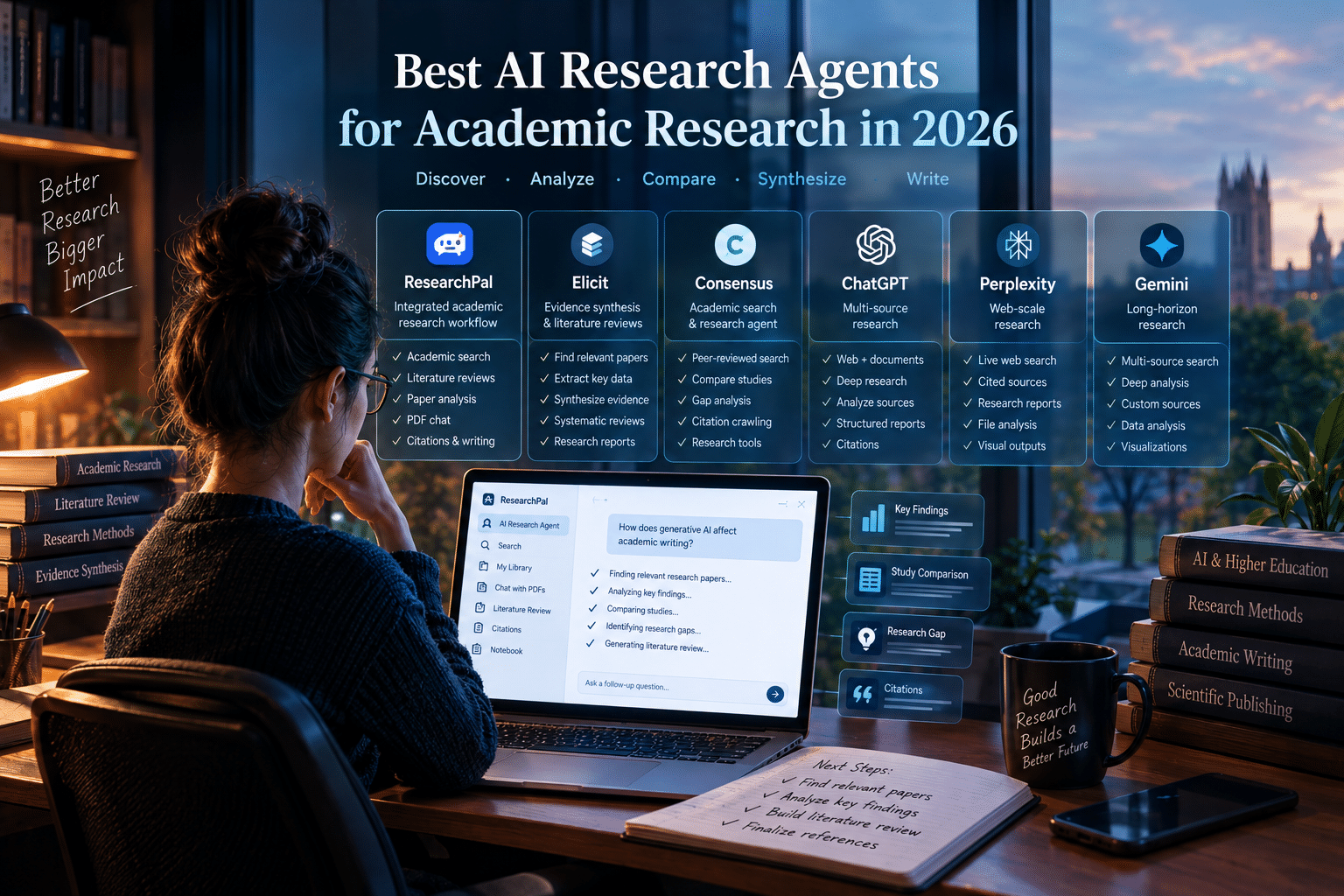
Academic research is becoming increasingly difficult to manage manually.
A single research project can involve finding hundreds of papers, screening abstracts, comparing methodologies, extracting findings, analyzing PDFs, managing references, identifying research gaps, and writing a literature review.
AI research agents are changing how researchers approach these tasks.
Instead of using AI only to generate text, researchers can now use agentic systems to search, retrieve, analyze, compare, synthesize, and organize information across multiple steps.
But not every AI research agent is designed for the same purpose.
Some are built specifically around academic literature. Others are general-purpose deep-research systems that search the broader web. Some focus heavily on systematic reviews, while others combine paper discovery, PDF analysis, citations, and writing in a single academic workspace.
This guide compares several major options available in 2026 and explains what each type of research agent is designed to do.
Quick Answer: What Are the Best AI Research Agents for Academic Research?
There is no single AI research agent that is best for every academic workflow.
The right option depends on your research requirements:
- ResearchPal — designed as an integrated academic research workspace covering discovery, literature reviews, paper analysis, PDFs, citations, and writing.
- Elicit — particularly focused on evidence synthesis, literature reviews, systematic-review workflows, and structured research reports.
- Consensus — focused on searching and synthesizing peer-reviewed research and now offers a multi-step Research Agent.
- ChatGPT Deep Research — useful for broad, multi-step research across the web, uploaded files, and connected sources.
- Perplexity Deep Research — designed for multi-source, cited research across the live web and user-provided information.
- Gemini Deep Research — designed for long-running research and synthesis across web and custom sources.
The important question is therefore not simply:
“Which AI research agent is number one?”
A more useful question is:
“Which research agent fits the way I actually conduct academic research?”
What Is an AI Research Agent?
An AI research agent is an AI system designed to perform or coordinate multiple steps involved in researching a question.
A conventional chatbot generally responds to a prompt.
An AI research agent can go further by planning a research process, searching for information, examining sources, refining queries, comparing evidence, and producing a structured output.
For academic research, that workflow can look like:
Research Question → Search → Source Discovery → Screening → Analysis → Comparison → Synthesis → Citations
Modern research agents increasingly combine several of these stages.
For example, Elicit’s Research Agent can search academic and other sources, extract information, analyze evidence, and create research outputs.
Consensus’s Research Agent can chain multiple research tools, including citation crawling, DOI lookup, author search, similar-paper discovery, study comparison, and gap analysis.
ResearchPal positions its AI Research Agent as a broader academic workspace that connects paper discovery, literature reviews, paper insights, PDF interaction, academic writing, and citation management.
Why AI Research Agents Matter for Academic Research
Academic research is not one task.
It is a chain of connected tasks.
Finding the Right Papers
Researchers often begin with keywords and databases.
The problem is that important papers may use different terminology from the original query.
AI-assisted discovery can help researchers explore related concepts and identify potentially relevant literature.
Understanding Complex Papers
Finding a paper is only the beginning.
Researchers may need to extract:
- Research questions
- Methodology
- Sample characteristics
- Variables
- Findings
- Limitations
- Contributions
- Conclusions
An AI research agent can help organize these details for closer examination.
Comparing Multiple Studies
Research becomes more meaningful when papers are compared.
Instead of reading every paper independently, researchers can create structured comparisons of:
Methods → Populations → Findings → Limitations → Conclusions
This can make recurring patterns and disagreements easier to investigate.
Building Literature Reviews
A literature review requires more than summarizing individual papers.
Researchers need to identify:
- Major themes
- Agreements
- Contradictions
- Methodological differences
- Research gaps
- Developments over time
Research agents can help organize these stages into a connected workflow.
How We Compare AI Research Agents
Rather than judging tools only by how impressive their generated answers look, academic researchers should examine the underlying research workflow.
Academic Source Coverage
Ask:
Where does the system get its research from?
Academic-focused platforms may search scholarly databases or curated research collections, while general deep-research tools may search across the broader web.
Both approaches can be useful, but they serve different purposes.
Research Depth
Can the system handle a multi-step question?
For example:
How has generative AI affected academic writing among university students, what methodologies have researchers used, and where does the current literature disagree?
That question requires more than finding one article.
Citation Traceability
Can you determine where an important claim came from?
This is particularly important in academic work.
A fluent answer without verifiable sources should not automatically be treated as reliable evidence.
Paper Analysis
Can the tool extract information from academic papers?
Useful capabilities include identifying:
- Methodology
- Findings
- Limitations
- Sample
- Research design
- Key contributions
Literature Review Support
Can the system move beyond individual summaries and help synthesize evidence across multiple papers?
PDF and Document Analysis
Researchers frequently work with papers that are not easily understood from abstracts alone.
PDF interaction can therefore be an important part of the workflow.
Research Organization
A useful research agent should ideally help researchers preserve discoveries instead of forcing them to start from zero each time.
Researcher Control
Researchers should be able to:
- Inspect sources
- Refine questions
- Reject irrelevant papers
- Review citations
- Correct outputs
- Verify important claims
AI should accelerate research without removing academic judgment.
1. ResearchPal — Integrated AI Research Workflow
ResearchPal is designed specifically around academic research rather than general web research.
Its AI Research Agent connects multiple research tasks inside one workspace.
What ResearchPal Can Do
According to ResearchPal’s current product information, its AI Research Agent supports:
- Academic paper discovery
- Literature reviews
- Paper insights
- PDF and document chat
- Academic writing
- Citation generation
- Research organization
ResearchPal says its academic search can search millions of papers across sources including PubMed, OpenAlex, and Semantic Scholar. It also supports citation formats including APA, Harvard, MLA, Chicago, and BibTeX.
Where ResearchPal Fits Best
ResearchPal is particularly relevant when a researcher wants to keep multiple stages of the academic workflow connected.
Instead of:
Search Tool → PDF Tool → Citation Tool → Writing Tool → Reference Manager
the intended workflow is:
Question → Papers → Analysis → Literature Review → Citations → Writing
The ResearchPal AI Research Agent is available as part of its academic research platform, with a free plan and paid tiers listed on its current pricing page.
Best For
Researchers who want an integrated academic research workflow rather than a standalone search or answer engine.
2. Elicit — Evidence Synthesis and Literature Reviews
Elicit is strongly focused on academic evidence synthesis.
Its current Research Agent is designed for complex research questions and can search academic papers, public sources, and uploaded data. Elicit says its research environment can search more than 138 million academic papers and supports structured research reports and evidence synthesis.
Elicit’s Research Workflow
Elicit’s current research tools cover several stages:
- Search for literature
- Screen papers
- Extract data
- Analyze evidence
- Synthesize findings
- Produce research outputs
Its systematic-review workflow also emphasizes reproducibility, screening criteria, extraction, and auditability.
Why Researchers Use It
Elicit is particularly relevant when the central challenge is:
“How do I systematically understand what the literature says?”
Its Reports workflow is designed to generate literature-focused research summaries, while its Research Agent extends the system toward more complex evidence-based research questions.
Best For
Literature reviews, evidence synthesis, systematic-review workflows, and structured academic evidence extraction.
3. Consensus — Academic Search and Research Agent
Consensus is an academic search platform focused on research evidence.
Consensus describes its database as containing more than 220 million peer-reviewed research papers and combines semantic and keyword search to find relevant studies.
In May 2026, Consensus introduced its Research Agent.
What Consensus Research Agent Does
Consensus says its Research Agent can:
- Plan searches
- Chain multiple research tools
- Search for similar papers
- Perform citation crawling
- Look up DOIs
- Search by author
- Compare studies
- Perform gap analysis
It can also apply filters such as recency, citation count, journal quartile, sample size, and study type using natural-language criteria.
Where Consensus Fits Best
Consensus is particularly useful when your starting point is:
“What does the scientific literature say about this question?”
It is especially relevant for researchers who want evidence-grounded academic search rather than general web answers.
Best For
Peer-reviewed literature discovery, evidence-backed questions, study comparison, and academic search.
4. ChatGPT Deep Research — Broad Multi-Source Research
ChatGPT includes Deep Research for complex, multi-step investigations.
OpenAI describes Deep Research as an agentic research capability that plans and performs multi-step searches, analyzes sources, and produces documented reports with citations. It can work with the public web, uploaded files, and supported connected sources.
What Makes It Different?
ChatGPT Deep Research is not limited to academic literature.
It can research questions involving:
- Academic studies
- Websites
- Reports
- Public data
- Uploaded documents
- Industry information
- Multiple source types
This makes it useful when academic research requires context beyond journal articles.
Example
Suppose you are researching:
How are universities adopting generative AI, what does the academic literature say, and what policies have institutions introduced in 2026?
That question combines academic literature with current institutional information.
A broader research agent can be useful because the evidence is distributed across multiple source types.
Best For
Broad, multi-source research where academic papers need to be combined with current web information, documents, or other sources.
5. Perplexity Deep Research — Web-Scale Research
Perplexity offers Deep Research for complex questions.
Its current Deep Research system creates a research plan, searches across sources, and produces cited reports. Perplexity says its system can use files alongside live web information and can create outputs such as reports, slide decks, spreadsheets, and dashboards in its Computer environment.
Where It Fits in Academic Research
Perplexity can be useful when academic research requires significant current web research.
For example:
“How have universities implemented AI policies since 2025?”
This may require:
- University policy documents
- Official announcements
- News reports
- Institutional pages
- Research papers
That is a different problem from conducting a purely academic literature search.
Best For
Current, web-heavy research that combines academic sources with broader online evidence.
6. Gemini Deep Research — Long-Horizon Research and Synthesis
Google Gemini offers Deep Research capabilities designed for longer research workflows.
Google describes its Deep Research and Deep Research Max agents as systems for long-horizon research, with support for web or custom sources, iterative investigation, and synthesis.
What It Can Be Useful For
A researcher may use a broad research agent when a question requires:
- Extensive web exploration
- Multiple rounds of searching
- Custom data
- Long reports
- Data analysis
- Visualizations
This makes it more comparable to general-purpose deep-research agents than to narrowly academic literature platforms.
Best For
Long-running research tasks that require broad source exploration, custom data, and synthesis.
AI Research Agents Compared
The following comparison focuses on workflow orientation, not an overall winner.
| Research Agent | Main Strength | Academic Literature | Literature Review | PDF / Document Work | Broad Web Research | Research Workflow |
|---|---|---|---|---|---|---|
| ResearchPal | Integrated academic workflow | Strong | Strong | Strong | Supporting | Strong |
| Elicit | Evidence synthesis | Strong | Strong | Strong | Supporting | Strong |
| Consensus | Academic search | Strong | Strong | Supporting | Limited/Supporting | Strong |
| ChatGPT Deep Research | Multi-source investigation | Strong when configured | Strong | Strong | Strong | Strong |
| Perplexity Deep Research | Web-scale research | Supporting | Supporting | Strong | Strong | Strong |
| Gemini Deep Research | Long-horizon research | Supporting | Supporting | Strong | Strong | Strong |
The distinction is important.
An academic research platform and a general deep-research agent may both produce a cited report, but they can approach the problem from different directions.
Academic-first tools emphasize scholarly literature.
General research agents emphasize broader information gathering and synthesis.
Which AI Research Agent Should Students Use?
Students often have a different workflow from professional researchers.
A student may need to:
- Understand a topic
- Find academic papers
- Read difficult studies
- Build a literature review
- Generate citations
- Organize references
- Write an assignment or research paper
An integrated academic platform can therefore be useful because the student does not need to switch between as many separate tools.
For example, ResearchPal combines academic search, literature reviews, paper analysis, PDF interaction, citations, and writing in one environment.
However, students should still read the original papers and follow their university’s rules regarding AI-assisted academic work.
Which AI Research Agent Should PhD Researchers Use?
PhD research often requires deeper literature analysis and greater methodological control.
Important requirements may include:
- Comprehensive literature discovery
- Systematic search strategies
- Evidence extraction
- Citation tracking
- Research-gap analysis
- Method comparison
- Long-term organization
Elicit’s systematic-review features can be relevant where structured screening and evidence extraction are central.
Consensus can be useful for exploring peer-reviewed research and comparing studies.
ResearchPal can be useful when the researcher wants to connect discovery, paper analysis, PDF interaction, literature reviews, citations, and writing in one workspace.
The right choice depends on the specific dissertation workflow and methodological requirements.
Which AI Research Agent Is Best for Literature Reviews?
Literature-review work requires more than generating paragraphs.
A useful workflow includes:
Step 1: Define the Research Question
Start with a clear question and scope.
Step 2: Develop Search Terms
Identify:
- Keywords
- Synonyms
- Related concepts
- Alternative terminology
Step 3: Find the Literature
Search relevant academic databases and research indexes.
Step 4: Screen Studies
Determine which papers actually fit the research question.
Step 5: Extract Evidence
Record:
- Methods
- Population
- Findings
- Limitations
- Variables
- Study design
Step 6: Compare Studies
Look for patterns and disagreements.
Step 7: Synthesize
Organize the evidence around themes rather than producing a list of summaries.
Step 8: Verify
Check important claims against the original studies.
For this workflow, academic-first platforms such as ResearchPal, Elicit, and Consensus can be particularly relevant, while broader deep-research agents can add useful context from outside the academic literature.
AI Research Agent vs AI Chatbot
The difference can be summarized simply.
| AI Chatbot | AI Research Agent |
|---|---|
| Answers prompts | Executes multi-step research workflows |
| Primarily conversational | Task-oriented |
| May rely on supplied context | Can retrieve external sources |
| Good for explanations | Designed for research processes |
| Often one response at a time | Can plan and execute multiple steps |
| Research organization varies | Often includes research-specific tools |
The distinction is not absolute.
Modern AI chatbots increasingly include agentic research features.
For example, ChatGPT’s Deep Research can plan searches, inspect sources, and produce a documented report rather than simply answering from the current conversation.
The important distinction is therefore capability, not the label used by a product.
How to Choose an AI Research Agent
Before choosing a research agent, ask seven questions.
1. Does It Search Academic Sources?
If your project is primarily scholarly, academic source coverage should be one of your first considerations.
2. Can You Verify the Evidence?
Every important claim should be traceable to a source.
3. Can It Analyze Full Papers?
Abstract-level discovery is useful, but many research questions require full-text analysis.
4. Can It Compare Studies?
A good literature review depends on comparison and synthesis.
5. Can It Handle Your Research Workflow?
Look beyond one impressive feature.
Ask whether the platform supports:
Discovery → Analysis → Organization → Writing → Citations
6. Can You Keep Your Research Organized?
Long projects create large collections of papers, PDFs, notes, and citations.
Organization becomes increasingly important as the project grows.
7. Does It Keep the Researcher in Control?
AI should support academic judgment rather than replace it.
Researchers should verify sources, evaluate methodology, and make final decisions about what evidence belongs in their work.
How to Use AI Research Agents Responsibly
AI research agents can make research faster, but speed should not replace verification.
Verify Important Claims
Read the original source before relying on an important finding.
Check Citations
Make sure the cited paper actually supports the claim being made.
Distinguish Summary From Interpretation
An AI-generated interpretation may not be identical to the authors’ conclusion.
Check Research Methods
Do not assume that a study is strong simply because an AI system summarizes it clearly.
Avoid Treating Search Absence as Proof
If an AI agent cannot find evidence for a topic, that does not automatically mean that no research exists.
Try:
- Alternative keywords
- Different databases
- Citation searching
- Author searching
- Reference lists
- Recent publications
Follow Institutional Policies
Universities and journals may have specific rules governing AI-assisted research and writing.
Always check the requirements that apply to your work.
A Practical AI Research Workflow for 2026
A modern research workflow can combine several approaches.
Phase 1: Explore
Start with a broad research question.
Use an AI research agent to identify:
- Key concepts
- Important terminology
- Major papers
- Research themes
Phase 2: Search
Run targeted academic searches.
Use synonyms and Boolean queries alongside semantic search where appropriate.
Phase 3: Build a Seed Collection
Save the most relevant papers.
These become the foundation for deeper exploration.
Phase 4: Analyze
Extract:
- Methodology
- Findings
- Limitations
- Contributions
Phase 5: Compare
Place studies side by side.
Ask:
Where do they agree?
Where do they disagree?
Why might their findings differ?
Phase 6: Expand
Follow:
- References
- Citations
- Similar papers
- Authors
- Research clusters
Phase 7: Synthesize
Organize evidence into themes and arguments.
Phase 8: Write
Develop the literature review, research proposal, thesis section, or academic paper.
Phase 9: Verify
Return to the original sources and verify important claims and citations.
The resulting workflow becomes:
Question → Search → Discover → Analyze → Compare → Synthesize → Write → Verify
Why an Integrated AI Research Agent Can Be Useful
One of the biggest problems with academic technology is fragmentation.
A researcher might use one service for:
Paper Search
another for:
PDF Analysis
another for:
Citation Generation
another for:
Literature Reviews
and another for:
Writing
Switching between tools creates friction.
An integrated research environment attempts to reduce those transitions.
ResearchPal describes its AI Research Agent as a single research workspace where users can discover academic papers, generate literature reviews, extract paper insights, chat with PDFs, improve academic writing, and manage citations.
The value is therefore not simply:
“AI writes faster.”
It is:
“More stages of the research workflow remain connected.”
Frequently Asked Questions
What is the best AI research agent for academic research in 2026?
There is no single best option for every academic workflow. ResearchPal, Elicit, Consensus, ChatGPT Deep Research, Perplexity Deep Research, and Gemini Deep Research serve different research needs. The appropriate choice depends on whether you prioritize academic literature, evidence synthesis, broad web research, document analysis, or an integrated research workflow.
What is the best AI research agent for literature reviews?
Literature reviews benefit from tools that can search academic papers, screen studies, extract evidence, compare findings, and support synthesis. Elicit is strongly focused on evidence synthesis and systematic-review workflows, while ResearchPal and Consensus also provide academic research and literature-review capabilities.
What is the best AI research agent for students?
Students should consider an agent that combines paper discovery, paper analysis, literature-review support, citations, and writing while remaining easy to verify. An integrated academic platform can reduce the need to switch between multiple research tools.
Can AI research agents find academic papers?
Yes. Academic-focused agents such as Elicit and Consensus are specifically designed around scholarly literature discovery. ResearchPal also provides academic paper search through sources including PubMed, OpenAlex, and Semantic Scholar.
Can AI research agents analyze research papers?
Yes. Depending on the tool, they can extract information such as methodology, findings, limitations, tables, figures, and conclusions. Researchers should still inspect the original paper when making important academic claims.
Can AI research agents identify research gaps?
They can help identify potential gaps by comparing findings, populations, methodologies, limitations, and unanswered questions. A potential gap should be validated with additional literature searching before being treated as an established research gap.
Are AI research agents reliable for academic research?
Reliability varies by tool, source coverage, retrieval quality, model behavior, and task. Researchers should verify important claims against original academic sources and check whether citations genuinely support the statements made.
Can an AI research agent replace a literature review?
No. AI can accelerate discovery, screening, extraction, comparison, and drafting, but a rigorous literature review still requires human judgment, appropriate search methodology, source evaluation, interpretation, and verification.
What is the difference between an AI research agent and an academic search engine?
An academic search engine primarily helps researchers discover scholarly papers. An AI research agent can go beyond discovery by coordinating multiple steps such as searching, analyzing, comparing, synthesizing, and producing structured research outputs.
Is ResearchPal an AI research agent?
Yes. ResearchPal currently presents its AI Research Agent as an academic research assistant that connects paper discovery, literature reviews, paper insights, PDF interaction, academic writing, and citations within one research workspace.
Final Thoughts
AI research agents are moving academic AI beyond simple question answering.
The emerging workflow is increasingly:
Ask → Search → Analyze → Compare → Synthesize → Cite → Write
But different tools approach that workflow differently.
Academic-first platforms such as ResearchPal, Elicit, and Consensus emphasize scholarly literature and research-specific workflows, while broader systems such as ChatGPT Deep Research, Perplexity Deep Research, and Gemini Deep Research can be useful when research requires information from the wider web and other source types.
The best choice depends on the research problem.
If your primary need is systematic evidence synthesis, evaluate tools around screening, extraction, traceability, and synthesis.
If you need broad current information, consider the breadth of web research and source controls.
If you want one environment connecting academic discovery, paper analysis, PDFs, literature reviews, citations, and writing, an integrated academic research agent may fit the workflow better.
Most importantly, AI should remain part of the research process—not a replacement for research judgment.
The researcher still decides:
What question matters.
Which evidence is relevant.
Which methods are credible.
What the findings actually mean.
What should ultimately be cited and written.
The role of an AI research agent is to help researchers get from question to evidence to insight with less repetitive work and a more connected research workflow.