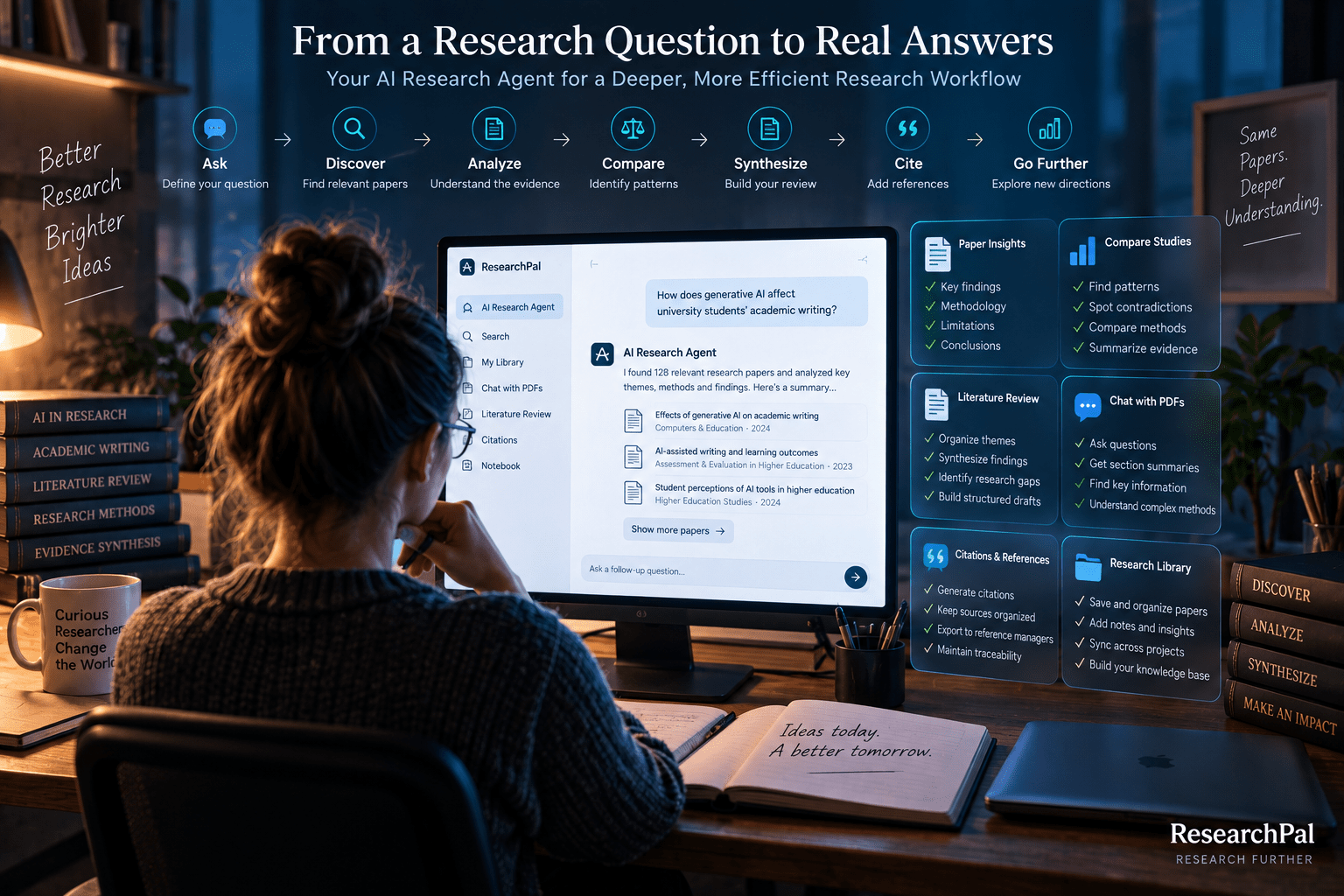
Academic research rarely involves a single task.
A researcher might begin with a broad question, search for relevant papers, read dozens of abstracts, compare methodologies, extract findings, investigate contradictory evidence, organize references, build a literature review, and finally start writing.
Traditionally, these activities happen across different tools.
One platform searches papers. Another manages references. PDFs are read separately. Notes live somewhere else. A general-purpose AI chatbot may help explain concepts, but the researcher still has to move information between systems.
AI research agents are emerging as a different approach.
Instead of treating research as a collection of isolated tasks, an AI research agent can assist across multiple stages of the research process.
The goal is not simply to answer a prompt.
It is to help move from:
Question → Search → Evidence → Analysis → Synthesis → Writing → Citations
For students, PhD researchers, academics, and professional researchers, this represents an important shift from using AI as a simple chatbot toward using AI as part of a connected research workflow.
Quick Answer: What Is an AI Research Agent?
An AI research agent is an AI-powered system designed to assist with multiple stages of research rather than performing only a single isolated task.
Depending on the platform, an AI research agent may help researchers formulate questions, discover academic papers, analyze studies, compare evidence, explore PDFs, identify research gaps, generate literature reviews, manage citations, and support academic writing.
The important distinction is that an AI research agent is designed around a research process, not simply a question-and-answer conversation.
AI Research Agent vs Traditional AI Chatbot
At first glance, an AI research agent can look similar to a chatbot.
You enter a question.
The system responds.
But the underlying research workflow can be very different.
A general AI chatbot is primarily conversational. It can explain concepts, brainstorm ideas, summarize supplied information, and help with writing.
A research agent is designed to connect that conversational interface with research-specific actions and evidence.
| Capability | General AI Chatbot | AI Research Agent |
|---|---|---|
| Answer questions | Yes | Yes |
| Explain concepts | Yes | Yes |
| Academic paper discovery | Varies | Core research function |
| Work with research PDFs | Varies | Often integrated |
| Extract paper methodology | Requires context/tools | Research-oriented |
| Compare studies | Possible with supplied information | Can be part of workflow |
| Literature review support | General generation | Evidence-oriented workflow |
| Citation management | Usually limited | Can be integrated |
| Research library | Usually separate | Can be connected |
| Multi-step research workflow | Limited/varies | Central concept |
The difference can be summarized simply:
A chatbot answers a question.
A research agent helps carry the question through a research workflow.
That does not mean every product using the word “agent” has identical capabilities. Researchers should evaluate what a particular system can actually search, retrieve, analyze, cite, and verify.
Why Researchers Need More Than a Chatbot
Academic research is fundamentally evidence-driven.
Consider the question:
How does generative AI affect academic writing among university students?
A chatbot could provide an immediate explanation.
But a researcher needs much more.
They may need to know:
- Which studies have investigated the question?
- Which papers are recent?
- What populations were studied?
- What methods did researchers use?
- Where do the findings agree?
- Where do they contradict each other?
- What limitations appear repeatedly?
- What evidence supports each conclusion?
- Which references should be cited?
- What questions remain unanswered?
That turns one apparently simple question into multiple research tasks.
An AI research agent is useful when it can help connect those tasks rather than treating every prompt as an isolated conversation.
How Does an AI Research Agent Work?
Different research agents use different architectures, data sources, models, retrieval systems, and workflows.
At a conceptual level, however, the process can be understood as a sequence.
Step 1: Understand the Research Question
The process starts with researcher intent.
A user might enter:
What are the effects of generative AI on student learning in higher education?
The system needs to identify important concepts such as:
- Generative AI
- Student learning
- Higher education
- Educational outcomes
A useful research assistant may also help narrow an overly broad question before searching.
Step 2: Search for Relevant Research
The next stage is evidence discovery.
Instead of producing an answer entirely from model knowledge, a research-oriented system can retrieve potentially relevant scholarly publications.
ResearchPal, for example, provides academic-paper discovery and currently describes search across academic sources including PubMed, OpenAlex, and Semantic Scholar as part of its research workflow.
The purpose is to move from:
Question → Generated answer
toward:
Question → Relevant sources → Evidence-based analysis
Step 3: Evaluate Candidate Papers
Finding papers is not enough.
Search results need to be assessed for relevance.
Researchers may consider:
- Title
- Abstract
- Publication year
- Research question
- Population
- Method
- Dataset
- Findings
- Availability of the full text
A paper that contains the right keywords may still be irrelevant to the actual research question.
Step 4: Extract Research Evidence
Once useful papers have been identified, an AI research agent can help extract structured information.
For example:
Paper A
- Method: Randomized experiment
- Population: University students
- Finding: Improved task completion
- Limitation: Small sample
Paper B
- Method: Survey
- Population: Postgraduate students
- Finding: Higher perceived productivity
- Limitation: Self-reported outcomes
This is much easier to compare than repeatedly moving between PDFs and manually reconstructing every study.
Step 5: Compare Studies
Research becomes valuable when individual papers are connected.
A research agent may help compare:
- Methods
- Populations
- Datasets
- Findings
- Limitations
- Contributions
- Contradictions
This supports one of the most important transitions in academic research:
Summary → Synthesis
Step 6: Generate Structured Research Outputs
Once evidence has been collected and compared, the system can help organize it into outputs such as:
- Literature-review sections
- Evidence tables
- Research summaries
- Method comparisons
- Research-gap discussions
- Outlines
- Academic drafts
Researchers should still evaluate these outputs critically and verify important claims against the underlying papers.
Step 7: Connect Evidence With Citations
Academic research requires traceability.
A useful research workflow should make it possible to move from a claim back to its supporting source.
That makes citations more than a formatting problem.
They become part of the evidence chain:
Claim → Evidence → Paper → Reference
What Can an AI Research Agent Do?
The exact capabilities depend on the platform, but several research tasks are particularly relevant.
1. Find Academic Papers
Research discovery is often the first major bottleneck.
Researchers may spend considerable time trying:
- Different keywords
- Synonyms
- Boolean queries
- Citation trails
- Author searches
- Related-paper searches
AI-supported academic discovery can help researchers explore a question using natural language and identify potentially relevant papers.
This is particularly useful when the researcher does not yet know all the terminology used by a field.
2. Analyze Research Papers
Finding a paper does not mean understanding it.
Academic papers may contain dense:
- Methodologies
- Statistical analyses
- Theoretical frameworks
- Tables
- Results
- Limitations
Research agents can help extract structured information from papers so researchers can identify what deserves closer examination.
3. Compare Multiple Studies
Imagine manually comparing 30 papers.
For every study, you might need to record:
Author | Year | Population | Method | Dataset | Findings | Limitations
Structured AI-assisted extraction can reduce the repetitive work involved in creating that initial comparison.
The researcher can then focus more attention on interpreting the differences.
4. Support Literature Reviews
A literature review is not simply a collection of paper summaries.
A strong review should identify:
- Themes
- Agreements
- Contradictions
- Methodological patterns
- Limitations
- Changes over time
- Research gaps
An AI research agent can support the process by helping researchers move between paper discovery, analysis, comparison, and synthesis.
5. Explore Research Gaps
Research gaps should not be generated from imagination.
They should emerge from evidence.
A useful workflow might look like:
Search Literature → Compare Studies → Examine Limitations → Identify Missing Populations/Methods/Questions → Investigate Further → Formulate Potential Gap
AI can help organize this process, but researchers need to judge whether a proposed gap is genuinely underexplored.
6. Chat With Research Papers
Instead of manually searching through a long PDF every time a question appears, researchers can interact with uploaded papers conversationally.
Questions might include:
- What methodology does this study use?
- What are the main findings?
- What limitations do the authors report?
- What population was studied?
- What does Table 3 show?
- Where does the paper support this conclusion?
ResearchPal’s PDF workflow is designed around this type of paper-grounded interaction, including questions about methods, findings, limitations, contributions, and implications.
7. Manage References and Citations
Research discovery creates another problem:
organization.
Ten papers can be manageable.
One hundred papers are much harder.
Research agents become more useful when discovered papers, citations, PDFs, notes, and analysis remain connected rather than being scattered across unrelated tools.
8. Support Academic Writing
Research and writing are closely connected.
After gathering evidence, researchers may need help developing:
- Outlines
- Research proposals
- Literature-review sections
- Arguments
- Abstracts
- Academic prose
AI can support drafting and editing, but evidence-backed academic writing still requires researchers to verify claims, interpret findings responsibly, and follow institutional requirements.
AI Research Agents and Literature Reviews
Literature reviews are one of the clearest applications of research agents because they involve many connected tasks.
A traditional workflow can look like:
Search database
↓
Download papers
↓
Read abstracts
↓
Create spreadsheet
↓
Take notes
↓
Compare papers
↓
Open reference manager
↓
Start writing
↓
Add citations
Each transition creates friction.
An agentic workflow attempts to connect more of these stages:
Research Question → Discover Papers → Analyze → Compare → Synthesize → Cite
ResearchPal’s literature-review workflow, for example, is designed to search academic literature, synthesize findings, connect results with citations, and save research into a library that can be revisited as the project develops.
The researcher remains responsible for deciding whether the selected evidence is appropriate and whether the synthesis accurately represents the literature.
AI Research Agents and Academic Search
Academic search has traditionally been query-centred.
Researchers enter keywords and receive results.
That approach remains essential, particularly for precise and reproducible search strategies.
AI research agents add another layer by allowing the researcher to interact with the discovery process.
Instead of stopping at:
Search → Results
the workflow can continue:
Search → Results → Ask → Refine → Explore → Analyze → Save
ResearchPal’s academic search currently allows searching by keywords, topics, or complete research questions, with filters including publication year, field, and open-access availability. Relevant papers can then be saved into the broader research workflow.
Can AI Research Agents Find Research Gaps?
They can help—but this requires careful interpretation.
Suppose several papers repeatedly report that:
- Samples are small
- Research focuses on one country
- Longitudinal evidence is limited
- A particular population has rarely been studied
An AI system can help researchers identify those recurring patterns.
But that does not automatically prove a research gap exists.
Before declaring:
“No research has studied X”
a researcher should conduct additional targeted searches.
A safer workflow is:
Potential Gap → Targeted Search → Citation Search → Recent Literature Check → Confirm or Reject Gap
AI can accelerate gap exploration.
It should not turn absence from one search into proof of absence from the literature.
What Makes a Good AI Research Agent?
Not every AI research tool needs every possible feature.
But researchers should evaluate several important characteristics.
Evidence Grounding
Can you identify the research supporting important claims?
An academically useful answer should make it possible to inspect the evidence rather than simply trust fluent prose.
Source Quality
Where does the research come from?
Researchers should understand which databases, indexes, repositories, uploaded files, or other sources a tool searches.
Traceability
Can you move from an AI-generated statement back to the source?
Traceability becomes increasingly important when AI is used for academic work.
Research-Specific Analysis
Can the system identify useful scholarly information such as:
- Methods
- Findings
- Limitations
- Contributions
- Datasets
rather than merely producing a generic summary?
Citation Support
Can identified sources remain connected to citations and references?
Research Organization
Can researchers save and revisit useful papers?
Human Control
Can researchers inspect, edit, reject, refine, and verify AI-generated material?
The strongest research workflow keeps the researcher in control of academic judgment.
AI Research Agent vs Academic Search Engine
An academic search engine and AI research agent perform related but different roles.
An academic search engine primarily helps answer:
“Which papers match my search?”
A research agent can help continue the process:
“Which papers matter, what do they say, how do they compare, and what should I investigate next?”
The relationship can therefore be viewed as:
Academic Search = Discovery
AI Research Agent = Discovery + Interaction + Analysis + Workflow
Researchers may still need specialist databases, particularly when conducting systematic or discipline-specific searches.
The agent does not eliminate databases.
It can provide another layer around the research process.
AI Research Agent vs AI Research Assistant
The terms AI research agent and AI research assistant are sometimes used interchangeably.
However, “agent” often implies a greater ability to coordinate tasks or move through multiple steps toward an objective.
A simple assistant might respond:
“Here are some keywords you could search.”
A more agentic system might help:
Interpret question → Search papers → Examine evidence → Structure findings → Continue investigation
The important question is not what the product calls itself.
Ask:
What can it actually do with my research?
What AI Research Agents Should Not Replace
AI research agents can reduce repetitive work, but several parts of academic research remain fundamentally human responsibilities.
Critical Judgment
A system can surface a paper.
The researcher decides whether it is credible, relevant, and appropriate.
Methodological Evaluation
A summary of a methodology is not the same as evaluating whether the methodology is suitable.
Interpretation
Two studies can produce apparently contradictory results because of differences in:
- Population
- Measurement
- Dataset
- Context
- Statistical method
- Study design
Understanding those differences requires domain judgment.
Source Verification
Important claims should be checked against the original research.
Research Ethics
Researchers remain responsible for complying with university, journal, funder, and disciplinary rules governing AI use, authorship, attribution, data handling, and research integrity.
How ResearchPal’s AI Research Agent Fits Into the Workflow
ResearchPal’s AI Research Agent is designed around a connected academic workflow rather than a standalone chatbot.
Its current research environment connects the agent with capabilities for academic-paper discovery, literature reviews, paper analysis, PDF interaction, citations, research organization, and academic writing.
A researcher can therefore move through a workflow such as:
Ask a Research Question
↓
Discover Academic Papers
↓
Evaluate Relevant Studies
↓
Extract Paper Insights
↓
Compare Evidence
↓
Explore PDFs
↓
Build a Literature Review
↓
Manage References
↓
Develop Academic Writing
ResearchPal also supports research-library workflows and imports from Zotero and Mendeley, helping keep discovered papers and research materials connected to later analysis.
The objective is not to remove the researcher from research.
It is to reduce the friction between the stages of research.
A Practical AI Research Agent Workflow
Suppose a postgraduate student is investigating:
How does generative AI affect critical thinking among university students?
Stage 1: Define
Begin with the broad question.
Use the research agent to explore related concepts and determine whether the question needs narrowing.
Stage 2: Discover
Search for relevant academic literature.
Look for different terminology, recent papers, foundational studies, and related research areas.
Stage 3: Screen
Examine titles and abstracts.
Remove papers that are clearly outside the research question.
Stage 4: Analyze
Extract useful information from promising studies:
- Population
- Method
- Findings
- Limitations
- Contribution
Stage 5: Compare
Look across the evidence.
Which findings recur?
Which contradict each other?
Do methodological differences explain the disagreement?
Stage 6: Investigate
Ask follow-up questions.
Explore individual PDFs when a result needs closer examination.
Stage 7: Organize
Save useful papers and citations into the research library.
Stage 8: Synthesize
Organize the evidence into themes rather than simply summarizing one paper after another.
Stage 9: Write
Develop the argument while keeping evidence connected to its sources.
Stage 10: Verify
Before submission, check important claims, quotations, citations, and interpretations against the original research.
That final step remains essential.
How to Use an AI Research Agent Responsibly
The fastest research workflow is not necessarily the best one.
Researchers should use AI to remove unnecessary friction while preserving academic rigor.
A useful principle is:
Automate retrieval and organization. Preserve human judgment.
Before using AI-generated research material in academic work:
- Check the source.
- Read the relevant evidence.
- Verify the citation.
- Evaluate the methodology.
- Distinguish the paper’s conclusions from the AI’s interpretation.
- Follow your institution’s AI-use policy.
The purpose of an AI research agent should be to make serious research easier to conduct—not to make verification optional.
Frequently Asked Questions
What is an AI research agent?
An AI research agent is an AI-powered system designed to assist with multiple stages of research, such as question development, academic search, paper analysis, evidence comparison, literature reviews, PDF exploration, citations, and writing.
How is an AI research agent different from ChatGPT or another chatbot?
A general chatbot primarily provides conversational responses. An AI research agent is designed around research-specific workflows and may connect conversations with academic search, source retrieval, document analysis, research organization, citations, and other scholarly tasks.
Can an AI research agent find academic papers?
Some can. Research-focused agents may integrate academic search or retrieval systems that allow users to discover papers related to a topic or research question.
Can an AI research agent write a literature review?
AI research agents can support literature-review workflows by finding studies, extracting information, comparing evidence, identifying themes, and assisting with synthesis. Researchers should verify the selected evidence and final interpretation against the original literature.
Can AI research agents find research gaps?
They can help identify potential gaps by comparing study limitations, populations, methodologies, and unanswered questions. A potential gap should then be validated through targeted literature searching before being presented as a genuine research gap.
Are AI research agents reliable?
Reliability depends on the system, task, sources, retrieval process, and how outputs are verified. Researchers should prefer transparent, source-grounded workflows and check important claims against original academic sources.
Can PhD students use AI research agents?
AI research agents can assist PhD students with literature discovery, paper analysis, evidence organization, research-question exploration, literature reviews, and academic writing workflows. Students should follow their university’s policies regarding acceptable AI use.
Can AI research agents replace researchers?
No. Research requires critical judgment, methodological evaluation, interpretation, originality, ethics, and accountability. AI agents can automate or assist parts of the workflow but do not remove the researcher’s responsibility for the work.
What should I look for in an AI research agent?
Look for academic source discovery, evidence grounding, traceability, paper analysis, citation support, research organization, PDF interaction, and meaningful researcher control over generated outputs.
What is the ResearchPal AI Research Agent?
ResearchPal’s AI Research Agent is an academic-focused assistant integrated with ResearchPal’s broader research workspace. It connects research conversations with academic-paper discovery, literature-review workflows, paper analysis, PDF interaction, citations, research organization, and academic writing tools.
Final Thoughts
The most important change introduced by AI research agents is not simply faster text generation.
It is the possibility of connecting previously fragmented research activities.
Traditional research software often asks the researcher to move repeatedly between:
- Search engines
- PDF readers
- Spreadsheets
- Reference managers
- Writing tools
- AI chatbots
An AI research agent attempts to create a more connected process:
Question → Evidence → Understanding → Synthesis → Writing
That can save researchers substantial repetitive work.
But speed should never come at the cost of research quality.
The strongest model is not:
AI does the research.
It is:
AI handles more of the research workflow while the researcher remains responsible for judgment, verification, interpretation, and academic integrity.
For researchers who want to explore this workflow directly, the ResearchPal AI Research Agent brings academic search, paper analysis, literature-review support, PDF interaction, citations, and research organization into one research-focused environment.