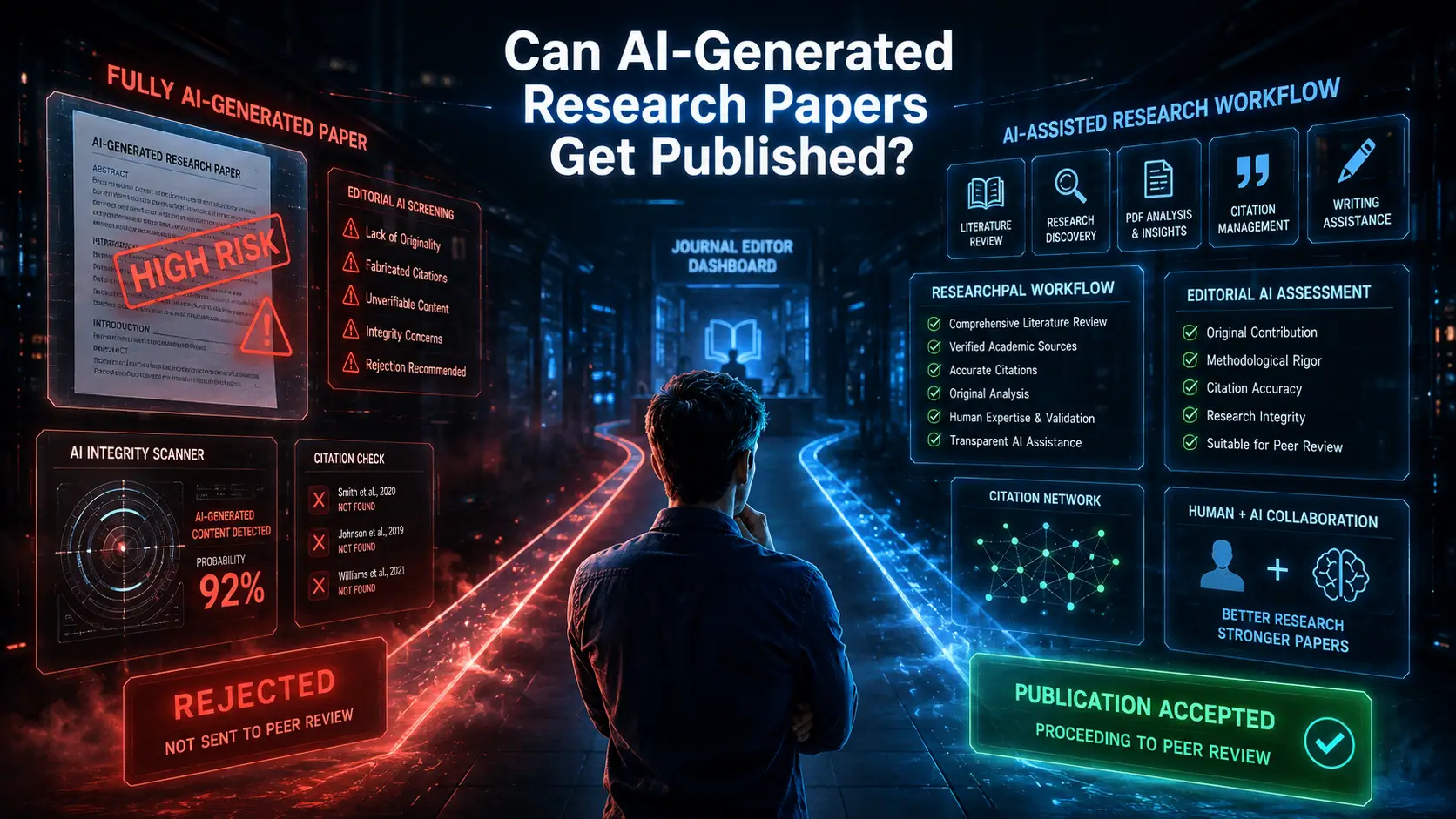
Artificial intelligence is transforming academic research faster than ever before. Researchers now use AI tools to generate literature reviews, summarize papers, improve writing, analyze PDFs, manage citations, and even draft entire sections of manuscripts.
This has created one of the most debated questions in academia:
Can AI-generated research papers actually get published?
The answer is more nuanced than a simple yes or no.
In 2026, many journals allow the use of AI during the research and writing process. However, fully AI-generated papers face significant challenges related to originality, accuracy, transparency, ethics, and research integrity.
Understanding where journals draw the line is essential for modern researchers.
The Short Answer
Can AI Help Write a Publishable Research Paper?
✅ Yes.
Can AI Be Listed as an Author?
❌ No.
Can Researchers Submit a Fully AI-Generated Paper Without Review?
❌ Extremely risky.
Can AI Assist Researchers Throughout the Publication Process?
✅ Absolutely.
The distinction between AI-assisted research and AI-generated research is what matters.
Why This Question Matters
Researchers are increasingly using AI for:
- Literature reviews
- Research discovery
- Citation generation
- Academic writing
- Data analysis support
- Manuscript refinement
At the same time, journals are introducing stricter AI disclosure policies.
Editors now ask:
- Was AI used?
- How was it used?
- Who verified the output?
- Is the research still original?
What Most Journals Allow
Most journals now permit researchers to use AI for:
Writing Assistance
AI can help:
- Improve clarity
- Fix grammar
- Enhance readability
- Improve structure
Literature Review Support
AI tools can:
- Summarize papers
- Compare studies
- Identify themes
- Highlight research gaps
Citation Assistance
Researchers can use AI to:
- Format references
- Organize citations
- Build bibliographies
Research Organization
AI can help manage:
- Notes
- PDFs
- References
- Research libraries
What Most Journals Do NOT Allow
AI as an Author
Leading publishers generally prohibit listing AI as an author because AI cannot:
- Take responsibility
- Verify findings
- Respond to reviewers
- Accept ethical accountability
Fabricated Citations
One of the biggest concerns is AI-generated fake references.
Editors increasingly screen manuscripts for:
- Nonexistent sources
- Incorrect citations
- Citation manipulation
AI-Generated Data
Submitting fabricated datasets or results generated by AI without disclosure is a serious ethical violation.
Fully Unverified AI Content
Researchers remain responsible for every sentence submitted.
“AI wrote it” is not an acceptable defense if inaccuracies are found.
Why Fully AI-Generated Papers Struggle
AI is powerful, but it still has limitations.
1. Lack of Original Research
AI generates content from existing knowledge.
It does not conduct:
- Experiments
- Surveys
- Fieldwork
- Novel discoveries
2. Citation Hallucinations
Some AI systems still generate:
- Fake papers
- Incorrect authors
- Invalid references
3. Weak Academic Reasoning
AI can summarize existing knowledge, but it often struggles with:
- Novel contributions
- Theoretical frameworks
- Complex arguments
4. Ethical Risks
Journals increasingly use AI-assisted screening systems to identify:
- AI-generated content
- Fabricated citations
- Integrity concerns
How Researchers Are Successfully Using AI
The most successful researchers use AI as a collaborator—not a replacement.
AI helps with:
Research Discovery
Finding relevant papers faster.
Literature Reviews
Synthesizing large volumes of research.
Citation Management
Organizing references efficiently.
Writing Enhancement
Improving readability and academic tone.
Publication Preparation
Preparing manuscripts for submission.
Competitor Comparison: AI Tools for Research Publishing
| Feature | ResearchPal | SciSpace | Elicit | Jenni AI |
|---|---|---|---|---|
| Literature Review Generation | ✅ Advanced | ⚠️ Moderate | ✅ Strong | ❌ Limited |
| Search Academic Papers | ✅ Yes | ⚠️ Basic | ✅ Strong | ❌ No |
| Citation Generator | ✅ Yes | ❌ No | ❌ No | ⚠️ Limited |
| PDF Chat & Analysis | ✅ Yes | ✅ Yes | ❌ No | ❌ No |
| Research Library Management | ✅ Yes | ❌ No | ❌ No | ❌ No |
| Paper Insights | ✅ Yes | ⚠️ Limited | ❌ No | ❌ No |
| Academic Writing Assistance | ✅ Strong | ⚠️ Moderate | ❌ Limited | ✅ Strong |
| End-to-End Research Workflow | ✅ Complete | ⚠️ Partial | ⚠️ Partial | ❌ No |
Why ResearchPal Is Different
Most AI tools focus on a single task:
- Writing
- Searching papers
- Reading PDFs
ResearchPal is designed to support the entire research lifecycle.
Researchers can:
Generate Literature Reviews
Create structured reviews from relevant academic sources.
Search Academic Papers
Discover papers using AI-powered search.
Chat With PDFs
Ask questions directly from research papers.
Manage Research Libraries
Store and organize papers in one place.
Generate Citations
Create citations and references efficiently.
Extract Research Insights
Analyze methodologies, findings, limitations, and contributions.
Improve Academic Writing
Refine manuscripts before submission.
Instead of replacing researchers, ResearchPal helps researchers work more efficiently while maintaining academic integrity.
What Journal Editors Think About AI in 2026
Most editors are not opposed to AI.
They are opposed to:
- Hidden AI use
- Fabricated research
- Fake citations
- Unverified claims
Editors generally support AI when it improves:
- Efficiency
- Clarity
- Accessibility
While preserving:
- Transparency
- Originality
- Accountability
Best Practice for Researchers
Use AI For:
Do Not Use AI For:
❌ Fabricating data
❌ Creating fake references
❌ Replacing critical thinking
❌ Submitting unverified content
Final Verdict
Can AI-Generated Research Papers Get Published?
Purely AI-generated papers?
Increasingly difficult and risky.
AI-assisted research papers?
Absolutely—and they are becoming common.
The future of academic publishing is not researchers versus AI.
It is researchers who know how to use AI responsibly outperforming those who do not.
Tools like ResearchPal help researchers leverage AI throughout the research process while maintaining the originality, transparency, and academic rigor that journals require.
From the Web
- Are AI Scientists Set to Reimagine Science? 5 Realities Researchers Must Know
- Best AI Tools for Writing Research Papers in 2026
https://papersflow.ai/blog/best-ai-writing-research-papers-2026

