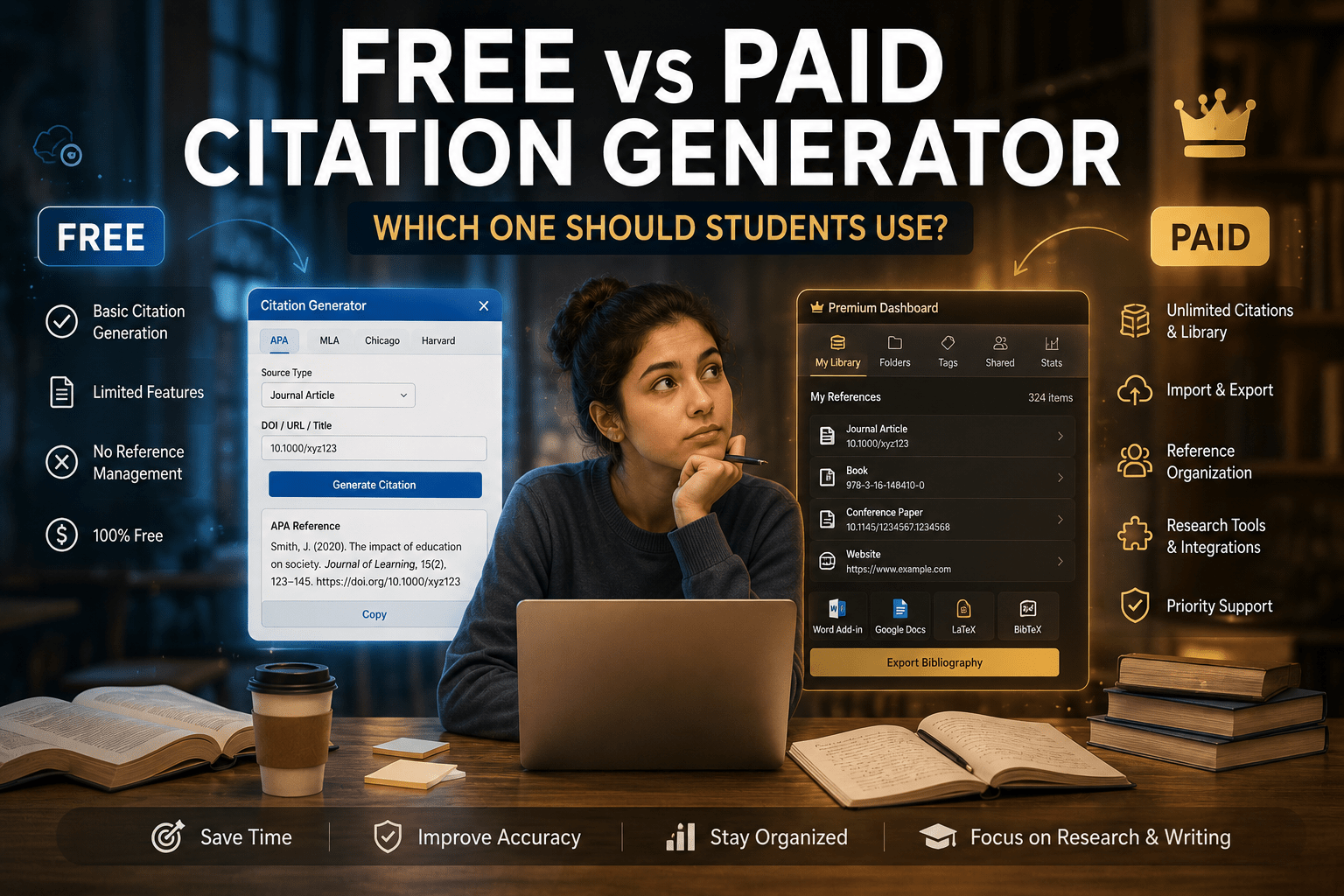
Citation generators can save students hours of repetitive formatting. Instead of manually arranging author names, publication dates, journal titles, page numbers, DOIs, and URLs, you can enter or import source information and generate a citation in seconds.
But that creates another question:
Do students actually need to pay for a citation generator?
For a short university assignment with five or ten references, a free citation generator may provide everything you need. For a dissertation, thesis, literature review, or research project involving dozens or hundreds of papers, basic citation generation may no longer be enough.
The important distinction is not simply free vs paid.
It is whether the tool fits the complexity of your academic work.
A student writing a 1,500-word essay has very different reference-management needs from a PhD researcher maintaining hundreds of papers across several projects.
This guide compares free and paid citation generators, explains when upgrading may be worthwhile, identifies features students should check before paying, and shows how citation generation fits into a broader academic research workflow.
Free vs Paid Citation Generators: What Students Need to Know
A free citation generator is often sufficient for short university assignments with a small number of references. Paid citation or reference tools become more useful when students need to manage larger research libraries, multiple projects, extensive bibliographies, or additional research and reference-management features.
When Is a Free Citation Generator Enough?
Free citation generators are generally suitable for students who need occasional citations, work with relatively small bibliographies, cite common academic source types, and do not require advanced reference organization.
When Can a Paid Tool Be Worth It?
Paying may make sense for dissertations, theses, literature reviews, and source-heavy research projects where reference organization, importing, exporting, reusable libraries, or additional research features can save substantial time.
Are Paid Citation Generators More Accurate?
Not automatically. Citation accuracy depends on correct source metadata, appropriate source classification, citation-style rules, and careful verification. Students should check generated citations whether the tool is free or paid.
Citation Generator vs Research Platform
A citation generator mainly formats references. A broader research platform can support additional stages such as discovering papers, organizing sources, analyzing academic literature, reviewing PDFs, developing literature reviews, and preparing academic writing.
Key Takeaways
- Short assignments: A capable free citation generator may be all you need.
- Large research projects: Advanced reference-management features become more valuable as the number of sources increases.
- Accuracy: Paying for a citation tool does not guarantee error-free references.
- Verification: Check generated references against the original source and your required citation guidelines.
- Value: Pay for features that solve a real research problem rather than upgrading simply because a premium plan exists.
Direct Answer
Should students use a free or paid citation generator? Most students can start with a free citation generator for short assignments and small bibliographies. A paid tool becomes more worthwhile when a student regularly manages many sources or needs advanced reference organization, exporting, integrations, or broader research features.
Where ResearchPal Fits
ResearchPal is designed to support more of the academic research workflow around citations, including academic search, research organization, paper analysis, PDF exploration, literature review workflows, citation and reference tasks, and academic writing support. This can be particularly useful when citation formatting is only one part of a larger research project.
Quick Answer: Free or Paid Citation Generator?
For many students, a free citation generator is enough for short assignments and occasional citation needs, particularly when only a small number of standard sources need to be formatted.
A paid tool becomes more useful when you regularly manage large numbers of references, work across multiple projects, need advanced reference organization, want better import and export capabilities, or require additional research features.
But there is an important rule:
Paid does not automatically mean accurate.
Whether a citation is generated by a free or premium tool, students should verify important details against the original source and the citation requirements provided by their university, department, instructor, or publisher.
What Is a Free Citation Generator?
A free citation generator is a tool that creates formatted references without requiring payment for its basic citation functionality.
Depending on the platform, students may be able to enter information manually or search using information such as:
- Article title
- DOI
- ISBN
- URL
- Author
- Publication title
The generator then uses that metadata to construct a citation in the selected referencing style.
For example, a student might find a journal article, enter its DOI, select APA, Harvard, MLA, Chicago, or another supported style, and generate a reference.
The student can then copy the citation into an assignment.
The exact features available for free vary considerably between tools.
Some free citation generators provide only basic citation formatting. Others may include reference lists, source lookup, saved citations, or limited reference-management features.
Who Is a Free Citation Generator Best For?
Free citation generators are particularly useful for students who:
- Write occasional academic assignments
- Have relatively small bibliographies
- Mostly cite common source types
- Use one or two citation styles
- Do not need long-term reference management
- Are comfortable checking generated citations manually
Imagine an undergraduate student writing a short essay with eight references.
The student may only need to:
Find source → Generate citation → Verify citation → Add it to the assignment
Paying for an advanced reference-management system may offer little additional value for that particular task.
What Is a Paid Citation Generator?
A paid citation generator generally places some features behind a subscription or premium plan.
The value of paying should come from more than simply being able to generate one formatted reference.
Depending on the platform, premium features may include:
- Larger reference libraries
- More citation styles
- Advanced source organization
- Additional import options
- Bibliography management
- Document integrations
- Collaboration
- Cloud synchronization
- Advanced export options
- Research or writing features
Not every paid citation tool includes all of these capabilities.
That is why students should compare the actual functionality rather than assuming a subscription automatically means a better academic experience.
Who Might Benefit From a Paid Citation Tool?
Paid citation or reference-management features may make more sense for:
- Master’s students
- PhD researchers
- Dissertation writers
- Thesis students
- Systematic-review researchers
- Frequent academic writers
- Students managing large research libraries
- Researchers working across multiple projects
For these users, the problem is rarely just:
“How do I format this citation?”
It becomes:
“How do I manage all of these sources efficiently?”
That is a much larger problem.
Free vs Paid Citation Generator: Side-by-Side Comparison
The exact differences depend on the provider, but this general comparison can help students understand what to evaluate.
| Feature | Free Citation Generator | Paid Citation Generator |
|---|---|---|
| Basic citation generation | Usually available | Usually available |
| Common citation styles | Often available | Often available |
| In-text citations | Varies | Often available |
| Bibliography generation | Often available | Usually available |
| DOI lookup | Varies | Often available |
| ISBN or URL lookup | Varies | Often available |
| Saved references | May be limited | Often more extensive |
| Reference organization | Basic or limited | May be more advanced |
| Import/export | Varies | Often broader |
| Collaboration | Less common | May be available |
| Document integration | Varies | May be available |
| Research features | Usually limited | May be included |
| Best suited to | Occasional citation needs | Frequent or source-heavy research |
This table should be treated as a general framework rather than a universal rule.
Some free tools can be surprisingly capable, while some paid tools may offer features that a particular student never needs.
Does Paying for a Citation Generator Make Citations More Accurate?
Not necessarily.
This is one of the most important things students should understand before purchasing a citation tool.
Price and citation accuracy are not the same thing.
A premium tool can still produce an incorrect citation if the source metadata it receives is incomplete or wrong.
For example, an automatically generated reference might contain:
- A missing author
- Incorrect capitalization
- The wrong publication year
- An incomplete journal title
- A missing issue number
- Incorrect page numbers
- An incorrect source type
- A malformed DOI
- Missing edition information
The generator may format the information perfectly while still using incorrect information.
That distinction matters.
There are effectively two questions:
Is the source metadata correct?
and
Has that metadata been formatted correctly?
A good citation workflow needs both.
Can Free Citation Generators Be Accurate?
Yes.
A free citation generator can produce a correct citation when the underlying source information is accurate and the citation rules are applied correctly.
However, students should avoid treating the output as automatically authoritative.
A useful workflow is:
Find source
↓
Import or enter metadata
↓
Generate citation
↓
Check source details
↓
Compare with required citation style
↓
Correct errors
↓
Use citation
The same verification process should be followed with paid tools.
When a Free Citation Generator Is Enough
Not every student needs a subscription.
There are several situations where a free citation generator may be the more sensible option.
You Only Have a Few References
If your assignment contains six or seven sources, sophisticated reference management may not provide much additional benefit.
Generating and checking each citation individually can be manageable.
You Mostly Cite Standard Sources
Free tools are particularly useful when your bibliography mainly consists of familiar publication types such as:
- Journal articles
- Books
- Websites
- Book chapters
More unusual sources can require additional manual checking regardless of which generator you use.
You Only Need One Citation Style
If your entire degree programme consistently uses the same referencing style, you may not need advanced style-management features.
The most important thing is whether the tool supports the specific version or institutional interpretation you are required to follow.
You Don’t Need a Research Library
A first-year student completing occasional essays may not need to maintain hundreds of references over several years.
In that case, a simple generator may be more efficient than adopting a complex research-management system.
Your University Already Provides Research Tools
Before purchasing anything, check what your university already provides.
Students may already have access to research databases, library resources, reference-management software, writing support, or institutional subscriptions.
There is little reason to pay twice for functionality you already have.
When Paying for a Citation Tool May Be Worth It
As academic work becomes more complex, citation generation becomes only one part of the problem.
You Are Writing a Dissertation or Thesis
A dissertation may involve dozens or even hundreds of sources.
At that scale, manually managing individual citations becomes increasingly inefficient.
You may need to:
- Save references
- Organize them by topic
- Identify duplicates
- Reuse citations
- Maintain consistent metadata
- Export bibliographies
- Switch styles
- Track sources over several months
Those capabilities can justify paying for a more advanced tool.
Your Paper Contains Many Sources
A 2,000-word essay and a 70,000-word thesis have completely different citation-management requirements.
As the number of sources grows, organization becomes increasingly valuable.
You Regularly Switch Citation Styles
Students sometimes need to move between:
- APA
- Harvard
- Chicago
- MLA
- Vancouver
- IEEE
- Other disciplinary styles
Researchers submitting manuscripts to different journals may face similar requirements.
A tool that can efficiently manage source metadata and reformat references may save significant time.
You Need Better Reference Organization
Once your research library contains hundreds of papers, simply storing citations is not enough.
You may need to organize sources according to:
- Research question
- Topic
- Methodology
- Literature-review theme
- Project
- Course
- Dissertation chapter
- Publication
If premium functionality meaningfully improves this workflow, the subscription may be worthwhile.
You Work Across Multiple Research Projects
Graduate students and researchers often work on several projects simultaneously.
For example:
Dissertation
Conference paper
Journal manuscript
Research proposal
Literature review
A reusable research library becomes much more valuable in this situation.
You Want Citation Management Integrated With Research
Citation formatting is usually one of the final stages of a much larger process.
Researchers first need to:
Search → Discover → Evaluate → Read → Organize → Analyze → Write → Cite
A broader research platform may therefore offer more value than paying exclusively for citation formatting.
Hidden Limitations Students Should Check Before Choosing a Citation Generator
The word “free” does not always mean unlimited.
Similarly, “premium” does not guarantee every feature you expect.
Before choosing a tool, investigate the limitations.
Citation Limits
Check whether the free version restricts:
- Number of citations
- Saved references
- Projects
- Bibliographies
- Exports
A tool that works well for a ten-reference essay may become inconvenient for a dissertation.
Limited Citation Styles
Make sure your required citation style is actually supported.
Do not assume that “Harvard” or another broad style label automatically matches your university’s specific guidelines.
Locked Export Features
Creating references is only part of the workflow.
Check whether you can:
- Copy citations
- Export references
- Download bibliographic files
- Move your data elsewhere
This becomes especially important when building a long-term research library.
Incomplete Metadata
Automatic source lookup is convenient, but metadata quality varies.
Always inspect imported information before using it.
Advertising and Distractions
Some free services support themselves through advertising.
That is not inherently a problem, but students who use a citation tool frequently may prefer a cleaner workflow.
Account Requirements
Some tools allow citations without registration.
Others require an account to save references or create bibliographies.
Consider whether you actually need persistent storage.
Reference Storage Limits
A storage limit may be irrelevant for a short essay but important for a multi-year PhD.
Premium-Only Research Features
Look carefully at what is actually behind the paywall.
The key question is:
Would I use this feature enough to justify paying for it?
What Students Should Look for Before Paying
Before subscribing to a citation generator or research tool, evaluate the features that affect your actual academic work.
Citation Style Support
Does the tool support the style your university requires?
If you use multiple styles, can you switch between them easily?
Source Type Coverage
Check support for sources such as:
- Journal articles
- Books
- Chapters
- Websites
- Conference papers
- Reports
- Theses
- Newspapers
- Datasets
- Government publications
In-Text Citations
Some students focus on the bibliography and forget that academic styles also specify how sources should appear within the text.
Check whether the tool supports the in-text citation formats you need.
Bibliography Generation
If you manage many sources, automatic bibliography creation can save substantial time.
DOI, ISBN and URL Lookup
Automatic metadata retrieval can reduce repetitive typing.
But imported metadata should remain editable.
Manual Editing
This is essential.
If a tool retrieves the wrong author, title, date, source type, or other information, you should be able to correct it.
Reference Organization
For long projects, look beyond citation generation.
Can you organize papers into libraries, projects, folders, collections, or other useful structures?
Import and Export
Students should think about portability.
Can references be moved into or out of the platform in formats compatible with their research workflow?
Research Features
If you are paying, ask whether the tool helps with more than citation formatting.
For example:
- Academic search
- Literature discovery
- Paper analysis
- PDF exploration
- Reference management
- Literature reviews
- Academic writing
These capabilities can matter much more during a dissertation than saving a few seconds on an individual citation.
Citation Generator vs Reference Manager: Know the Difference
These terms are sometimes used interchangeably, but they solve different problems.
Citation Generator
A citation generator primarily answers:
“How should I format this source?”
Its core workflow is:
Source information → Citation
This is ideal for quick assignments and occasional citation needs.
Reference Manager
A reference manager addresses a broader question:
“How do I organize and reuse all the sources in my research?”
Its workflow is closer to:
Find → Save → Organize → Retrieve → Cite → Reuse
That difference becomes increasingly important as research projects grow.
A student with six sources may need a citation generator.
A researcher with 600 sources probably needs a system for managing research.
Free Citation Tools for Short Assignments vs Research Tools for Long Projects
The easiest way to decide what you need is to consider your complete workflow.
Short Assignment Workflow
For a straightforward university essay:
Find source
↓
Generate citation
↓
Verify citation
↓
Add it to assignment
↓
Submit
A free citation generator may handle this perfectly well.
Dissertation or Research Paper Workflow
A longer academic project might look more like:
Define research question
↓
Search academic literature
↓
Discover relevant papers
↓
Evaluate source quality
↓
Save useful research
↓
Organize papers
↓
Read and analyze PDFs
↓
Compare findings
↓
Develop literature-review themes
↓
Write
↓
Insert citations
↓
Generate bibliography
↓
Verify references
Here, citation generation is only one small component.
That is why students should choose research tools based on the whole workflow, not simply how quickly they can generate one APA or Harvard reference.
How ResearchPal Fits Into the Student Research Workflow
ResearchPal approaches citations as part of a broader academic research process.
How to Read Research Papers Like a Pro
Instead of treating the citation as an isolated formatting task, students can use research tools across the stages that happen before and around citation creation.
Citation and Reference Tools
Citation tools can reduce repetitive formatting and help students manage academic references.
The final citation should still be checked against the source and required style guide.
Academic Search
Before citing a paper, you need to find it.
Academic Search helps students and researchers discover literature relevant to their research questions.
Research Library
Relevant papers can be organized rather than rediscovered every time they are needed.
This becomes particularly valuable for dissertations, theses, and long-term research projects.
Paper Insights
Finding a paper does not necessarily mean it deserves a place in your bibliography.
Paper Insights can help researchers examine aspects such as:
- Research objectives
- Methods
- Findings
- Contributions
- Limitations
That can help students make more informed decisions about which studies deserve deeper reading and potential citation.
PDF Chat
Long papers can be difficult to navigate.
PDF Chat can support exploration of academic documents while students verify important evidence, quotations, page references, and claims against the original paper.
Literature Review Tools
A good literature review is not a long list of citations.
Students need to identify:
- Agreements
- Contradictions
- Themes
- Methodological differences
- Limitations
- Research gaps
Literature review tools can support this synthesis process.
Academic Writing Support
Once the evidence has been collected and organized, students need to turn it into clear academic writing.
Citation generation then becomes part of a connected workflow rather than a separate task performed just before submission.
How to Choose: A Simple Student Decision Guide
You do not need the most expensive citation tool.
You need the tool that matches your research complexity.
Choose a Free Citation Generator If:
- You have a short assignment.
- You only need a few citations.
- You mostly cite common source types.
- You use one main referencing style.
- You do not need a permanent reference library.
- You are comfortable verifying citations yourself.
- You only need basic citation formatting.
Consider a Paid Tool If:
- You cite sources every week.
- You are writing a dissertation or thesis.
- You manage dozens or hundreds of references.
- Your bibliography is becoming difficult to organize.
- You regularly switch citation styles.
- You work across several academic projects.
- Premium features would genuinely save you time.
Consider a Broader Research Platform If:
- You need to find academic papers as well as cite them.
- You want to organize your research library.
- You regularly read long PDFs.
- You need to analyze papers.
- You are conducting a literature review.
- You want research and writing tools in the same workflow.
Free vs Paid Citation Generator Checklist
Before entering your card details, ask yourself:
Does the free version already do everything I need?
Which paid feature would I actually use?
How many sources do I normally cite?
Does it support my university’s required citation style?
Can I correct imported metadata?
Can I organize references for long-term projects?
Can I export my references if I change tools?
Will I still use this platform after my current assignment?
Does my university already provide a similar tool?
Am I paying for citation formatting—or for a genuinely better research workflow?
If you cannot identify a specific premium feature that solves a real problem, staying with the free option may make more sense.
Frequently Asked Questions
Are free citation generators accurate?
Free citation generators can produce accurate references when the source metadata is correct and the citation style is implemented properly. However, automatic metadata can contain errors or missing information. Students should check author names, titles, publication dates, source types, page numbers, DOIs, and other important fields before submitting academic work.
Are paid citation generators more accurate?
Not automatically. Paying for a citation generator may provide additional features, reference storage, integrations, or research tools, but price alone does not guarantee citation accuracy. Both free and paid citations should be checked against the original source and the referencing guidelines required for the assignment.
Is it worth paying for a citation generator?
It depends on how frequently you cite sources and what additional functionality you need. Students completing occasional short assignments may be well served by a free tool. Paying becomes more attractive for dissertations, theses, literature reviews, and projects involving large numbers of references.
What is the best free citation generator for students?
The best free citation generator is one that supports the student’s required referencing style and source types, provides editable citation information, and produces references that can be easily checked against the original source. Students should evaluate functionality rather than choosing a tool solely because it is free.
Can I use a free citation generator for university assignments?
Yes, provided your university or instructor allows citation generators. You remain responsible for ensuring that the final citations follow the required referencing guidelines. Always check generated references before submitting an assignment.
Can citation generators make mistakes?
Yes. Citation generators can receive incomplete or incorrect metadata, misidentify a source type, omit important information, or format unusual sources incorrectly. This is why generated citations should be treated as a starting point that requires verification rather than unquestioned final output.
Should I use a citation generator for my dissertation?
A citation generator can save time during dissertation writing, but a dissertation often requires more than one-off citation formatting. Reference organization, source storage, metadata management, research discovery, literature analysis, and bibliography management become increasingly important as the number of sources grows.
What is the difference between a citation generator and a reference manager?
A citation generator primarily formats source information into a required citation style. A reference manager provides broader functionality for storing, organizing, retrieving, exporting, and reusing references across academic projects.
Should students check automatically generated citations?
Yes. Students should verify automatically generated references against the original source and their required citation guidelines. Pay particular attention to author names, publication dates, titles, page numbers, editions, source types, DOI information, and capitalization.
Can ResearchPal help with citations and research?
ResearchPal supports citation and reference workflows alongside academic search, research organization, Paper Insights, PDF Chat, literature review tools, and academic writing support. This allows students to work across more stages of the research process instead of treating citation generation as an isolated task.
Final Verdict: Free or Paid?
For many students, free is enough.
If you are writing a short university assignment with a small number of references, a reliable free citation generator may provide everything you need.
Generate the citation.
Check it.
Use it.
There is no reason to pay for advanced functionality simply because it exists.
The equation changes when your research becomes larger.
A dissertation, thesis, systematic review, journal manuscript, or multi-year research project may involve dozens or hundreds of sources. At that point, your biggest problem may no longer be formatting citations.
It may be managing research.
You need to find papers, determine which ones matter, organize them, understand their methods and findings, compare studies, build a literature review, write your argument, insert citations, and maintain an accurate bibliography.
That is where broader research platforms such as ResearchPal can become more useful than thinking only in terms of a standalone citation generator.
So instead of asking only:
“Should I use a free or paid citation generator?”
Ask:
“What research problem am I actually trying to solve?”
For a short assignment, the answer may be a simple free citation tool.
For serious, source-heavy research, the better investment may be a system that helps you manage the entire journey from finding evidence to understanding, organizing, writing, and citing it.
From The Web
- https://www.sourcely.net/post/the-best-citation-generators-for-students-free-vs-paid-tools-compared
- https://www.thesify.ai/blog/top-10-free-reliable-citation-generator-tools-for-students-researchers-in-2025
Frequently Asked Questions About Free vs Paid Citation Generators
These quick answers help students decide whether a free citation generator is enough or whether paying for advanced citation and research features may be worthwhile.
Are free citation generators accurate?
Free citation generators can produce accurate references when the source metadata is correct and the citation style is applied properly. However, students should still verify author names, publication dates, titles, page numbers, DOIs, and source types before submitting academic work.
Are paid citation generators more accurate?
Not automatically. Paying for a citation generator may provide more features, storage, integrations, or reference-management tools, but price alone does not guarantee citation accuracy. Both free and paid citations should be checked against the original source.
Is a free citation generator enough for university assignments?
For many short university assignments, yes. A free citation generator can be sufficient when you only need a small number of references, mostly cite common source types, and do not require advanced reference organization or long-term research management.
When is it worth paying for a citation generator?
Paying may be worthwhile when you regularly manage many sources, write a dissertation or thesis, work across multiple research projects, need advanced export or organization features, or benefit from tools that support more of the research workflow.
Can citation generators make mistakes?
Yes. Citation generators can import incomplete metadata, select the wrong source type, miss page information, or format unusual sources incorrectly. Generated citations should therefore be treated as a starting point that requires verification.
Should students use a citation generator for dissertations?
Citation generators can save time during dissertation writing, but students usually need more than one-off citation formatting. Large projects often benefit from reference organization, source storage, metadata management, literature analysis, and reusable research libraries.
What is the difference between a citation generator and a reference manager?
A citation generator mainly formats source information into a citation style. A reference manager goes further by helping users store, organize, retrieve, export, and reuse references across multiple academic projects.
Should students check automatically generated citations?
Yes. Students should compare generated references with the original source and their university’s required citation guidelines. Important fields to check include authors, titles, publication dates, editions, page numbers, DOI information, capitalization, and source type.
What should students check before paying for a citation tool?
Check whether the tool supports your required citation styles, source types, in-text citations, bibliography generation, metadata editing, DOI or ISBN lookup, reference organization, export options, and any research features you will actually use.
How can ResearchPal help with citations and academic research?
ResearchPal supports citation and reference workflows alongside academic search, research organization, Paper Insights, PDF Chat, literature review tools, and academic writing support, helping students work across more stages of the research process.

