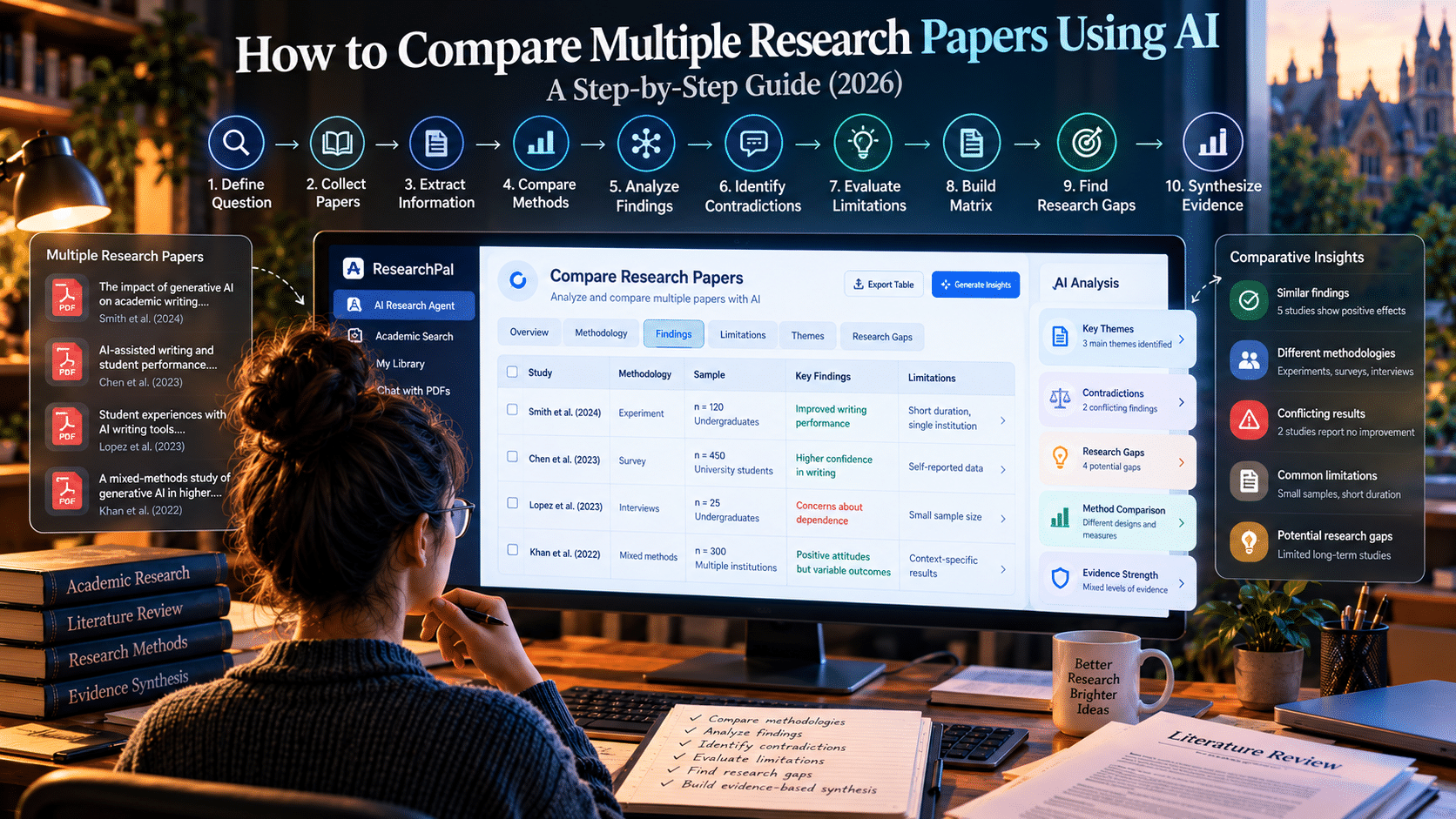
Finding academic papers is only the beginning of research. The real challenge begins when you need to understand how different studies relate to one another.
Imagine downloading 30 research papers for your literature review. Each paper has a different methodology, sample size, research objective, findings, and limitations.
How do you compare them effectively?
Reading every paper individually can take considerable time. Even after reading them, identifying similarities, contradictions, and research gaps can be difficult.
This is where AI-powered research paper comparison becomes useful.
AI research tools can help researchers extract important information, organize findings, compare methodologies, identify patterns, and develop evidence-based literature reviews.
However, using AI to compare research papers requires more than uploading PDFs and asking for a summary.
You need a systematic approach that connects the evidence across multiple studies.
In this guide, you’ll learn how to compare multiple research papers using AI, build a research comparison matrix, analyze conflicting findings, and use ResearchPal to support your academic research workflow.
Quick Answer: How to Compare Multiple Research Papers Using AI
To compare multiple research papers using AI, collect relevant studies, upload or import them into a research tool, extract their research objectives, methodologies, sample sizes, findings, and limitations, and organize the information into a comparison matrix.
Next, use AI to identify similarities, differences, contradictions, and potential research gaps. Finally, verify the extracted information against the original papers before using it in your literature review.
The recommended workflow is:
Collect Papers → Extract Information → Compare Methods → Analyze Findings → Identify Contradictions → Evaluate Limitations → Build Comparison Matrix → Synthesize Evidence → Verify Sources
AI can make this process easier to manage, but researchers remain responsible for interpreting the evidence accurately.
Why Comparing Research Papers Is Difficult
Academic research rarely produces identical findings.
Two studies may investigate the same topic but use different research designs, populations, datasets, or analytical methods.
These differences can influence their conclusions.
Different Research Methodologies
One study may use quantitative surveys, while another relies on qualitative interviews.
A third may use an experimental design.
Although these studies investigate related questions, their findings may not be directly comparable.
Researchers must understand what each methodology can and cannot establish.
Different Sample Sizes and Populations
Consider two hypothetical studies investigating AI-assisted learning.
Study A examines 40 undergraduate students at one university.
Study B surveys 1,200 students across several institutions.
The studies differ in sample size, setting, and potentially the outcomes measured.
A larger sample does not automatically mean a better study. Sampling methods, measurement quality, research design, and bias also matter.
Conflicting Research Findings
One study might report improved academic performance after using an AI learning tool.
Another might find no meaningful improvement.
A third might report benefits for certain students but not others.
These differences require investigation rather than simple averaging.
Information Overload
A literature review may contain dozens or hundreds of papers.
Researchers need to remember which study used which method, what it found, and how reliable the evidence was.
Without structured organization, comparing studies becomes increasingly difficult.
Difficulty Identifying Research Gaps
Research gaps often become visible only after comparing multiple studies.
A gap may involve an understudied population, an unresolved contradiction, a methodological limitation, or an insufficiently examined outcome.
Identifying these patterns requires synthesis rather than isolated summaries.
What Is AI-Powered Research Paper Comparison?
AI-powered research paper comparison is the use of artificial intelligence to extract, organize, and compare information across multiple academic publications.
Instead of manually creating every comparison table from scratch, researchers can use AI tools to assist with identifying relevant information.
Depending on the platform, AI may help compare:
- Research objectives
- Theoretical frameworks
- Methodologies
- Sample characteristics
- Datasets
- Variables
- Findings
- Statistical results
- Limitations
- Research contributions
- Recommendations for future research
The objective is not to replace critical reading.
It is to make the evidence easier to examine systematically.
For example, a researcher investigating the impact of generative AI on university education could compare 20 papers to understand which outcomes were studied, how those outcomes were measured, and where findings differ.
An academic-focused platform such as ResearchPal can support this process through research discovery, Paper Insights, PDF analysis, and literature-review tools.
How to Compare Multiple Research Papers Using AI: 10 Steps
The following workflow can be used for undergraduate assignments, master’s dissertations, PhD research, and literature reviews.
Step 1: Define Your Research Question
Before comparing papers, identify exactly what you want to investigate.
A broad topic such as:
Artificial intelligence in education
is too general for a focused comparison.
A better research question might be:
How does generative AI influence academic writing performance among undergraduate students?
This question identifies three central concepts:
- Technology: Generative AI
- Population: Undergraduate students
- Outcome: Academic writing performance
Your comparison should focus on studies that contribute evidence relevant to these concepts.
Example AI prompt:
“Help me refine the research question ‘How does generative AI affect undergraduate academic writing?’ Identify the main concepts, possible comparison dimensions, and inclusion criteria. Explain any ambiguities.”
A clear research question prevents the comparison from becoming a collection of unrelated findings.
Step 2: Collect Relevant Research Papers
Next, gather academic publications related to your question.
You can use scholarly databases, university library resources, academic search engines, citation networks, and research discovery tools.
Useful sources may include:
- Google Scholar
- PubMed, where relevant
- Scopus, where accessible
- Web of Science, where accessible
- Discipline-specific repositories
- University library databases
- ResearchPal’s academic search capabilities
Search using multiple terms rather than relying on one phrase.
For example:
("generative AI" OR ChatGPT OR "large language models") AND ("academic writing" OR "writing performance") AND (undergraduate OR "university students")
Review the results and select papers that match your research question.
Example AI prompt:
“Help me develop search terms and a screening strategy for studies examining generative AI and undergraduate academic writing performance. Suggest synonyms, relevant outcome measures, and possible exclusion criteria.”
For systematic reviews, document the databases, search strings, search dates, and screening decisions according to the review protocol.
Step 3: Extract Key Information From Each Paper
After selecting your papers, extract the information needed for comparison.
This is one of the most useful applications of AI in academic research.
Instead of writing long summaries, create a consistent evidence-extraction structure.
| Information | What to record |
|---|---|
| Paper title | Full publication title |
| Authors and year | Bibliographic information |
| Research objective | What the study investigates |
| Methodology | Research design and methods |
| Sample | Participants or dataset |
| Variables | Main factors investigated |
| Findings | Reported results |
| Limitations | Weaknesses and constraints |
| Contribution | What the study adds to the field |
Example AI prompt:
“Analyze these research papers and extract their research objectives, methodologies, sample characteristics, key findings, limitations, and contributions. Present the information in a structured table. Include supporting page references where possible, and mark information that is unavailable.”
The resulting table should be checked against the original publications.
AI can misread tables, confuse results with interpretations, or omit important methodological details.
Step 4: Compare Research Methodologies
Once the basic information is organized, examine how the studies were conducted.
Research methodology strongly influences the meaning of a study’s findings.
Consider three hypothetical papers.
| Study | Methodology | Sample | Main focus |
|---|---|---|---|
| Study A | Controlled experiment | 120 students | Writing performance |
| Study B | Survey | 450 students | Student perceptions |
| Study C | Interviews | 25 students | Learning experiences |
All studies in this example are fictional and used only to demonstrate comparison.
These papers investigate related issues, but they do not measure exactly the same thing.
Study A may provide evidence about performance under the conditions tested.
Study B may describe students’ reported experiences or perceptions.
Study C may provide detailed insights into how participants understand their experiences.
A strong comparison acknowledges these differences.
Example AI prompt:
“Compare the methodologies of these papers. Identify their research designs, sampling methods, outcome measures, potential biases, and limitations. Explain which findings can be meaningfully compared and which cannot.”
Step 5: Compare Findings and Results
The next step is to compare what the studies actually found.
Avoid simply listing conclusions.
Instead, investigate whether the evidence supports similar or different interpretations.
For example, imagine that three hypothetical studies report:
Study A: Students using an AI writing assistant completed a writing task more quickly.
Study B: Students reported greater confidence in their writing.
Study C: Some students expressed concerns about becoming dependent on AI suggestions.
These findings are not necessarily contradictory.
They examine different dimensions of AI-assisted writing.
A useful comparison might conclude that the studies address efficiency, perceived confidence, and learner independence, respectively.
The researcher would then investigate whether these outcomes are related.
Example AI prompt:
“Compare the main findings across these studies. Group findings by the outcomes measured. Identify areas of agreement, disagreement, and insufficient evidence. Do not assume that different outcomes represent contradictory results.”
Step 6: Identify Contradictions Between Studies
Contradictions can reveal important questions about the evidence.
Suppose two studies measure the same outcome but reach different conclusions.
The researcher should investigate possible explanations.
These may include:
- Different populations
- Different interventions
- Different study durations
- Different measurement instruments
- Different research settings
- Different statistical methods
- Differences in study quality
For example, a short-term classroom experiment and a year-long observational study may produce different results because they examine different contexts.
Example AI prompt:
“Identify studies that appear to report conflicting findings. For each apparent contradiction, compare the research design, sample, intervention, outcome measures, and limitations. Distinguish genuine disagreements from differences caused by study scope.”
Do not force contradictory findings into a single conclusion.
Sometimes the appropriate finding is that the evidence remains mixed.
Step 7: Evaluate Research Limitations
Research limitations help explain how confidently findings can be interpreted.
Common limitations include:
- Small or unrepresentative samples
- Short study duration
- Self-reported outcomes
- Missing comparison groups
- Measurement limitations
- Selection bias
- Limited geographical coverage
- Uncontrolled confounding variables
AI can help organize reported limitations across papers.
However, researchers should distinguish between limitations explicitly acknowledged by the authors and additional concerns identified during critical appraisal.
Example AI prompt:
“Create a limitations matrix for the selected papers. Separate limitations reported by the authors from additional methodological concerns. Explain how each limitation may affect interpretation or generalizability.”
Step 8: Build a Research Paper Comparison Matrix
A comparison matrix is one of the most practical ways to organize multiple papers.
It allows researchers to examine studies side by side.
Example Research Paper Comparison Matrix
| Dimension | Study A | Study B | Study C |
|---|---|---|---|
| Research focus | AI and writing quality | AI and writing confidence | AI and learner independence |
| Method | Experiment | Survey | Interviews |
| Sample | 120 students | 450 students | 25 students |
| Main finding | Faster task completion | Higher reported confidence | Concerns about dependence |
| Key limitation | Short intervention | Self-reported data | Small qualitative sample |
| Contribution | Performance-related evidence | Student perception evidence | Contextual understanding |
This matrix is illustrative and does not describe actual published studies.
A comparison matrix can help researchers recognize patterns that are difficult to identify from separate summaries.
For larger reviews, consider adding columns for:
- Country
- Publication year
- Theoretical framework
- Data collection method
- Statistical analysis
- Effect estimates
- Risk-of-bias assessment
- Research gaps
The best matrix is not necessarily the largest.
It is the one that captures the information needed to answer your research question.
Step 9: Identify Potential Research Gaps
After comparing findings, methodologies, and limitations, look for questions that remain insufficiently addressed.
Potential research gaps may involve:
Population gaps: Important groups are underrepresented in the available studies.
Methodological gaps: Most studies use similar designs, leaving other approaches insufficiently explored.
Contextual gaps: Evidence is concentrated in particular countries, institutions, or settings.
Temporal gaps: Long-term outcomes have received less attention than short-term outcomes.
Theoretical gaps: Existing studies provide limited explanation of why certain effects occur.
Evidence gaps: Findings are inconsistent or too limited to support a clear conclusion.
An AI tool can help identify these patterns.
But identifying a possible gap is only the beginning.
You must search specifically for literature that might already address it.
Example AI prompt:
“Based on the comparison matrix, identify potential research gaps supported by recurring limitations or insufficient evidence. Explain which studies support each proposed gap and suggest additional searches to test whether the gap remains unresolved.”
Important: An AI-generated research gap is a hypothesis to investigate, not proof that the literature is missing.
Step 10: Develop an Evidence-Based Synthesis
The final step is to turn your comparison into a coherent academic discussion.
A literature review should explain relationships between studies rather than present a sequence of disconnected summaries.
For example, instead of writing:
“Study A investigated writing performance. Study B examined confidence. Study C explored student experiences.”
A stronger synthesis would explain:
“Research on AI-assisted academic writing addresses several distinct outcomes, including task performance, perceived confidence, and learner independence. Because these outcomes are measured using different methodologies, the findings should be interpreted as complementary perspectives rather than direct evidence of a single overall effect.”
This example illustrates synthesis without inventing a claim about actual research.
Example AI prompt:
“Using the verified comparison matrix, develop a thematic synthesis of the selected studies. Organize the discussion around common findings, methodological differences, contradictions, and limitations. Connect each claim to its supporting source and identify areas where the evidence is insufficient.”
The final draft should be reviewed for accuracy, balance, and proper citation.
Research Paper Comparison Matrix: A Practical Example
Consider a researcher investigating:
How does remote learning influence university students’ academic performance?
The researcher collects studies examining online learning environments.
A useful comparison framework might include five dimensions.
Research Design
Were the studies experimental, observational, qualitative, or mixed-methods?
Student Population
Did the research focus on first-year students, postgraduate students, or students from particular disciplines?
Learning Environment
Did the studies examine fully online, blended, or emergency remote learning?
Academic Outcomes
Were outcomes measured using examination scores, course grades, engagement, retention, or student perceptions?
Study Limitations
Did the studies control for prior academic performance, access to technology, or differences in teaching quality?
Comparing these dimensions can reveal why studies produce different findings.
It also prevents researchers from treating all forms of remote learning as equivalent.
Manual vs AI-Powered Research Paper Comparison
Researchers have traditionally compared papers using spreadsheets, notes, and reference-management tools.
AI introduces additional assistance, particularly for extraction and organization.
| Research task | Manual approach | AI-assisted approach |
|---|---|---|
| Extract study details | Read and record individually | Generate structured extraction drafts |
| Compare methodologies | Build tables manually | Assist with methodology matrices |
| Identify common findings | Review notes across papers | Group findings by themes |
| Investigate contradictions | Cross-reference studies | Highlight potential disagreements |
| Organize limitations | Create individual summaries | Build limitations matrices |
| Develop themes | Manually code and group evidence | Suggest thematic structures |
| Draft synthesis | Write from research notes | Assist with evidence-linked drafting |
| Verify claims | Check original papers | Still requires researcher verification |
AI assistance can reduce repetitive organization work, but its accuracy depends on the available documents, retrieval quality, and system capabilities.
Researchers should not assume that AI-assisted comparison is automatically faster or more reliable for every project.
Common Mistakes When Comparing Research Papers Using AI
Comparing Only Abstracts
Abstracts often omit methodological details and important limitations.
Where possible, examine the full text before making detailed comparisons.
Ignoring Differences in Research Design
An experimental study, survey, and interview study may provide different types of evidence.
Do not treat their conclusions as interchangeable.
Treating Correlation as Causation
An association between two variables does not automatically establish that one causes the other.
Trusting AI-Generated Tables Without Checking
AI can incorrectly extract sample sizes, methods, statistical results, or conclusions.
Verify important fields against the original publications.
Confusing Different Outcomes With Contradictory Findings
Studies examining different outcomes may be complementary rather than conflicting.
Assuming a Research Gap Exists
A missing paper in one search result does not establish an unexplored research area.
Ignoring Study Quality
A comparison matrix should not give every study equal evidential weight without considering its design, relevance, and limitations.
Generating Citations Without Verification
Confirm that every reference exists and supports the associated claim.
How ResearchPal Helps Compare Academic Papers
ResearchPal provides academic research tools that can support different stages of paper comparison.
Rather than treating every paper as an isolated PDF, researchers can use a connected workflow for discovering, examining, organizing, and synthesizing literature.
Academic Paper Discovery
Researchers can search for publications related to their questions and explore relevant academic literature.
This helps establish the evidence base before comparison begins.
Paper Insights for Structured Analysis
ResearchPal’s Paper Insights feature helps extract structured information from academic papers.
Researchers can examine information such as:
- Methodology
- Key findings
- Research contributions
- Limitations
- Other study-specific details
Structured extraction can make comparisons easier to organize.
Chat With PDF for Deeper Investigation
When a paper requires closer examination, PDF Chat allows researchers to ask focused questions about its content.
For example:
“What sampling method did this study use?”
“What limitations did the authors report?”
“Which results support the main conclusion?”
Researchers should confirm the answers against the original PDF.
AI Research Agent for Connected Research Workflows
The ResearchPal AI Research Agent is designed to support multi-step academic research activities.
This can help researchers move between literature discovery, analysis, and synthesis without treating each stage as an unrelated task.
Literature Review Support
After comparing studies, researchers can use literature-review tools to help organize evidence into themes and develop a structured discussion.
Research Library and Citation Management
ResearchPal also provides research organization and citation-related tools.
These can help researchers maintain access to selected papers and prepare references for academic writing.
A practical ResearchPal workflow is:
Search Papers → Select Studies → Paper Insights → PDF Analysis → Comparison Matrix → Literature Review → Citation Verification
The goal is to help researchers spend less effort on repetitive information handling and more attention on evaluating the evidence.
Best Practices for Accurate AI Research Paper Analysis
Use a Consistent Extraction Framework
Compare the same fields across every paper.
This reduces the risk of overlooking important methodological differences.
Keep Claims Connected to Sources
Record the supporting publication for every important finding.
Page numbers or source passages are useful when available.
Separate Findings From Interpretations
Distinguish between what a study directly reports and what you infer from it.
Investigate Missing Information
If an AI tool cannot identify a sample size or methodology, inspect the original paper rather than accepting a guess.
Preserve Contradictory Evidence
Do not remove studies simply because their findings disagree with your emerging argument.
Use Appropriate Quality Assessment
Where relevant, apply appraisal criteria suitable for the study design and review methodology.
Document AI Assistance
Follow institutional or journal policies concerning AI use, disclosure, confidentiality, and academic integrity.
Verify the Final Synthesis
Before submission, check that your interpretation accurately reflects the evidence.
Frequently Asked Questions
Can AI compare multiple research papers?
Yes. AI tools can help extract and organize methodologies, findings, sample characteristics, limitations, and other information across multiple papers. Researchers should verify important details against the original publications.
How do I compare research papers using AI?
Start by selecting relevant studies. Use AI to extract consistent information, create a comparison matrix, analyze methodological differences, identify common and conflicting findings, and develop an evidence-based synthesis. Verify all important claims and citations.
What is the best AI tool for comparing research papers?
The best tool depends on your workflow. Look for academic paper discovery, full-text analysis, structured extraction, multi-paper comparison, citation traceability, and research organization. ResearchPal provides several tools relevant to these tasks.
Can AI identify differences between research methodologies?
Yes. AI can help identify differences in research design, sampling, data collection, analytical methods, and limitations when sufficient source information is available.
Can AI compare research findings from multiple PDFs?
Some AI research tools can analyze multiple uploaded documents and organize their findings. Capabilities and document limits vary by platform, and extracted information should be verified.
Can AI identify contradictions between research papers?
AI can help flag potentially conflicting findings. Researchers must determine whether the studies actually measure comparable outcomes and whether differences in methods or populations explain the results.
Can AI identify research gaps?
AI can help suggest potential gaps based on patterns in the literature, but those suggestions require targeted searching and human validation.
What is a research paper comparison matrix?
A research paper comparison matrix is a structured table that organizes information from multiple studies, such as objectives, methodologies, samples, findings, and limitations, to support systematic comparison.
Is AI-generated research paper analysis reliable?
AI analysis can be useful, but errors are possible. Reliability depends on source quality, document accessibility, the system’s capabilities, and researcher verification.
How does ResearchPal help compare research papers?
ResearchPal supports academic discovery, structured paper analysis through Paper Insights, PDF interaction, literature-review workflows, and research organization. These capabilities can help researchers compare evidence across studies.
Final Thoughts
Comparing multiple research papers is one of the most important parts of academic research.
It helps researchers move beyond collecting publications toward understanding what the evidence actually shows.
AI can assist with this process by organizing study details, extracting relevant information, comparing methodologies, highlighting potential contradictions, and supporting literature synthesis.
However, the quality of the comparison still depends on the researcher’s judgment.
A strong workflow follows these stages:
Discover → Extract → Compare → Evaluate → Synthesize → Verify
The objective is not simply to compare papers faster.
It is to compare them more systematically, understand their differences, and develop conclusions that accurately reflect the available evidence.
For researchers working on dissertations, theses, literature reviews, and academic publications, the ResearchPal AI Research Agent provides a connected environment for academic discovery, paper analysis, and research synthesis.
Better research begins when you stop reading papers in isolation and start understanding how the evidence connects.

