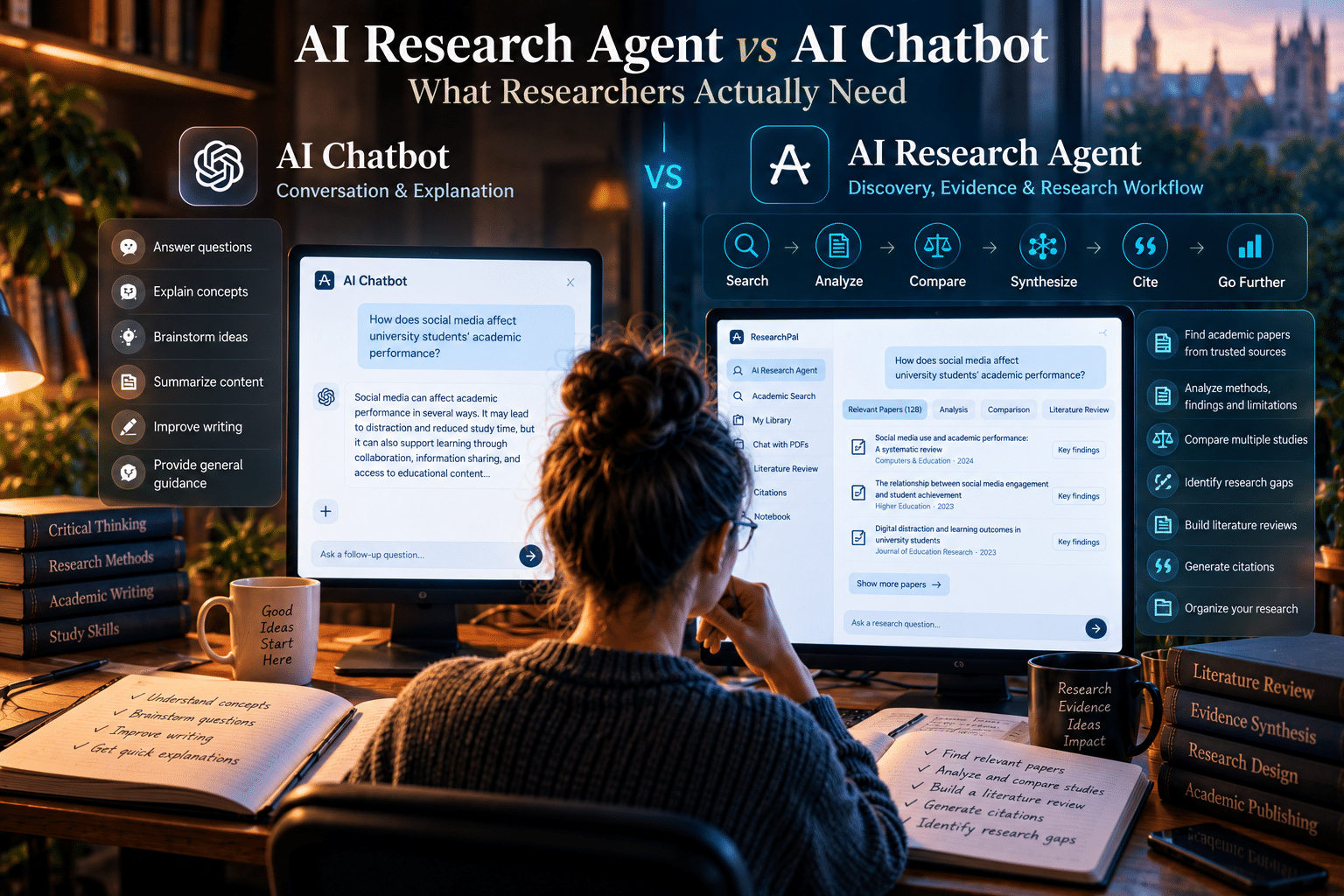
Ask an AI chatbot a research question and you may receive a polished answer within seconds.
But academic research rarely ends with an answer.
Researchers need to know:
Where did the evidence come from?
Which papers support the claim?
What methods did those studies use?
Do other studies disagree?
What limitations affect the evidence?
Can the sources be verified and cited?
This is where the difference between an AI chatbot and an AI research agent becomes important.
A chatbot is primarily designed for conversation. It can explain concepts, brainstorm ideas, summarize supplied material, improve writing, and answer questions.
An AI research agent is designed to help carry a research objective through multiple connected steps—such as discovering academic literature, analyzing papers, comparing evidence, exploring PDFs, organizing sources, and supporting literature reviews.
The distinction can be summarized simply:
AI Chatbot → Helps you talk about research
AI Research Agent → Helps you work through the research process
Researchers do not necessarily need to choose one and abandon the other.
They need to understand which type of AI fits which research task.
Quick Answer: AI Research Agent vs AI Chatbot
An AI chatbot is primarily a conversational system that responds to prompts, explains information, brainstorms ideas, summarizes content, and assists with writing.
An AI research agent is designed to coordinate multiple research tasks around a research objective. Depending on the platform, this can include searching academic literature, finding relevant papers, analyzing studies, comparing evidence, exploring PDFs, generating structured research outputs, organizing references, and supporting literature reviews.
For simple explanations and brainstorming, a chatbot may be enough.
For evidence-driven academic work, researchers often need something more:
Question → Search → Sources → Analysis → Comparison → Synthesis → Citations → Verification
That is the workflow research agents are designed to support.
What Is an AI Chatbot?
An AI chatbot is a conversational interface powered by an artificial intelligence model.
Users provide prompts and receive generated responses.
For researchers, chatbots can be extremely useful.
They can help:
- Explain unfamiliar concepts
- Brainstorm research questions
- Generate potential keywords
- Clarify terminology
- Summarize text supplied by the researcher
- Improve academic writing
- Create outlines
- Explain statistical concepts
- Suggest alternative arguments
- Translate difficult material into simpler language
Suppose a student asks:
“Explain the difference between qualitative and quantitative research.”
A chatbot can answer that question effectively without needing to conduct a multi-stage research investigation.
The task is primarily explanatory.
The limitations become more important when the user moves from:
“Help me understand this.”
to:
“Help me investigate what the academic evidence says about this.”
Those are different tasks.
What Is an AI Research Agent?
An AI research agent is an AI-powered system designed to work through multiple stages of a research task.
Instead of treating every prompt as an isolated conversation, the system can operate around a broader research objective.
For example, consider:
“How does generative AI affect critical thinking among university students?”
A useful research workflow might require the system to:
- Interpret the research question
- Identify important concepts
- Search for academic papers
- Evaluate potentially relevant studies
- Extract methodologies and findings
- Compare the evidence
- Identify disagreements
- Investigate limitations
- Organize sources
- Produce a structured synthesis
The workflow becomes:
Ask → Discover → Analyze → Compare → Synthesize → Cite → Verify
That multi-step orientation is what makes the concept of an AI research agent particularly relevant to academic work.
AI Research Agent vs AI Chatbot: The Main Difference
The biggest difference is not necessarily the underlying language model.
It is the workflow surrounding the model.
A chatbot typically begins with:
Prompt → Response
A research agent aims to support:
Research Objective → Plan → Search → Evidence → Analysis → Output
Consider this example.
A researcher asks:
“Does social media use affect university students’ academic performance?”
How an AI Chatbot Might Approach It
A chatbot might generate an explanation discussing:
- Distraction
- Study habits
- Time management
- Social interaction
- Potential educational benefits
The response may be useful for orientation.
But the researcher still needs to ask:
Which studies support these claims?
How an AI Research Agent Might Approach It
A research-oriented agent could instead help:
- Search academic literature
- Identify relevant studies
- Extract study populations
- Compare methodologies
- Examine findings
- Identify contradictory evidence
- Organize sources
- Build an evidence-based synthesis
The difference is therefore:
Generated knowledge vs research workflow.
AI Research Agent vs AI Chatbot: Comparison Table
| Capability | AI Chatbot | AI Research Agent |
|---|---|---|
| Answer general questions | Strong | Strong |
| Explain concepts | Strong | Strong |
| Brainstorm ideas | Strong | Strong |
| Improve writing | Strong | Often available |
| Find academic papers | Varies | Core capability for academic agents |
| Search across multiple sources | Varies | Often central |
| Analyze research papers | Possible when provided | Often integrated |
| Compare multiple studies | Possible with context | Research-oriented workflow |
| Extract methodology/findings | Requires documents/context | Often structured |
| Citation traceability | Varies | Important capability |
| Literature-review workflow | Limited without tools | Often integrated |
| PDF interaction | Varies | Common capability |
| Research organization | Usually separate | Can be integrated |
| Multi-step research planning | Varies | Central concept |
| Evidence synthesis | Possible | Research-focused |
| Researcher verification | Required | Required |
This table highlights an important point:
Modern chatbots and research agents increasingly overlap.
A chatbot can gain search, file analysis, citation, and agentic capabilities.
Likewise, a research agent often includes a conversational interface.
The labels therefore matter less than the actual capabilities.
7 Differences Researchers Should Understand
1. Conversation vs Research Objective
Chatbots are naturally conversation-oriented.
You ask:
“What is retrieval-augmented generation?”
The chatbot explains it.
A research agent is more useful when the task becomes:
“Investigate how retrieval-augmented generation is being evaluated in medical question-answering systems.”
That requires a research objective rather than a simple explanation.
2. Answers vs Evidence Discovery
A chatbot can generate an answer from its available context and capabilities.
Academic researchers need something more fundamental:
Evidence.
That means finding the papers, reports, datasets, or documents behind the answer.
A research agent should help move from:
“Here is an answer.”
to:
“Here is the evidence you should examine.”
3. One Prompt vs Multiple Research Steps
Real research is iterative.
A researcher may begin with one question and discover that:
- The terminology is wrong
- The topic is too broad
- An important theory was missed
- Another population matters
- Results contradict each other
- A newer methodology exists
Research therefore behaves more like:
Question → Search → Learn → Refine → Search Again → Compare → Investigate
than:
Question → Answer
Research agents are designed around this multi-step process.
4. General Information vs Academic Literature
General-purpose AI systems can work across enormous amounts of information.
Academic research requires special attention to scholarly sources.
Researchers may need:
- Journal articles
- Conference papers
- Reviews
- Preprints
- Books
- Theses
- Research reports
An academic research agent should make scholarly literature a central part of the workflow rather than treating it as just another source type.
5. Summary vs Structured Paper Analysis
A chatbot can summarize a paper you provide.
But researchers often need consistent information across many papers.
For example:
| Paper | Population | Method | Finding | Limitation |
|---|---|---|---|---|
| Study A | Undergraduates | Experiment | Finding A | Small sample |
| Study B | Postgraduates | Survey | Finding B | Self-reporting |
| Study C | Mixed sample | Interviews | Finding C | Single institution |
Structured extraction makes comparison easier.
That becomes increasingly important when a literature review grows from five papers to dozens.
6. Citation Generation vs Evidence Traceability
A citation and evidence are not the same thing.
Researchers need to know whether:
The paper exists.
The bibliographic information is correct.
The paper actually supports the claim.
The interpretation accurately reflects the study.
Research agents should therefore emphasize traceability, not merely formatted references.
The ideal chain is:
Claim → Evidence → Source → Citation
7. Assistance vs Research Coordination
A chatbot helps with individual tasks.
An agent can help coordinate tasks.
That distinction becomes increasingly valuable as research complexity grows.
Instead of manually moving between:
Search Engine → PDF Reader → Spreadsheet → Notes → Citation Generator → Writing Tool
a research agent can attempt to connect more of the workflow.
When an AI Chatbot Is Enough for Researchers
Research agents are not necessary for every academic task.
A chatbot can be the more efficient choice for many situations.
Understanding a Concept
If you need an accessible explanation of:
Regression analysis
Construct validity
Transformer architecture
Grounded theory
a chatbot may be sufficient as an initial learning aid.
Brainstorming Research Ideas
Chatbots can help generate:
- Topic variations
- Potential questions
- Hypotheses
- Variables
- Search terminology
These ideas should be evaluated rather than accepted automatically.
Improving Academic Writing
A chatbot can help:
- Improve clarity
- Reduce repetition
- Restructure paragraphs
- Explain grammar
- Suggest transitions
Researchers should ensure that editing remains consistent with their institution’s AI policies.
Generating Search Terms
Suppose your topic is:
AI and student learning
A chatbot could suggest related terminology such as:
- Generative AI
- Large language models
- AI-assisted learning
- Intelligent tutoring systems
- Higher education
- Learning outcomes
The researcher can then use those terms in academic databases.
Explaining Methods
Chatbots can provide introductory explanations of statistical tests, research designs, sampling approaches, and analytical techniques.
The key point is:
If the task is primarily conversational or explanatory, a chatbot may be enough.
When Researchers Need an AI Research Agent
The case for a research agent becomes stronger when the task depends on external evidence and multiple connected steps.
Finding Research Papers
Researchers need actual publications, not merely descriptions of what research might exist.
An academic research agent can help discover papers around a question.
Conducting a Literature Review
Literature reviews require:
Discovery → Screening → Analysis → Comparison → Synthesis
That workflow is naturally more agentic than conversational.
Comparing Studies
Suppose 20 studies investigate the same research question.
Researchers may want to compare:
- Sample sizes
- Populations
- Research methods
- Variables
- Findings
- Limitations
Structured research workflows can make that process easier to manage.
Investigating Contradictory Evidence
Imagine one group of studies reports positive effects while another finds no meaningful effect.
The next question becomes:
Why?
A research agent can support investigation across methods, populations, contexts, and study designs.
Exploring Research Gaps
Potential gaps may emerge from patterns such as:
- Understudied populations
- Missing geographical contexts
- Methodological limitations
- Inconsistent results
- Limited longitudinal evidence
- Unexplored variables
AI can help surface these patterns, but researchers should verify potential gaps with targeted searches.
Managing Large Research Projects
As projects become larger, organization becomes increasingly important.
PhD theses, dissertations, systematic reviews, and major research reports may involve hundreds of sources.
The ability to keep discovery, analysis, PDFs, notes, and citations connected becomes valuable.
Why Researchers Cannot Rely on Fluent AI Answers Alone
One of the biggest risks in AI-assisted research is confusing confidence with evidence.
AI-generated prose can sound authoritative even when:
- Important context is missing
- A source is weak
- A claim is oversimplified
- Studies disagree
- A citation is incorrect
- Evidence has been interpreted too broadly
Researchers should therefore adopt a simple rule:
Fluency is not verification.
A well-written paragraph should never substitute for checking the underlying evidence.
For important academic claims:
Find the source → Inspect the evidence → Evaluate the method → Verify the interpretation → Cite appropriately
Research Agent vs Chatbot for Literature Reviews
Literature reviews demonstrate the difference particularly clearly.
Chatbot-Based Workflow
A researcher might ask:
“Write a literature review about generative AI in higher education.”
The system generates text.
This is fast.
But several important questions remain:
Which papers were searched?
Why were those papers selected?
What literature was excluded?
Are the citations accurate?
Does the synthesis reflect the actual findings?
Research-Agent Workflow
A stronger process is:
Define Question
↓
Search Academic Literature
↓
Select Relevant Studies
↓
Extract Evidence
↓
Compare Findings
↓
Identify Themes
↓
Investigate Contradictions
↓
Synthesize
↓
Cite
↓
Verify
The second workflow treats the literature review as a research process rather than a writing prompt.
Research Agent vs Chatbot for Finding Papers
Another important difference appears during literature discovery.
A chatbot may suggest:
- Search terms
- Paper titles
- Authors
- Research directions
A research agent with academic-search capabilities can instead help search scholarly literature directly.
This becomes particularly valuable when the researcher does not know the correct terminology.
For example, someone searching:
AI helping students write essays
may need literature discussing:
LLM-assisted academic writing
AI-mediated composition
human-AI collaborative writing
automated writing support
Academic discovery needs to move beyond one phrase.
A stronger workflow becomes:
Keywords → Semantic Discovery → Seed Papers → Citations → Related Literature
Research Agent vs Chatbot for Research Gaps
Ask a chatbot:
“What are the research gaps in generative AI and education?”
It may generate a plausible list.
But plausibility is not evidence.
A research gap should emerge from the literature.
A more defensible process is:
Step 1: Search Relevant Literature
Build a reasonable evidence base.
Step 2: Compare Studies
Examine populations, methods, variables, and findings.
Step 3: Review Limitations
Look for recurring limitations explicitly reported by researchers.
Step 4: Identify Potential Gaps
Possible patterns may emerge.
Step 5: Search Again
Run targeted searches specifically around the proposed gap.
Step 6: Validate
Only then should the researcher decide whether the gap is sufficiently supported.
The principle is:
Don’t ask AI to invent a gap. Use AI to help investigate whether a gap exists.
Research Agent vs Chatbot for PhD Research
PhD researchers face particularly complex information-management problems.
A doctoral project may involve:
- Hundreds of papers
- Multiple theories
- Competing methodologies
- Long-term note taking
- Evolving research questions
- Citation management
- Multiple thesis chapters
A chatbot can remain useful throughout that process.
But a connected research environment becomes increasingly valuable as the evidence base grows.
A useful PhD workflow might be:
Research Question
↓
Academic Search
↓
Seed Papers
↓
Citation Trails
↓
Paper Analysis
↓
Evidence Matrix
↓
Research Gaps
↓
Literature Review
↓
Research Library
↓
Writing
↓
Verification
This is where an AI research agent can offer more value than isolated conversations.
Do Researchers Need Both?
For many researchers, the answer is yes.
Chatbots and research agents are not necessarily competing categories.
They can complement one another.
Use a chatbot when you need:
- Explanation
- Brainstorming
- Writing feedback
- Concept clarification
- Search-term ideas
Use a research agent when you need:
- Academic paper discovery
- Evidence retrieval
- Multi-paper analysis
- Literature-review workflows
- Citation-linked synthesis
- Research organization
- Multi-step investigation
The ideal research environment may combine both.
Conversation helps researchers think.
Agentic workflows help researchers investigate.
What Researchers Should Look for in an AI Research Agent
Before choosing a research agent, evaluate the capabilities behind the label.
Academic Source Coverage
Where does the system search?
Academic researchers should understand whether the tool can access relevant scholarly sources.
Evidence Traceability
Can you move from a generated claim back to the supporting source?
Paper-Level Analysis
Can the system examine methodology, findings, limitations, and other research-specific information?
Multi-Paper Comparison
Can researchers compare multiple studies in a structured way?
Literature Review Support
Does the system help with evidence synthesis rather than simply generating paragraphs?
PDF Interaction
Can researchers investigate their own papers and documents?
Citation Support
Can discovered evidence remain connected to references?
Research Organization
Can useful papers and insights be saved for later stages of the project?
Researcher Control
Can users inspect, refine, correct, and reject AI outputs?
A sophisticated autonomous workflow is not useful if researchers cannot understand or verify what it did.
How ResearchPal Combines Chat and Agentic Research
ResearchPal is designed around the idea that researchers need both conversational assistance and connected research tools.
Instead of limiting research to a chat window, the ResearchPal environment connects multiple academic tasks.
Academic Search
Researchers can discover papers related to their questions and topics.
AI Research Agent
The ResearchPal AI Research Agent is designed to help researchers move through multi-step academic research workflows rather than treating each question as an isolated prompt.
Paper Insights
Researchers can extract structured information from papers, including findings, methodology, and limitations.
Chat With PDFs
Individual papers can be investigated conversationally when deeper examination is required.
Literature Review
Researchers can move from paper discovery toward evidence comparison and synthesis.
Research Library
Relevant papers and research materials can be organized for continued work.
Citations
Sources can remain connected to later writing and reference-generation workflows.
The overall process becomes:
Ask → Search → Discover → Analyze → Compare → Organize → Synthesize → Cite
That is fundamentally different from asking an AI system to generate an academic answer from a single prompt.
A Better AI Workflow for Academic Research
Researchers do not need to automate everything.
A stronger approach is to decide which tasks should be conversational, which should be agentic, and which require direct human judgment.
Phase 1: Think
Use conversational AI to:
- Explore the topic
- Clarify concepts
- Brainstorm questions
- Generate terminology
Phase 2: Discover
Use research-oriented search to:
- Find academic papers
- Explore synonyms
- Identify seed papers
- Follow related literature
Phase 3: Analyze
Examine:
- Methodologies
- Findings
- Populations
- Limitations
- Contributions
Phase 4: Compare
Identify:
- Agreements
- Contradictions
- Methodological differences
- Evidence patterns
Phase 5: Synthesize
Develop themes and arguments from the evidence.
Phase 6: Write
Use AI where appropriate to improve structure and clarity without replacing evidence-based reasoning.
Phase 7: Verify
Return to the original sources.
Check:
Claims
Citations
Quotations
Interpretations
Methodological details
The final workflow becomes:
Chat → Discover → Investigate → Analyze → Synthesize → Write → Verify
AI Research Agent vs AI Chatbot: Which Should You Choose?
Choose based on the task rather than the marketing label.
Choose an AI Chatbot When:
You primarily need:
- Explanations
- Brainstorming
- Writing assistance
- Concept clarification
- Simple summarization
- Search-term suggestions
Choose an AI Research Agent When:
You primarily need:
- Academic source discovery
- Multi-step research
- Paper analysis
- Evidence comparison
- Literature reviews
- Citation traceability
- PDF research
- Research organization
Choose a Combined Research Platform When:
You regularly move between both types of tasks.
For researchers working on dissertations, theses, academic papers, systematic reviews, or long-term projects, the ability to move from conversation into evidence discovery and analysis can reduce unnecessary fragmentation.
Frequently Asked Questions
What is the difference between an AI research agent and an AI chatbot?
An AI chatbot primarily provides conversational responses to prompts, while an AI research agent is designed to coordinate multiple research tasks such as searching for sources, analyzing papers, comparing evidence, and supporting research synthesis. The capabilities can overlap, so researchers should evaluate what a specific system actually does.
Is ChatGPT an AI chatbot or an AI research agent?
ChatGPT is conversational AI, but modern versions can also provide agentic and research-oriented capabilities depending on the available mode and tools. This illustrates why researchers should evaluate capabilities rather than relying solely on product categories.
Is an AI research agent better than a chatbot for academic research?
For evidence-intensive tasks such as literature discovery, multi-paper analysis, and literature reviews, a research agent can provide a more appropriate workflow. For explanations, brainstorming, and writing assistance, a chatbot may be sufficient.
Can an AI chatbot find research papers?
Some AI chatbots can search external sources when appropriate search or research tools are available. Others may rely primarily on model knowledge or user-provided information. Researchers should check the specific system’s search and citation capabilities.
Can an AI research agent write a literature review?
An AI research agent can support literature-review tasks such as discovery, evidence extraction, comparison, thematic organization, and drafting. Researchers remain responsible for search methodology, source evaluation, interpretation, verification, and the final academic work.
Can AI research agents generate accurate citations?
They can assist with citation generation, but citations should still be verified against the original source metadata. A formatted reference does not guarantee that the cited paper supports the associated claim.
Can an AI research agent identify research gaps?
AI can help surface potential gaps by comparing populations, methods, findings, and limitations across studies. Researchers should then perform targeted searches to determine whether the proposed gap is genuinely underexplored.
Do PhD students need an AI research agent?
Not necessarily, but research agents can be useful for literature-heavy doctoral workflows involving paper discovery, analysis, evidence organization, citations, and long-term research management. PhD students should also follow their institution’s AI-use policies.
Can an AI research agent replace a researcher?
No. Research requires judgment, methodology, interpretation, ethics, originality, and accountability. AI research agents can assist with repetitive and information-intensive tasks, but responsibility for the research remains with the researcher.
What should researchers look for in an AI research agent?
Researchers should evaluate academic source coverage, evidence traceability, paper analysis, multi-paper comparison, literature-review support, PDF capabilities, citations, research organization, and the ability to inspect and correct AI-generated outputs.
Final Thoughts
The question is not:
“Should researchers use an AI chatbot or an AI research agent?”
The better question is:
“What does this stage of my research actually require?”
If you need to understand a concept, brainstorm ideas, improve a paragraph, or explore terminology, a chatbot may be exactly the right tool.
If you need to find academic evidence, analyze papers, compare studies, investigate contradictions, build a literature review, and maintain traceability between claims and sources, you need a more research-oriented workflow.
That is the fundamental distinction:
Chatbots help researchers converse with AI.
Research agents help researchers investigate with AI.
And the most useful academic systems increasingly bring the two together.
A strong research workflow does not end at:
Prompt → Answer
It continues:
Question → Discovery → Evidence → Analysis → Synthesis → Citations → Verification
That is what researchers actually need.
