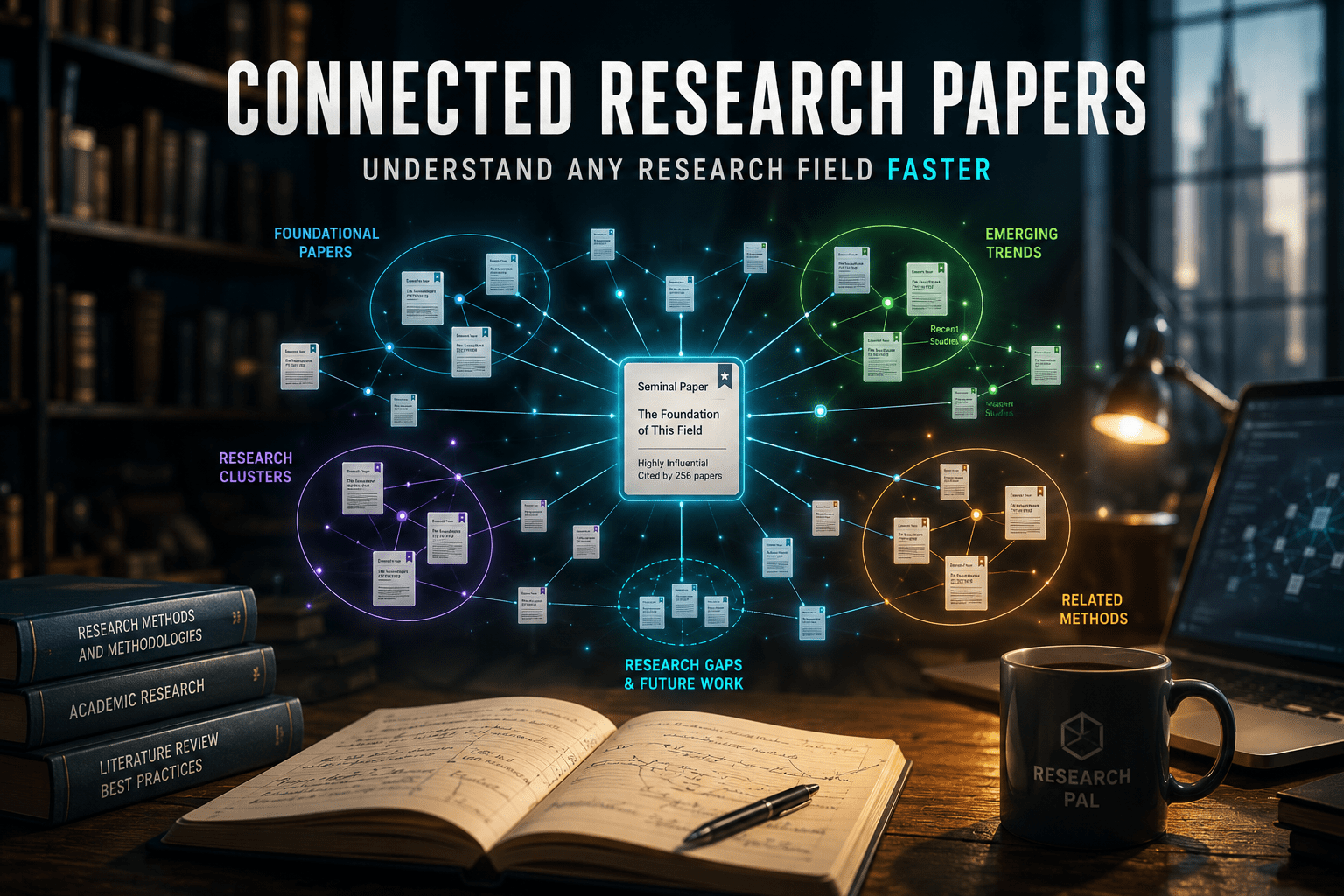
Entering a new research field can feel overwhelming. You may know the broad topic you want to study, but you may not yet understand its major theories, influential researchers, foundational papers, competing approaches, or emerging areas.
Traditional academic search often makes this harder.
A keyword search can return hundreds or thousands of papers, but a long list does not tell you how those studies relate to one another. Some papers may introduce foundational ideas, others may extend them, and newer studies may challenge earlier assumptions. Without understanding those relationships, researchers can spend hours reading papers individually without developing a clear picture of the field.
This is where connected research papers and interactive literature graphs become particularly useful.
Instead of viewing academic publications as isolated documents, graph-based research discovery helps you see a field as a network of connected ideas. Tools such as Connected Papers arrange related studies according to similarity, allowing researchers to identify clusters and relationships that may not be obvious from keywords alone. Connected Papers explicitly notes that its graph is based on paper similarity rather than functioning simply as a citation tree.
ResearchPal extends this type of visual discovery into a broader academic workflow by connecting Similarity Graphs with academic search, literature review generation, PDF analysis, Paper Insights, citations, and research organization.
This guide explains how connected papers help you understand an unfamiliar research field faster—and how to turn a visual research network into a meaningful literature review.
How Connected Research Papers Help You Understand a Research Field Faster
Connected research papers help researchers understand an academic field by revealing relationships between foundational studies, recent publications, research clusters, competing ideas, and emerging knowledge gaps. Instead of reading papers as isolated documents, interactive literature graphs make it easier to see how a field is structured and how different strands of research connect.
What Connected Papers Reveal
- Foundational research
- Related academic studies
- Research clusters and subfields
- Influential authors and papers
- Emerging research directions
Why This Speeds Up Research
A visual research network helps users identify the most important papers first, understand the vocabulary of a field, recognize major themes, and avoid reading hundreds of loosely related search results.
Best Starting Point
Begin with one or more highly relevant seed papers, then explore connected literature through citation relationships, semantic similarity, recurring authors, shared methods, and related concepts.
How ResearchPal Helps
ResearchPal combines Similarity Graphs with Academic Search, Paper Insights, PDF Chat, Literature Review Generation, citation tools, and Research Library management so researchers can move from discovery to analysis and writing in one workflow.
Key Takeaways
- Connected papers reveal how individual studies fit into a larger research field.
- Interactive literature graphs make research clusters and subfields easier to identify.
- Foundational and recent papers should be examined together to understand field evolution.
- Graph exploration should complement keyword search, semantic search, and critical reading.
- ResearchPal connects visual literature discovery with deeper paper analysis and research organization.
Direct Answer
The fastest way to understand a research field is to start with a relevant seed paper and explore the connected literature around it. This reveals major research clusters, influential studies, recurring theories, methodological patterns, and newer developments. ResearchPal supports this process with Similarity Graphs, Academic Search, Paper Insights, PDF Chat, Literature Review Generation, and research organization tools.
Research Best Practice
Interactive research graphs are discovery tools, not substitutes for source evaluation. Researchers should still read original papers, compare methodologies, verify claims, assess limitations, and use appropriate review methods before drawing conclusions about a field.
Quick Answer: How Do Connected Papers Help You Understand a Research Field?
Connected papers make a research field easier to understand because they show relationships rather than isolated search results.
By starting with one strong paper and exploring visually connected research, you can quickly identify foundational studies, major research clusters, recurring authors, newer developments, and competing approaches.
This allows you to build a mental map of the field before reading every paper in detail.
What Are Connected Research Papers?
Connected research papers are academic publications that share meaningful relationships.
Those relationships may arise because the papers:
- Study similar questions
- Cite similar literature
- Use related methodologies
- Explore the same theory
- Investigate similar populations
- Belong to the same academic conversation
- Build upon earlier work
Interactive literature tools visualize these relationships as networks.
Each paper appears as a node, while position and connections provide clues about how closely different studies relate.
Connected Papers, for example, creates a graph around an origin paper by analyzing a much larger body of literature and selecting a smaller set of strongly connected papers. Its graph positions publications according to similarity, so papers can appear close together even when they do not directly cite one another.
Why Understanding a Research Field Is Hard
Before looking at how graphs help, it is useful to understand why traditional literature discovery can be so difficult.
A Research Field Has Multiple Layers
Most academic topics contain:
- Foundational theories
- Historical developments
- Competing perspectives
- Different methodologies
- Specialist subfields
- Recent extensions
A newcomer rarely knows these categories in advance.
Researchers Use Different Terminology
Two researchers may investigate nearly the same idea while using completely different terminology.
For example, work relating to AI-supported university learning might appear under terms such as:
- Artificial intelligence in education
- Intelligent tutoring
- Adaptive learning
- Automated feedback
- Generative AI in higher education
- Educational machine learning
Exact keyword searching can therefore produce an incomplete picture.
Search Rankings Do Not Explain Relationships
A traditional academic search result may show ten highly relevant papers.
But the list does not immediately tell you:
- Which paper introduced the core theory
- Which studies belong to the same research tradition
- Which publication changed the direction of the field
- Which newer papers challenge older conclusions
Graphs add that missing relational context.
Start with a Strong Seed Paper
The most efficient way to understand a field visually is to begin with one highly relevant seed paper.
A seed paper acts as your entry point into the literature network.
What Makes a Good Seed Paper?
Look for a study that:
- Closely matches your research question
- Has clear terminology
- Contains useful references
- Represents an important research direction
- Is methodologically relevant
A recent systematic review can also be useful because it often connects you to many earlier studies.
Why One Paper Can Unlock an Entire Field
A relevant paper contains clues to the wider research landscape:
- References to earlier work
- Authors working in the area
- Important terminology
- Theories
- Methods
- Datasets
- Research gaps
Interactive graphs turn these clues into visible pathways.
How Connected Papers Reveal Foundational Research
One of the fastest ways to understand a new topic is to identify the research that everything else builds upon.
Interactive graphs make this easier.
Central Papers Often Signal Influence
In visual research networks, influential or strongly connected papers can become easier to recognize.
Connected Papers’ own graph interface indicates citation count through node size while using publication year as another visual signal.
Citation count should not automatically be treated as a quality score, but it can help identify work that has played an important role in a field.
Foundational Papers Explain the Vocabulary of the Field
Reading several foundational studies can quickly teach you:
- Key concepts
- Standard definitions
- Major theories
- Established methodologies
Once you understand this vocabulary, later research becomes much easier to interpret.
How Research Clusters Reveal Subfields
One of the most valuable features of interactive research graphs is the ability to see clusters.
A cluster is a group of closely connected papers.
Clusters Often Represent Different Research Directions
Suppose you are studying artificial intelligence in education.
One cluster might focus on:
- Intelligent tutoring systems
Another might focus on:
- Automated assessment
A third might cover:
- Generative AI and academic writing
A fourth might explore:
- AI ethics in education
Seeing these groups visually helps you understand that what initially looked like one broad topic is actually composed of several distinct research conversations.
Clusters Help Structure Literature Reviews
These clusters can later become literature review themes.
Instead of organizing your review paper-by-paper, you might organize it around:
- Theoretical approaches
- Methodologies
- Applications
- Populations
- Research controversies
This produces a more analytical literature review.
How Connected Papers Help You Understand Research Evolution
Research rarely develops in a straight line.
Ideas are proposed, challenged, refined, and sometimes replaced.
Interactive graphs can make this progression easier to understand.
Compare Older and Newer Papers
Start by identifying older influential papers.
Then examine newer connected publications.
Ask:
- What changed?
- Which assumptions remained?
- Which methods improved?
- Which limitations were addressed?
- Did newer evidence support or challenge earlier conclusions?
This turns literature discovery into an intellectual timeline.
Follow Changes in Methodology
A field may evolve from:
- Small qualitative studies
to:
- Larger observational datasets
and eventually to:
- Experimental or computational methods
Understanding this progression helps explain why current research questions exist.
Connected Papers Can Reveal Competing Schools of Thought
Not every research field agrees on one explanation.
Different clusters may represent different theoretical or methodological traditions.
This is particularly valuable for advanced research.
Instead of concluding:
“The literature shows X.”
you may discover that:
“One group of studies supports X, while another research tradition argues Y.”
That distinction can dramatically improve the sophistication of a thesis or literature review.
How Connected Research Helps You Find Knowledge Gaps
Research gaps are often easier to identify after you understand the structure of the existing literature.
Look Between Clusters
Sometimes two well-developed areas of research have surprisingly few connections.
That can suggest opportunities for interdisciplinary research.
Look for Understudied Populations
You may discover that most studies focus on:
- University students
while very little research examines:
- School teachers
or:
- Low-resource educational settings
Look for Methodological Imbalances
A literature graph may lead you to a field dominated by surveys but containing very few longitudinal or experimental studies.
These patterns can become potential research opportunities.
Connected Papers vs Traditional Search
Neither approach should replace the other.
They solve different problems.
| Research Task | Keyword Search | Connected Research Graphs |
|---|---|---|
| Find a specific paper | Excellent | Good |
| Search exact terminology | Excellent | Limited |
| Discover related concepts | Moderate | Excellent |
| Understand research clusters | Difficult | Excellent |
| Find foundational work | Moderate | Strong |
| Visualize field structure | No | Yes |
| Identify hidden connections | Limited | Strong |
The strongest workflow combines both.
How ResearchPal Helps Build a Complete Picture of a Field
ResearchPal’s advantage is that visual discovery does not have to remain a separate research activity.
Its current platform combines academic paper search and citation-backed literature review generation with broader research features.
ResearchPal’s own research discovery materials describe Similarity Graphs that connect papers through cited studies, referencing papers, and keywords.
Similarity Graphs
Start with a relevant publication and visually explore connected work.
This helps identify:
- Related papers
- Influential studies
- Research clusters
- Connected terminology
Academic Search
Once you identify an important concept or author through the graph, switch back to academic search to investigate it systematically.
Paper Insights
Finding papers is only the beginning.
Paper Insights can help researchers examine aspects such as:
- Methodology
- Findings
- Contributions
- Limitations
- Research gaps
This makes comparison across connected papers easier.
PDF Chat
Full-text analysis helps answer questions that abstracts cannot.
For example:
- Which population was studied?
- What variables were measured?
- Which theoretical framework was used?
- What limitation did the authors identify?
Literature Review Generator
Once related papers have been identified and screened, ResearchPal can help transform the literature into a structured, citation-backed review. Its current product materials describe literature review generation based on academic paper search and source-grounded synthesis.
Research Library
Save important papers instead of repeatedly rediscovering them.
Organizing papers by cluster or theme makes the field easier to understand later.
A Step-by-Step Workflow for Understanding a New Research Field Faster
Use this workflow when entering an unfamiliar topic.
Step 1: Define the Broad Research Question
Start with a question broad enough to discover the field but focused enough to exclude unrelated areas.
Step 2: Find Two or Three Seed Papers
Do not depend entirely on one starting paper.
Selecting several papers reduces the chance of entering the field through one narrow perspective.
Step 3: Build the Literature Graph
Explore connected papers around each seed.
Identify recurring:
- Authors
- Concepts
- Publications
- Theories
- Methods
Step 4: Identify Major Clusters
Write down what each cluster appears to represent.
These clusters become your preliminary map of the research field.
Step 5: Find Foundational Studies
Look for older influential papers that appear repeatedly.
Read these carefully.
Step 6: Examine Recent Developments
Follow newer connected papers to understand where the field is moving.
Step 7: Compare Methodologies
Do not focus only on conclusions.
Compare how researchers generated their evidence.
Step 8: Save and Categorize Relevant Papers
Organize papers into themes such as:
- Foundational
- Methodological
- Supporting evidence
- Contradictory evidence
- Emerging research
- Potential research gaps
Step 9: Read the Most Important Papers in Full
Graphs are discovery tools, not substitutes for reading.
Step 10: Turn the Map into a Literature Review
Your visual research clusters can become the thematic structure of your review.
Common Mistakes When Using Connected Research Graphs
Assuming Every Connected Paper Is Relevant
Similarity does not automatically mean inclusion.
Screen every paper according to your actual research question.
Following Only Highly Cited Studies
Older papers naturally have more time to accumulate citations.
Important recent research may have relatively few citations.
Using Only One Seed Paper
A poor or overly narrow seed can distort your view of the field.
Use several starting points.
Treating the Graph as Evidence
A graph shows relationships between publications.
It does not prove that the findings of those papers are valid.
Critical appraisal is still required.
Ignoring Traditional Search
Graph exploration is powerful, but databases and semantic search remain necessary for comprehensive literature discovery.
Best Practices for Faster Research Field Mapping
To get the most value from connected-paper exploration:
- Start with several relevant seed papers.
- Combine graphs with semantic and keyword searches.
- Identify clusters before reading every paper.
- Study foundational research first.
- Compare older and recent publications.
- Track repeated authors and theories.
- Record why each saved paper matters.
- Read original studies before relying on summaries.
- Use graphs to generate questions, not conclusions.
- Verify important claims directly from the source.
How Connected Papers Improve Literature Review Writing
The real value of connected-paper discovery becomes clear when writing begins.
A weak literature review often looks like this:
Study A found this. Study B found that. Study C found something else.
A stronger literature review explains relationships:
Early studies established one theoretical framework, while a later cluster applied that framework to a different population. More recent research has challenged those assumptions using newer methodologies.
Interactive literature graphs make these relationships easier to see before you start drafting.
That leads to literature reviews that are:
- More thematic
- More analytical
- More coherent
- Better grounded in the development of the field
Final Thoughts
Understanding a research field is not simply about collecting as many papers as possible.
The goal is to understand the structure of knowledge within that field.
Which papers established the major ideas?
Which studies belong to different research clusters?
Where do scholars disagree?
How have methodologies changed?
What questions remain unresolved?
Connected research papers and interactive literature graphs help answer these questions by transforming literature discovery from a list of isolated documents into a visual network of academic relationships.
The fastest workflow combines this visual exploration with traditional academic search, careful source evaluation, full-text reading, and systematic organization.
ResearchPal supports that broader process by linking Similarity Graphs with academic search, Paper Insights, PDF Chat, literature review generation, citation management, and research library tools—helping researchers move from “I found some papers” to “I understand how this field fits together.”
From The Web
- Ten simple rules for reading a scientific paper
- How to Read a Research Paper Quickly and Effectively
Frequently Asked Questions About Connected Research Papers
Quick answers about connected research papers, literature graphs, research field mapping, seed papers, research gaps, and ResearchPal.
What are connected research papers? +
Connected research papers are academic studies linked through similarities such as shared citations, topics, methodologies, concepts, or research themes. Interactive literature graphs make these relationships visible, helping researchers understand how individual studies fit into a broader research field.
How do connected papers help you understand a research field? +
Connected papers help reveal foundational studies, major research clusters, influential publications, recurring theories, competing approaches, and newer developments. This gives researchers a structured overview of a field before they read every relevant paper in detail.
What is an interactive literature graph? +
An interactive literature graph visually maps relationships among academic papers. Papers appear as nodes within a network, helping researchers explore related studies and recognize clusters that may be difficult to identify from a traditional list of search results.
What is a seed paper? +
A seed paper is a highly relevant research paper used as the starting point for literature exploration. Researchers can use it to discover related studies, earlier foundational work, newer publications, recurring authors, and neighboring research topics.
Can connected papers help identify research gaps? +
Yes. Mapping connected literature can make it easier to notice under-researched populations, methodological imbalances, conflicting findings, weak connections between research clusters, and questions that existing studies have not adequately addressed. These patterns can point researchers toward potential research gaps.
Are connected research papers better than keyword search? +
Neither method is universally better. Keyword search is useful for finding papers matching specific terminology, while connected-paper exploration is valuable for revealing relationships, clusters, and neighboring research. Strong literature searches usually combine both approaches.
Can connected papers improve a literature review? +
Yes. Connected-paper exploration can help researchers organize literature around themes, theories, methodologies, debates, and research clusters rather than describing studies one by one. This can support a more analytical and coherent literature review.
Can research graphs replace reading academic papers? +
No. Research graphs are discovery and mapping tools. Researchers should still read relevant original papers, examine methodologies, assess limitations, verify claims, and evaluate whether each source is appropriate for their research question.
How does ResearchPal help explore connected research papers? +
ResearchPal combines Similarity Graphs with Academic Search, Paper Insights, PDF Chat, Literature Review Generation, citation tools, and Research Library management. Researchers can move from discovering connected literature to analyzing, organizing, citing, and writing about relevant research.
What is the fastest way to understand a new research field? +
Start with several strong seed papers, map their connected literature, identify major research clusters and foundational studies, compare older and newer publications, and then read the most relevant papers in depth. ResearchPal can support this workflow through Similarity Graphs, Academic Search, Paper Insights, and PDF Chat.

