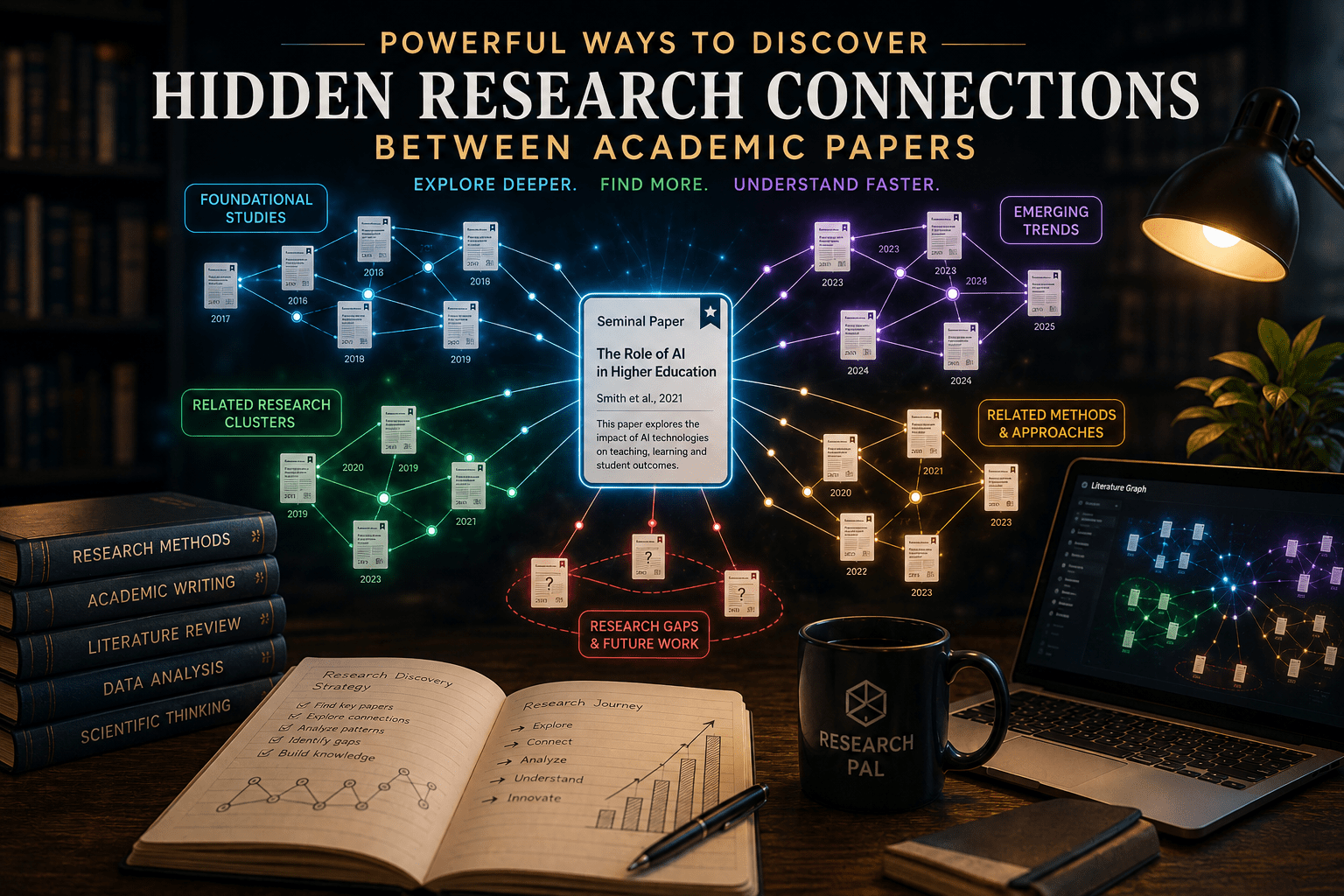
Finding academic papers is easier than ever. Understanding how those papers connect is much harder.
A traditional academic search might return hundreds of publications containing your keywords. But some of the most valuable research relationships are not immediately visible in those results.
Two papers may investigate the same underlying problem while using completely different terminology. Studies from separate disciplines may use similar methods without citing each other. An older theoretical paper may quietly influence an entire cluster of newer research. Two publications may never directly cite one another but repeatedly appear together in the reference lists of later studies.
These are hidden research connections.
Discovering them can help students and researchers understand a field more deeply, find important literature they might otherwise miss, develop stronger literature reviews, and even identify promising research gaps.
Modern research discovery therefore requires more than typing keywords into a search box.
Citation networks, similarity graphs, co-citation analysis, bibliographic coupling, author networks, and cross-disciplinary searching can reveal relationships that conventional search results often leave hidden.
This guide explains seven powerful ways to discover hidden connections between academic papers and how tools such as ResearchPal can help turn those connections into a more structured research workflow.
Quick Answer: How Can You Find Connections Between Academic Papers?
Researchers can discover connections between academic papers by combining citation chaining, similarity graphs, co-citation analysis, bibliographic coupling, semantic and alternative-keyword searching, author exploration, and research-cluster analysis.
The most effective approach is not to rely on one technique. Start with a highly relevant paper, examine its references and later citations, explore similar publications, identify recurring authors and research clusters, and verify promising connections by reading the original studies.
This approach can uncover relevant literature even when papers use different terminology or do not directly cite one another.
What Are Hidden Connections Between Research Papers?
A hidden research connection is a meaningful relationship between academic publications that may not be obvious from their titles, keywords, or position in ordinary search results.
Consider two hypothetical papers:
Paper A: “Automated Feedback Systems for Undergraduate Learning”
Paper B: “Large Language Models as Formative Assessment Assistants”
A simple keyword search might treat these as different topics.
But both could investigate a similar underlying question:
Can AI-generated feedback improve student learning?
The relationship becomes clearer when you examine their:
- Research questions
- References
- Methods
- Theoretical frameworks
- Findings
- Authors
- Citation patterns
This is why discovering literature should involve more than exact keyword matching.
Why Research Connections Are Easy to Miss
Academic knowledge does not develop inside one perfectly organized database.
Research spreads across disciplines, journals, countries, terminology, and research traditions.
Different Terminology for Similar Ideas
Academic language evolves.
Researchers studying closely related concepts might use terms such as:
- Generative AI in education
- Large language models for learning
- AI-supported tutoring
- Automated educational feedback
- Intelligent learning assistants
Searching for only one phrase can exclude valuable literature using another.
Research Is Spread Across Disciplines
The same underlying problem may be studied independently by several disciplines.
For example, misinformation might be investigated within:
- Computer science
- Psychology
- Political science
- Communication
- Sociology
Each field may use different terminology, theories, methods, and publication venues.
Cross-disciplinary connections may therefore remain invisible during a narrow database search.
Keyword Search Shows Relevance, Not Structure
A search engine might identify 100 papers relevant to your query.
But it may not immediately tell you:
- Which papers introduced the main theories
- Which studies belong to the same intellectual tradition
- Which publications influenced later work
- Which papers share methodological foundations
- Where different research areas overlap
To understand these relationships, researchers need additional discovery techniques.
1. Explore Citation Networks
Citation networks are one of the simplest and most powerful ways to move beyond keyword search.
Every useful academic paper provides two potential research directions:
Backward into earlier literature.
Forward into later literature.
Follow References Backward
Start with a highly relevant paper and examine its reference list.
This is known as backward citation searching or backward citation chaining.
Look for references that:
- Appear central to the argument
- Introduce important theories
- Define key concepts
- Describe established methodologies
- Are repeatedly cited
Suppose a 2025 paper on AI-assisted university assessment repeatedly refers to a 2019 study about automated feedback.
Opening the earlier paper might lead you to the theoretical foundations behind the newer research.
Continue following important references and you can gradually reconstruct the intellectual history of the topic.
Follow Citations Forward
The opposite strategy is forward citation searching.
Instead of asking:
“What did this paper cite?”
ask:
“Which later papers cited this study?”
Forward searching can reveal:
- New applications
- Replication studies
- Critiques
- Methodological improvements
- Updated datasets
- Contradictory findings
Using backward and forward searching together allows you to explore how an idea developed over time.
2. Use Research Paper Similarity Graphs
Citation searching follows explicit citation links.
But relevant papers do not always cite each other.
This is where similarity graphs become useful.
A research similarity graph visually groups publications according to measures of relatedness used by the particular platform.
Start With a Strong Seed Paper
A seed paper is the publication you use as the starting point for graph exploration.
Choose a paper that:
- Closely matches your question
- Uses relevant methodology
- Contains useful references
- Represents an important research direction
The stronger your starting point, the easier it becomes to explore meaningful neighboring literature.
Explore Neighboring Research Clusters
Once the graph appears, don’t simply click the closest node.
Look at the broader structure.
You may notice groups of papers forming clusters.
For example:
AI in Higher Education
→ Academic integrity
→ AI literacy
→ Automated feedback
→ Assessment design
→ Student perceptions
These clusters can reveal relationships that were difficult to recognize from a standard search-results page.
Similarity graphs are especially useful when papers discuss related ideas using different terminology.
3. Look for Co-Citation Connections
Two papers do not have to cite each other to be intellectually connected.
They may instead be cited together by other researchers.
This is the basic idea behind co-citation.
What Is Co-Citation?
Imagine:
Paper C cites Paper A and Paper B.
Paper A and Paper B have now been co-cited.
If many later publications repeatedly cite A and B together, that pattern can indicate that researchers view them as conceptually or intellectually related.
Why Co-Citation Reveals Hidden Relationships
Suppose one paper introduces a theory while another develops an important methodology.
The papers may never directly cite each other.
Yet later researchers might repeatedly use both when studying the same problem.
Co-citation can therefore reveal connections based on how the wider research community uses publications together.
It is particularly useful for identifying:
- Foundational literature
- Intellectual traditions
- Closely related theories
- Influential methodological papers
- Research communities
4. Use Bibliographic Coupling
Bibliographic coupling approaches connections from another direction.
Instead of asking whether later researchers cite two papers together, it asks whether two papers cite the same earlier literature.
How Shared References Connect Papers
Imagine:
Paper A cites Papers X, Y, and Z.
Paper B also cites Papers X, Y, and Z.
Even if Paper A never cites Paper B, their shared references suggest that they may build upon similar intellectual foundations.
The more references two papers share, the stronger this type of bibliographic relationship may be.
When Bibliographic Coupling Is Useful
Bibliographic coupling can be particularly useful for newer research.
Why?
Co-citation relationships can take time to develop because later papers need to cite the publications.
New papers may not yet have accumulated many citations.
But their reference lists already exist at publication.
Examining shared references can therefore help reveal relationships among relatively recent studies.
5. Search Across Different Academic Keywords
One of the simplest ways to uncover hidden literature is also one of the most frequently overlooked:
Change your vocabulary.
Never assume your first search phrase represents the terminology used across an entire research field.
Find Synonyms and Related Concepts
Suppose your topic is:
AI feedback for students
Alternative searches might include:
- Automated feedback
- Intelligent feedback systems
- Generative AI feedback
- LLM-based feedback
- Adaptive feedback
- AI-supported formative assessment
Each variation may reveal a different group of papers.
Explore Terminology From Other Disciplines
Cross-disciplinary vocabulary is even more important.
A researcher investigating “trust in artificial intelligence” might find related work under:
- Human-AI trust
- Algorithmic trust
- Automation trust
- Technology acceptance
- Reliance on AI
- Human-computer interaction
Once you discover new terminology in one paper, add it to your search strategy.
Your search vocabulary should evolve as you learn about the field.
6. Follow Authors and Research Groups
Papers are connected through ideas, but they are also connected through people.
When the same researchers repeatedly appear in relevant literature, investigate their wider work.
Identify Recurring Researchers
Suppose five papers in your literature review cite the same researcher.
Search that author’s publication history.
You may discover:
- Earlier foundational work
- Follow-up studies
- Related experiments
- Collaborators
- Newer research directions
This can expose an entire research stream that a topic-based search did not reveal clearly.
Explore Collaboration Networks
Researchers frequently work within collaborative groups.
One author may connect you to:
- Co-authors
- Research laboratories
- Universities
- Research centres
- International collaborations
Following these networks can be particularly useful in specialist or emerging fields where a relatively small number of research groups produce much of the literature.
However, avoid limiting your review to one influential author network. Doing so can introduce selection bias and cause competing research traditions to be overlooked.
7. Compare Research Clusters
Individual clusters help you understand subfields.
But some of the most interesting discoveries happen between clusters.
Find Connections Between Subfields
Imagine your literature graph contains two strong clusters:
Cluster A: Generative AI in higher education
Cluster B: Accessibility technologies for students with disabilities
Each area may contain substantial research.
But perhaps relatively little work investigates:
Generative AI accessibility for university students with disabilities.
The relationship between these clusters may reveal an interdisciplinary research opportunity.
Spot Potential Interdisciplinary Opportunities
Look for:
- Similar questions studied in different disciplines
- Methods that could transfer between fields
- Populations studied in one area but ignored in another
- Theories that could explain findings in a neighboring field
- Technologies applied in one domain but not another
These connections can inspire stronger research questions.
However, a visual gap between clusters is not automatically evidence of a genuine academic research gap.
Always verify it through broader searching.
Citation Networks vs Similarity Graphs vs Keyword Search
These methods answer different questions.
| Method | Best Question It Answers |
|---|---|
| Keyword Search | Which papers contain or relate to these terms? |
| Semantic Search | Which papers match the meaning of my question? |
| Backward Citations | Which earlier research influenced this paper? |
| Forward Citations | Which later research built on this paper? |
| Similarity Graphs | Which publications appear closely related? |
| Co-Citation | Which papers are repeatedly cited together? |
| Bibliographic Coupling | Which papers rely on similar earlier literature? |
| Author Networks | Which researchers and groups are connected? |
The strongest literature discovery strategy combines several methods rather than treating any one of them as complete.
How Hidden Connections Can Reveal Research Gaps
Once relationships become visible, missing relationships can become interesting.
Suppose you discover three well-developed research areas:
A: AI-generated feedback
B: Higher education assessment
C: Non-native English-speaking students
You may find extensive literature connecting A and B but comparatively little work connecting all three.
That observation could lead to a potential question:
How does AI-generated formative feedback affect assessment outcomes for university students writing in a second language?
This is how literature discovery can evolve into research-question development.
Look for Four Types of Potential Gaps
Population gaps:
Who has not been studied sufficiently?
Methodological gaps:
Which methods are missing?
Contextual gaps:
Which countries, institutions, industries, or environments are underrepresented?
Conceptual gaps:
Which ideas have rarely been investigated together?
Every apparent gap should be validated before being presented as a research contribution.
Example: Discovering a Hidden Research Connection Step by Step
Imagine you are researching:
Generative AI and student learning
Step 1: Search the Main Topic
You find a strong paper about generative AI use among university students.
Step 2: Examine Its References
Several citations discuss self-regulated learning.
You had not included that phrase in your original search.
Step 3: Search the New Concept
You search:
Generative AI + self-regulated learning
This reveals another set of papers.
Step 4: Explore a Similarity Graph
The new papers connect to studies about:
- Metacognition
- Student agency
- Personalized feedback
- Learning strategies
Step 5: Follow Authors
A recurring researcher has published several studies on AI-assisted metacognition.
Step 6: Compare Clusters
You notice extensive research on AI feedback and extensive research on self-regulated learning, but fewer studies directly examining how generative AI feedback changes students’ self-regulation strategies.
Step 7: Verify the Potential Gap
You conduct broader searches using:
- Alternative keywords
- Citation chaining
- Academic databases
- Related authors
- Recent publications
Only after this broader verification should you consider the relationship a credible potential research gap.
The important point is that your original keyword search did not reveal the final research direction.
Following connections did.
How ResearchPal Helps Discover Hidden Research Connections
Finding hidden relationships is most useful when discovery connects directly to reading, analysis, organization, and writing.
ResearchPal brings several of these research stages into one workflow.
Similarity Graphs
Similarity Graphs allow researchers to move beyond isolated search results and visually explore related academic publications.
They can help reveal:
- Related papers
- Neighboring research areas
- Research clusters
- Potentially overlooked literature
Academic Search
Once a graph reveals an interesting concept, researcher, or terminology, Academic Search can be used to investigate it further.
This creates a useful cycle:
Search → Graph → New concept → Search again → Deeper discovery
Paper Insights
Finding a relationship between two papers does not tell you whether their actual evidence is comparable.
Paper Insights can help researchers examine aspects such as:
- Research objectives
- Methodology
- Findings
- Contributions
- Limitations
This supports deeper comparison between connected studies.
PDF Chat
Full-text exploration becomes particularly valuable when a connection is subtle.
Researchers can investigate questions such as:
- Do these papers use the same theoretical framework?
- How do their populations differ?
- Are their methodologies comparable?
- Do their findings agree?
- What limitations do the authors identify?
Important interpretations should always be verified against the original paper.
Literature Review Generator
Once meaningful connections have been identified, researchers need to synthesize them.
A literature review should explain relationships rather than simply summarize papers individually.
ResearchPal’s literature review workflow can assist researchers in organizing source-grounded literature around themes, findings, methods, and research directions.
Research Library
Save useful papers as soon as you discover them.
Consider organizing your library into categories such as:
- Foundational research
- Supporting evidence
- Contradictory evidence
- Methods
- Theories
- Emerging research
- Potential gaps
This turns discovery into a reusable research knowledge base.
Common Mistakes When Exploring Research Connections
Assuming a Connection Means Agreement
Two papers can be closely connected while reaching opposite conclusions.
Always read the actual findings.
Treating Citations as Quality Scores
A highly cited paper is influential, but influence does not automatically mean methodological strength.
Following Only One Research Cluster
If you explore only one cluster, you may reinforce one theoretical perspective while missing competing interpretations.
Searching Only One Database
Different databases have different coverage.
Important literature may exist outside your primary search platform.
Confusing Similarity With Citation
Two papers can be similar without citing each other.
Always understand what a particular graph’s connections represent.
Declaring Research Gaps Too Early
Finding few papers during your first search does not prove a research gap exists.
Expand terminology, databases, citation networks, and disciplines before making that claim.
Best Practices for Literature Discovery
A stronger discovery workflow looks like this:
Define topic → Search broadly → Select seed papers → Follow references → Check later citations → Explore similarity graphs → Expand terminology → Follow key authors → Compare clusters → Read relevant papers → Verify connections → Organize evidence
Throughout this process:
- Use multiple seed papers.
- Record new terminology.
- Search backward and forward.
- Explore more than one cluster.
- Compare methodologies, not just titles.
- Include recent as well as foundational work.
- Verify summaries against original papers.
- Keep a record of your search strategy.
- Treat graphs as discovery tools rather than proof.
- Validate potential research gaps systematically.
Frequently Asked Questions
What are research connections between academic papers?
Research connections are relationships between academic publications based on factors such as citations, shared references, co-citation, similarity, theories, methodologies, authors, or research themes. Some relationships are explicit, while others become visible only through deeper literature analysis.
How can I find papers related to one research paper?
Start with the paper’s reference list, examine later publications that cite it, explore similar-paper networks, search its authors, and reuse important terminology from the paper in additional academic searches.
What is citation chaining?
Citation chaining is the process of following citations backward to earlier references and forward to newer publications that cite a paper. It helps researchers trace how academic ideas develop over time.
What is co-citation?
Co-citation occurs when two publications are cited together by another paper. Repeated co-citation can indicate that the research community considers those publications intellectually related.
What is bibliographic coupling?
Bibliographic coupling occurs when two papers cite some of the same references. Shared references can suggest that the papers build upon similar intellectual foundations.
Can two papers be related without citing each other?
Yes. Papers may investigate similar questions, use related methodologies, rely on similar literature, or belong to neighboring research areas without directly citing one another.
Can research connections help identify research gaps?
Yes. Comparing research clusters and relationships can suggest understudied populations, missing methodological approaches, weak interdisciplinary connections, or unanswered questions. Potential gaps should always be verified through broader literature searching.
Are similarity graphs useful for literature reviews?
Yes. Similarity graphs can help discover related literature, reveal research clusters, and develop thematic structures. Researchers should still critically evaluate each paper before including it in a literature review.
How does ResearchPal help find hidden research connections?
ResearchPal combines Similarity Graphs with Academic Search, Paper Insights, PDF Chat, Literature Review generation, citation tools, and Research Library management, helping researchers move from literature discovery to analysis, organization, and academic writing.
Final Thoughts
The most valuable paper for your research may not contain your exact keywords.
It may not appear on the first page of your search results.
It may not even directly cite the paper you started with.
Academic knowledge develops through a complex network of citations, shared intellectual foundations, theories, methodologies, researchers, terminology, and interdisciplinary ideas.
Finding those relationships requires moving beyond simple keyword search.
Start with strong seed papers. Follow their references backward. Trace their influence forward. Explore similarity networks. Look for co-citation and shared-reference patterns. Learn the vocabulary of neighboring disciplines. Follow influential researchers. And, most importantly, compare the research clusters that emerge.
That is where hidden connections become visible.
ResearchPal can support this process by combining Similarity Graphs, Academic Search, Paper Insights, PDF Chat, Literature Review generation, citation tools, and Research Library management within a connected academic research workflow.
The goal is not simply to find more papers.
It is to understand why the papers you find belong together—and what those relationships reveal about the research field itself.

