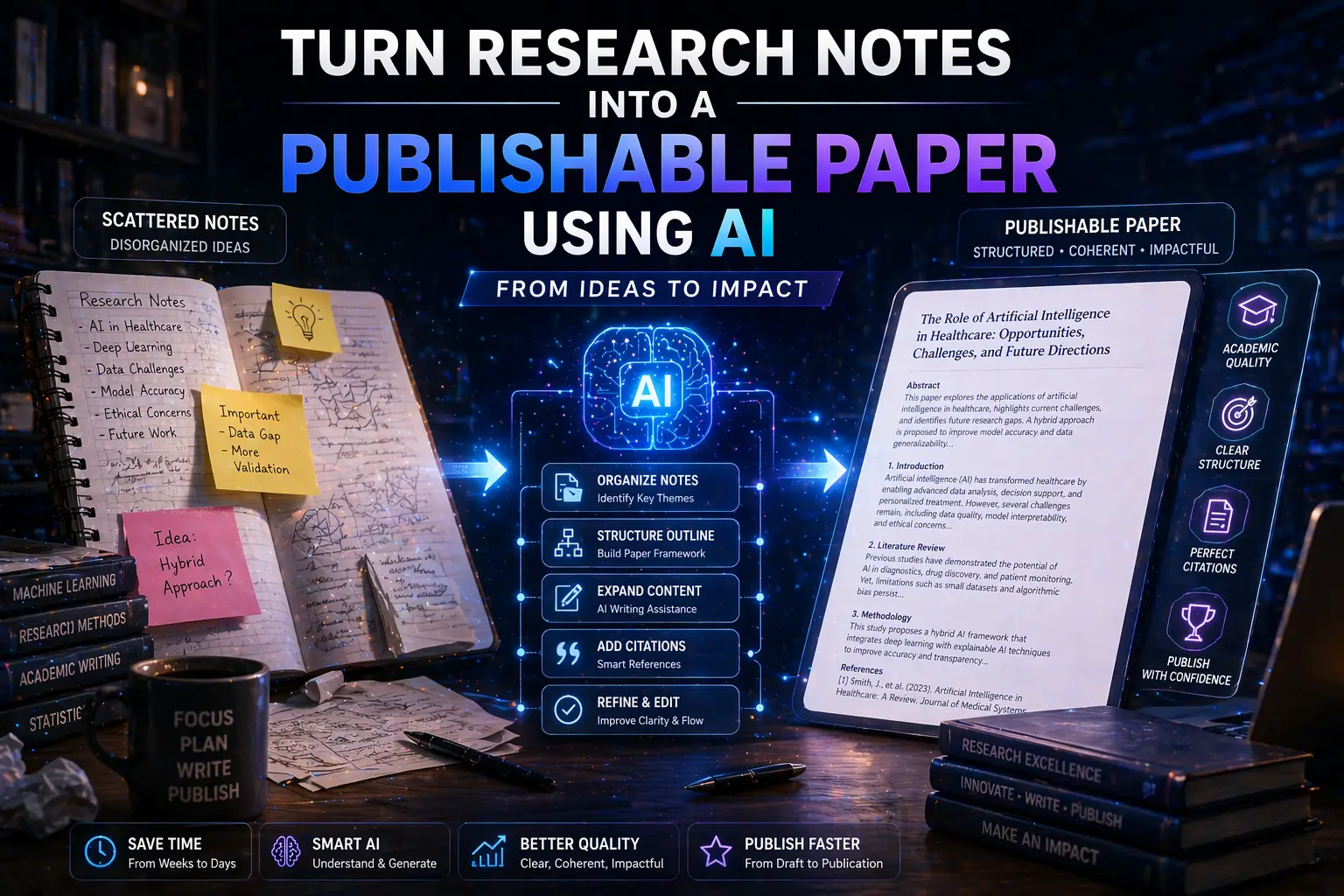
Many researchers collect valuable notes over time — from papers, lectures, and ideas — but struggle to convert them into a structured, publishable research paper.
The challenge isn’t lack of content — it’s organization, structure, and clarity.
This is where AI becomes extremely powerful. Learning how to turn research notes into a publishable paper using AI can help you transform scattered ideas into a well-structured academic manuscript efficiently.
Why Researchers Struggle With Research Notes
Most researchers face these issues:
- Notes are scattered across files and tools
- Ideas are unstructured
- No clear paper outline
- Difficulty connecting concepts
- Time-consuming writing process
As a result, valuable research often remains unused.
How AI Solves This Problem
AI tools can help:
- Organize scattered notes
- Identify key themes
- Generate structured outlines
- Convert notes into academic writing
- Improve clarity and flow
This reduces the effort required to move from notes → paper.
Step-by-Step: Convert Research Notes Into a Paper Using AI
Step 1: Gather and Consolidate Your Notes
Collect all your notes from:
- PDFs
- Documents
- Notebooks
- Research tools
AI works best when all input is in one place.
Step 2: Identify Key Themes
Use AI to:
- Group related ideas
- Identify repeated concepts
- Highlight important points
This helps create the foundation of your paper.
Step 3: Generate a Paper Outline
Ask AI to create a structure:
- Introduction
- Literature Review
- Methodology
- Results
- Discussion
- Conclusion
This transforms notes into a clear framework.
Step 4: Expand Notes Into Sections
Use AI prompts like:
“Convert these notes into a structured academic paragraph.”
AI will:
- Expand ideas
- Improve flow
- Add academic tone
Step 5: Add Citations and References
AI tools can:
- Suggest relevant citations
- Format references
- Insert in-text citations
Always verify accuracy.
Step 6: Refine and Edit
AI can help:
- Improve clarity
- Enhance readability
- Fix grammar and tone
But final editing must be done manually.
Example Workflow
Notes → Themes → Outline → Draft → Citations → Final Paper
AI accelerates each step.
Benefits of Using AI
Faster Writing
Convert notes into drafts quickly.
Better Structure
AI organizes ideas logically.
Improved Clarity
Enhances academic writing style.
Common Mistakes to Avoid
Copying AI Output Directly
Always edit and refine.
Ignoring Logical Flow
Ensure arguments are coherent.
Skipping Verification
Check citations and references.
When AI Should Be Used Carefully
Avoid relying on AI for:
- Original arguments
- Complex interpretation
- Final conclusions
Human input is essential.
Best Practice: AI + Human Workflow
- Use AI for structuring
- Use AI for drafting
- Edit manually
- Validate sources
- Finalize paper
Final Thoughts
Learning how to turn research notes into a publishable paper using AI can significantly improve productivity. AI helps organize, structure, and accelerate writing — but researchers must ensure accuracy, originality, and academic integrity.
Tools like ResearchPal make this process seamless by integrating note analysis, literature review, writing assistance, and citation management into one workflow.
Related Reading
- AI Literature Review vs Manual Literature Review: Which Is Better for Researchers in 2026?
- ResearchPal vs Jenni AI: Which AI Writing Tool Is Better for Academic Research?
From The Web
- Convert Thesis Into Research Paper With These FREE AI Tools
https://www.scientificpakistan.com/post/convert-thesis-into-research-paper-with-these-free-ai-tools
- Transform Your Research Writing with AI Paper Writer

