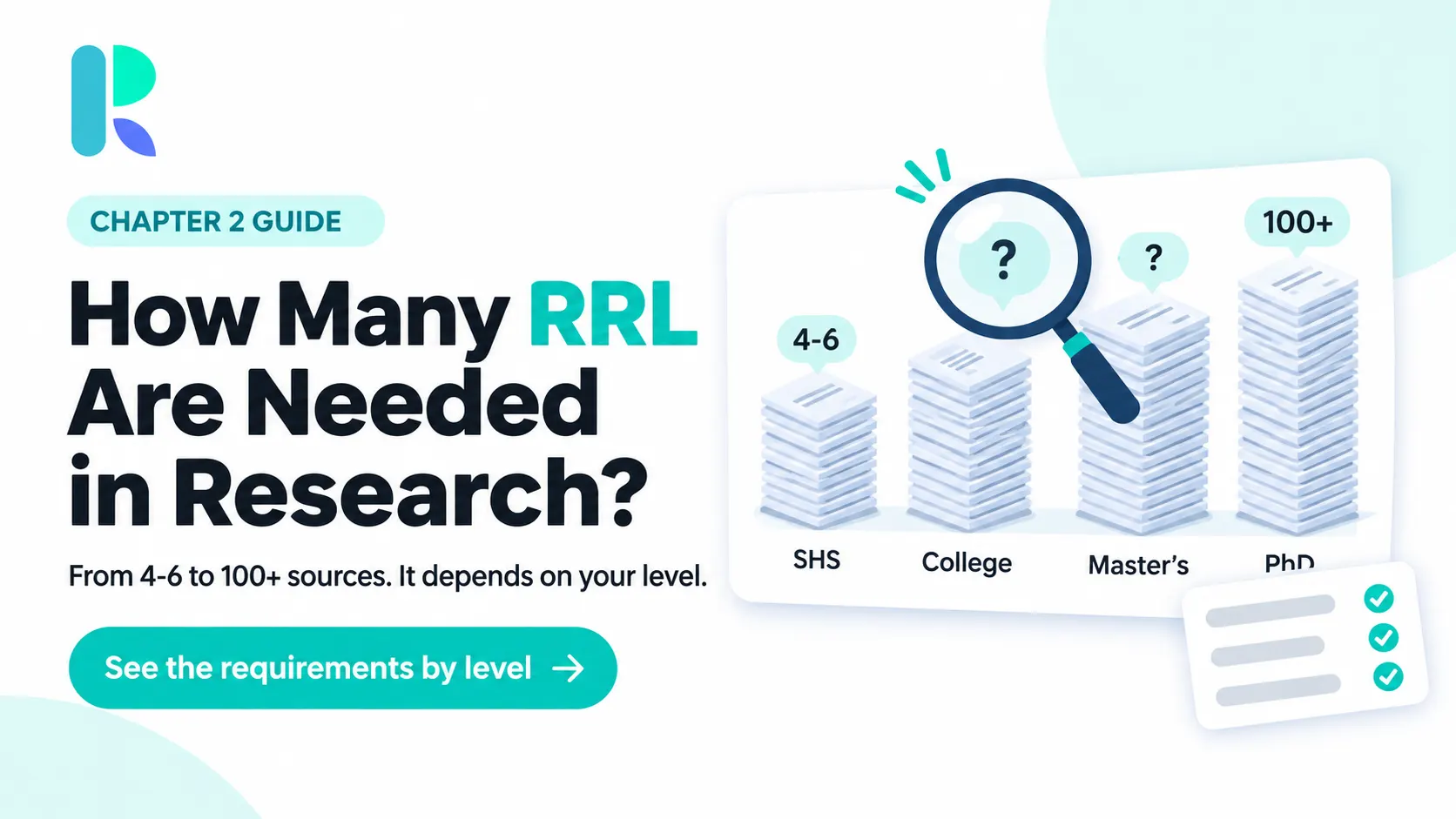
Your teacher, adviser, or school’s thesis manual decides how many sources your review of related literature (RRL) needs. In the sources checked here, requirements run from at least 4 to 6 sources in one senior high school module to at least 100 references for a dissertation. The check found no Department of Education (DepEd) or Commission on Higher Education (CHED) rule that fixes how many RRL are needed in research. Below are the requirements by level, a per-variable planning method, a sample matrix, and a checklist.
How Many Sources Should an RRL Have? Requirements by Level
| Level | What the Cited Source Asks For | Source |
|---|---|---|
| Senior high school | At least 4 to 6 local and international sources. No year limit. | DepEd Region 10 module for Inquiries, Investigation and Immersion, Quarter 1, Module 3 (Second Edition, 2021) |
| College | No minimum number and no year limit. The RRL covers foreign and local literature and studies. | Emilio Aguinaldo College (EAC) Cavite, Manual for Undergraduate Programs on Thesis Writing, 2025 Edition (PDF) |
| Master’s | At least 50 references, all within 10 years, at Divine Word College of Calapan (DWCC). At least 20 sources, 5 in each of four groups, at Pacific InterContinental College (PIC). | Divine Word College of Calapan Graduate School, Format and Style (PDF). The Pacific InterContinental College guidelines are linked in the next row. |
| Doctoral | At least 100 references, all within 10 years, at DWCC. The same 20-source minimum at PIC. | Pacific InterContinental College, Thesis/Dissertation Writing Requirements and Guidelines (PDF), and the same Divine Word College of Calapan document. |
Each row reports one source’s rule as of November 2026. Schools revise these documents, so read your own manual first.
What Counts as One RRL Source?
The RRL is the chapter. A source is one book, article, report, thesis, or study that you discuss in it. When students ask how many RRL they need, they are counting sources.
The EAC and PIC documents above sort sources into related literature and related studies. Related literature means books, articles, and reports that discuss concepts and theories. Related studies are theses, dissertations, and journal articles that report research findings. A DepEd Region 10 module for Practical Research 1 (2019) describes related studies as usually unpublished work, so ask your adviser where a published research article belongs.
Both documents split each group into local and foreign. In that DepEd module, a study is local when it was conducted in the Philippines and foreign when it was conducted abroad. Check that each one is among the credible sources for research before you count it.
A source counts once, however many in-text citations point to it. If you cite one study five times, your reference list still gains one entry.
How Many RRL Do You Need in Research at Each Level?
Read the figures below as examples of what schools ask for as of 2026. Chapter numbers differ too. EAC places the RRL in Chapter 1, and PIC makes it Chapter 2.
Senior High School
A DepEd Region 10 module for Inquiries, Investigation and Immersion (2021) asks Grade 12 students for “at least 4-6 local and international sources.” It sets no year limit and says sources must be updated and reliable. Your research teacher decides the final number for your class. Ask whether the count applies to the whole group or to each member.
College
EAC’s 2025 manual for undergraduate theses sets no minimum number and no year limit. It tells you to ask how each source helps answer your research questions. Where a manual is silent, your adviser or department decides. If you get no number, ResearchPal’s guide to how many sources a literature review needs gives 5 to 20 for an undergraduate paper.
Master’s Thesis
DWCC requires at least 50 references for a master’s thesis. PIC requires at least 5 sources in each of four groups, or 20 in all: local literature, foreign literature, local studies, and foreign studies. Your adviser and panel decide whether the minimum is enough for your topic. Count by group as you collect, so one thin group does not hold up your proposal.
Doctoral Dissertation
DWCC requires at least 100 references for a dissertation. PIC’s guidelines cover theses and dissertations, so the 20-source minimum applies there too. Treat both numbers as floors, and ask your adviser and panel for the working target. Keep a running count per variable and per publication year, so you can show the panel where your sources sit.
How Many Related Literature Sources and Studies Does a Research Paper Need per Variable?
None of the manuals cited here gives a number per variable. You can still turn your adviser’s total into a plan.
First, list your variables and research questions, which your conceptual framework already names. Next, treat each variable and each relationship between variables as one theme. Then divide the required total by the number of themes. If several research questions cover the same variables, map each question to a theme so none is left without sources.
Here is an example. A study on social media use and academic performance has two variables and one relationship, so it has three themes. If your teacher asks for 15 sources, plan 5 per theme, because 15 divided by 3 is 5. In this example, that could mean 2 literature sources and 3 studies in each theme.
Inside each theme, split the sources the way your manual requires. A school with a four-group rule like PIC’s needs local and foreign literature and local and foreign studies. Write the plan as a small table with one row per theme and one column per group, and adjust it after you search. Keep 1 or 2 extra sources per theme in reserve, in case your adviser rejects one.
How Many Years Back Should RRL Sources Go?
Year limits come from your school too. DWCC requires all references to fall within 10 years. It accepts older references that support the paper’s content, such as the work that first proposed a theory. PIC asks for at least 5 related studies from the last 10 years for each topic you present.
Other sources are looser. Benguet State University Open University’s Form & Style guide (PDF) prefers references from 2000 onward and favors books and journals over websites. A DepEd Region 10 module for Practical Research 1 (2019) uses a 5-year recency period in one search activity. EAC’s undergraduate manual sets no year limit.
Ask whether the limit counts back from the year you write or the year you defend. Counted from 2026, a 10-year limit reaches back to 2016. Keep an older source only when it is the origin of a theory or method you use, and tell your adviser why.
How Long Should the RRL Be?
Length is your school’s call too. The rules quoted on this page cover source counts and year limits, so ask your adviser for a page or word range.
For planning, see ResearchPal’s guide to how long a literature review should be. It gives 5,000 to 20,000 words for a master’s thesis review and 20,000 to 40,000 for a PhD dissertation. They are general ranges, so cut or add after your adviser reads the draft.
How to Tell You Have Enough RRL
Meeting the count is the first test. Run the other five before you stop searching. Each one takes a few minutes with your matrix open.
- You meet your adviser’s count and year limit, with the split between local and foreign sources that your manual asks for.
- Every variable and research question has sources, and no theme rests on a single study.
- New searches keep returning studies you already have, even when you change the search terms.
- You can state what is known, what is disputed, and what is missing. You will use the missing part when you write a research gap statement.
- Every source is discussed and compared with at least one other source. None appears only as a name in a list of citations.
- Each claim in the chapter traces to an entry in your reference list, and each entry appears in the chapter.
If one test fails, search for that theme only. Adding sources to every theme makes the chapter longer and leaves the weak spot where it was.
Sample RRL Matrix
This sample uses the social media and academic performance example. All 4 sources are free to read online.
| Author and Year | Type | Local or Foreign | Variable or Theme | Main Finding | How It Relates to Your Study |
|---|---|---|---|---|---|
| Alshalawi (2022) | Literature (review article) | Foreign | Social media and learning performance | Reviewed 130 articles from five educational technology journals. Most studies of learning performance reported a positive influence. | Summarizes the state of research for the opening of this theme. |
| Asanga et al. (2023) | Study | Foreign | Social media use and academic performance | Surveyed 168 senior secondary students in Uyo, Nigeria. Reported high social media use and linked it to weak academic performance. | A negative result to weigh against the review above. |
| Valdez and Datu (2023) | Study | Local | Kind of use and academic self-efficacy | Among 566 Filipino undergraduates, Facebook overuse predicted lower academic self-efficacy. Use for self-expression predicted higher self-efficacy. | Shows that the kind of use matters, which supports asking about purpose of use. |
| Amba and Cacharo (2025) | Study | Local | Social media use, study habits, and achievement | Reported significant relationships among social media use, study habits, and achievement in one Bukidnon senior high school. | A local senior high school setting. Read the full text for the direction of each relationship. |
Build your own literature review matrix in a spreadsheet, with one row per source. Fill in each row as soon as you finish reading, while the finding is fresh. Sort by theme to see which variable is short of sources, and by the local or foreign column to check your split. The last column tells you where each source goes in your argument, and rows that disagree, like the first two above, give you material for synthesis.
How to Find RRL Sources Faster With ResearchPal
For the collecting stage, ResearchPal has a paper search tool and a paper comparison tool. If you are new to database searching, read these literature search tips first.
- Open Search Papers and type your topic as a question, one variable at a time.
- Turn on the Open Access toggle when you need full text, and set the date range to match your year limit.
- Save the papers you plan to use. ResearchPal stores each citation and abstract in your Research Library, and the PDF when the paper is open access.
- Run Paper Insights on your PDFs to compare Methods Used, Results, and Limitations side by side. Export the table and copy what you need into your matrix.
Read each paper yourself before it goes into your RRL. The tools find and summarize sources, and you decide what each one means for your study.
Frequently Asked Questions
Is an RRL the Same as a Literature Review?
Yes. RRL is the name Philippine schools use for the literature review chapter, and the difference is in the layout. PIC, for example, divides the chapter into local literature, foreign literature, local studies, and foreign studies. Your RRL may need headings that a literature review elsewhere does not have.
How Many Related Studies Should Chapter 2 Have?
It depends on your school. PIC asks for at least 5 local studies and 5 foreign studies, on top of its literature sources. The other manuals cited here give one total or no number, and they leave the split to you. Ask your adviser for a number of studies per variable.
Do I Need Both Local and Foreign Sources in My RRL?
Yes, when your school’s format has both headings. The DepEd module for Inquiries, Investigation and Immersion asks for local and international sources, and PIC requires local and foreign sections. If local studies on your topic are few, tell your adviser early. Ask which sources may fill the local group.
How Many Citations Should One RRL Paragraph Have?
No manual cited here sets a number per paragraph. The APA Style page Appropriate Level of Citation advises 1 or 2 representative sources for each key point in most papers. It adds that literature reviews cite more. Cite every source you discuss, and do not repeat a citation in every sentence.
How Many Pages Should the RRL Be?
Your school decides, so ask your adviser for a page or word range. If you get none, let the sources set the length. Give each theme enough space to report what its sources found, compare them, and say what is missing. A chapter that does this for every theme is long enough.
What If I Cannot Find Enough RRL for My Topic?
Widen the search before you change the topic. Search each variable separately, try other terms for the same idea, and add foreign studies when local ones are few. You can also find open-access research papers in repositories and preprint servers. If the count is still short, show your adviser your search record and ask about adjusting the topic.
Your Next Step
Ask your teacher or adviser for two things in writing: the number of sources and the year limit. Then open a blank matrix and enter the sources you already have. The empty rows show how far you are from the number.

