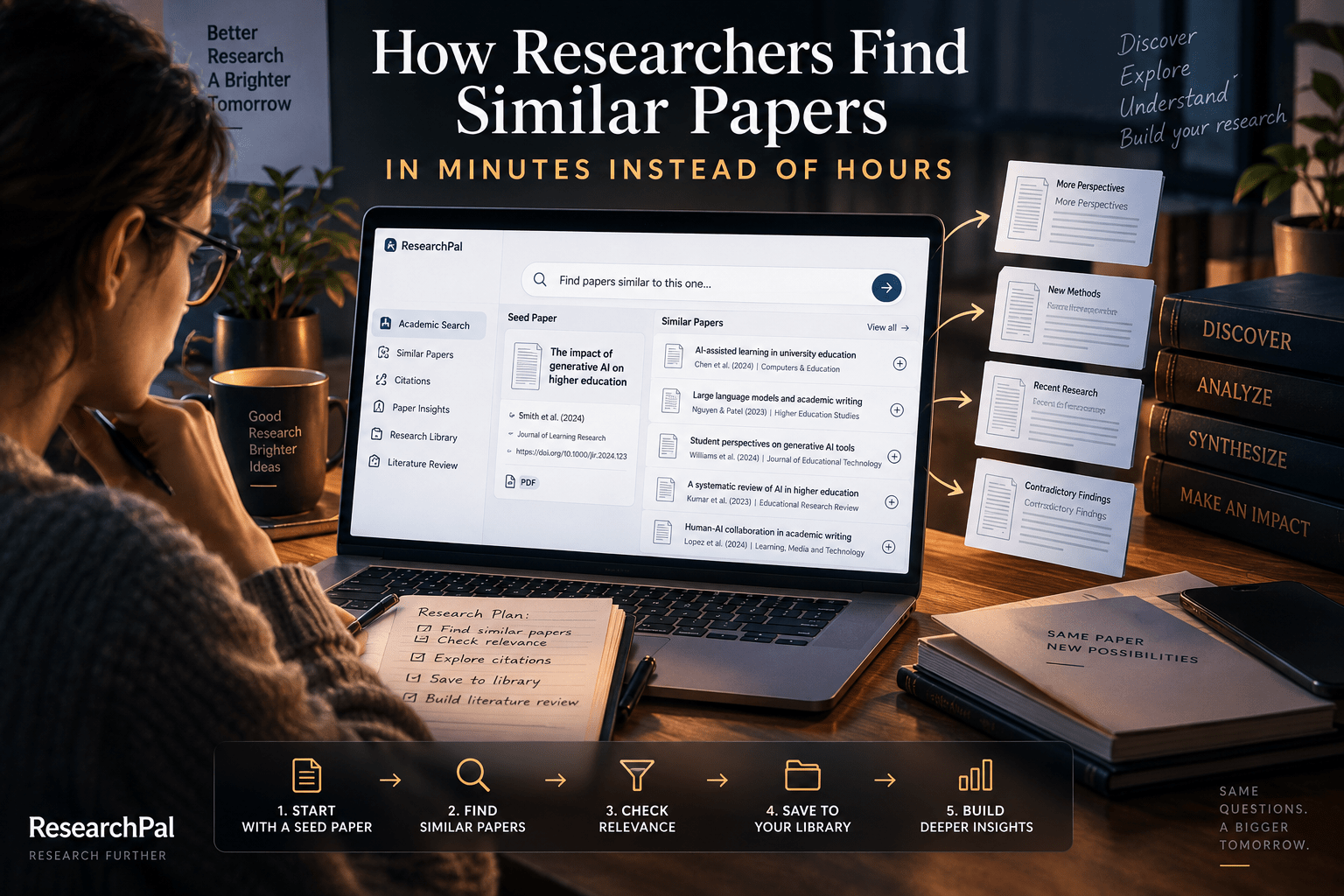
Finding one useful research paper is often just the beginning.
You discover an article that closely matches your research question, methodology, population, or theoretical framework. Then comes the harder part: finding more papers like it.
The traditional approach can quickly become repetitive. You rewrite keywords, search different combinations, scan dozens of titles, open abstracts, follow references, return to the search engine, and repeat the process.
Hours can disappear before you have built a useful reading list.
A better strategy is to stop treating every search as a new search.
Once you have found one highly relevant paper, that paper can become a seed paper—a starting point for discovering an entire network of related research.
Modern academic search methods can use the paper’s topic, abstract, terminology, references, citations, authors, methods, and semantic relationships to uncover relevant studies much faster.
The workflow becomes:
Seed Paper → Similar Papers → Relevance Check → Citation Trail → Research Library
This does not mean a comprehensive literature review can be completed in ten minutes. It means researchers can build a strong initial set of potentially relevant papers far faster than by repeatedly starting from keywords alone.
Quick Answer: How Do You Find Similar Research Papers?
The fastest way to find similar research papers is to start with one highly relevant seed paper and expand outward.
Search using its title or DOI, explore semantically related papers, inspect its reference list, find newer studies that cite it, investigate related work from the same authors, and examine research relationships through academic search and literature-discovery tools.
Instead of relying on only one search query, use multiple signals:
Topic + Meaning + References + Citations + Authors + Methods
Then check the resulting papers for actual relevance before adding them to your literature review or research library.
Why Traditional Keyword Search Can Take Hours
Keyword searching remains an important part of academic research.
The problem is that keywords alone do not always capture how researchers describe the same idea.
Different Researchers Use Different Terminology
Imagine that you are researching the use of artificial intelligence in university education.
One paper might use:
artificial intelligence in higher education
Another could discuss:
generative AI in universities
A third might focus on:
large language models for student learning
Another could describe:
AI-supported academic writing
These papers may be closely related even though their titles and abstracts do not contain exactly the same phrases.
If you search only one expression, you may miss useful research described with different terminology.
Broad Keywords Can Produce Too Many Results
A broad search such as:
AI education
could return research covering schools, universities, teacher training, educational robotics, intelligent tutoring systems, assessment, learning analytics, generative AI, administration, and many other areas.
The researcher then has to filter a large number of results manually.
Narrow Keywords Can Hide Relevant Studies
Making a search more specific reduces noise, but it can also remove relevant studies.
Researchers therefore face a constant trade-off:
Broad query → More results, more noise
Narrow query → Fewer results, greater risk of missing research
Researchers Repeat Similar Searches
A typical manual discovery process might involve:
Search → Scan → Change keywords → Search → Scan → Add synonym → Search again
This is useful during systematic searching, but it can be inefficient when your immediate goal is simply to discover research similar to a paper you already know is relevant.
What Does “Similar Paper” Actually Mean?
Two papers do not need to contain identical keywords to be academically related.
Similarity can exist at several levels.
Papers may investigate the same:
- Research problem
- Topic
- Population
- Theory
- Method
- Dataset
- Intervention
- Technology
- Outcome
- Academic debate
They may also be connected through references or citations.
For example, two papers could use different terminology but evaluate similar interventions in comparable populations.
Another pair might study the same topic using completely different methodologies.
A third pair could disagree with each other while addressing the same research question.
That final example is particularly important.
Similar does not mean identical, and it does not mean supportive.
Contradictory research can be extremely valuable in a literature review.
Start With One Strong Seed Paper
A seed paper is a publication used as the starting point for further literature discovery.
Instead of asking:
“What keywords should I search next?”
you can ask:
“What research is connected to this paper?”
What Makes a Good Seed Paper?
A useful seed paper should be closely aligned with your actual research problem.
Ideally, it has meaningful overlap with one or more of the following:
- Research question
- Population
- Methodology
- Variables
- Theoretical framework
- Dataset
- Research context
The most highly cited paper is not automatically the best seed paper.
A less famous publication may be a better starting point if it is much closer to your specific research question.
Why Seed-Paper Quality Matters
Related-paper discovery depends heavily on where you begin.
If your starting paper is only loosely related to your topic, the papers discovered around it may also drift away from your research question.
A strong seed paper provides a more useful centre for exploration.
7 Fast Ways to Find Papers Similar to a Research Article
Once you have a good seed paper, there are several ways to expand the search.
1. Search Using the Exact Paper Title
Start with the complete title.
An exact-title search can help you locate:
- The publisher version
- Repository copies
- Citation records
- Author profiles
- Related-paper pages
- Discussions of the research
It also reduces the risk of accidentally searching for a different publication with a similar topic.
2. Search by DOI
If the paper has a DOI, use it as a precise identifier.
A DOI can help distinguish the publication from papers with similar titles and can provide a useful starting point for retrieving publication information.
This is especially useful when organizing references or moving between academic discovery and citation workflows.
3. Use Semantic Academic Search
This is where related-paper discovery becomes particularly powerful.
Traditional keyword retrieval depends heavily on the words used in a query and document.
Semantic search attempts to retrieve research based more broadly on meaning and context.
Suppose your seed paper studies how generative AI affects university students’ academic writing.
A semantic discovery system may surface research involving:
- Large language models
- AI-assisted writing
- ChatGPT in higher education
- Automated writing support
- Student use of generative technologies
even when every paper does not use the same terminology as your original query.
Semantic search does not eliminate the need for keywords.
It gives researchers another discovery route.
4. Explore the Paper’s References
Open the reference list of your seed paper.
Those references show you what earlier research influenced the study.
This is commonly described as backward citation searching.
It can help uncover:
- Foundational studies
- Earlier theories
- Original methods
- Previous datasets
- Important reviews
- Seminal publications
If a paper is highly relevant, some of the literature it builds upon may also deserve investigation.
5. Find Papers That Cited It
References take you backwards.
Citations can take you forwards.
Find later papers that cite your seed publication and examine how the research developed afterwards.
This can reveal:
- Replications
- Extensions
- Critiques
- Updated datasets
- New applications
- Contradictory findings
- Methodological improvements
This is particularly useful when your seed paper is several years old.
6. Search the Authors’ Related Work
Researchers frequently work on related problems over multiple publications.
If a paper is highly relevant, examine the authors’ other work.
You may discover:
- Earlier versions of the research
- Follow-up studies
- Related experiments
- Conference papers
- Reviews
- New applications of the same method
Do not assume every paper by the same author is relevant. Use authorship as another discovery signal, not as a substitute for relevance checking.
7. Explore Similarity and Literature Graphs
Literature graphs can provide a visual way to explore clusters and relationships around a paper.
Instead of viewing academic search results only as a linear list, researchers can investigate groups of connected publications and move between related areas.
Graphs can be especially useful for identifying:
- Research clusters
- Influential papers
- Related studies
- Branches of a research field
- Connections between topics
However, graph-based discovery is only one approach.
For a strong search strategy, combine it with semantic search, keyword searching, references, citations, and relevance evaluation.
Keyword Search vs Semantic Search for Similar Papers
Keyword and semantic search should not necessarily be treated as competitors.
They solve different discovery problems.
| Feature | Keyword Search | Semantic Search |
|---|---|---|
| Main signal | Search terms | Meaning and context |
| Exact terminology | More important | Less dependent on exact wording |
| Known technical terms | Very useful | Useful |
| Terminology variation | Can require multiple queries | Can help uncover related language |
| Starting point | Usually a query | Query or research context |
| Best use | Precise controlled searching | Related-paper discovery |
If you know the exact technical terminology used in your field, keyword searching can be extremely powerful.
If you are still learning how a research field describes a concept, semantic discovery can help reveal terminology you had not considered.
A strong researcher can use both.
The 10-Minute Similar-Paper Discovery Workflow
Finding every relevant paper for a dissertation in ten minutes is unrealistic.
Finding a useful initial research set does not have to take hours.
Here is a practical workflow.
Minutes 0–2: Select Your Seed Paper
Choose one publication that strongly matches your research question.
Confirm that you understand:
- What it studies
- Who or what it studies
- How the research was conducted
- Why it matters to your project
Minutes 2–4: Discover Semantically Related Research
Use academic discovery tools to search around the topic or paper.
Do not immediately read every result.
Look first at:
- Titles
- Years
- Abstracts
- Research questions
Your goal at this stage is discovery, not deep reading.
Minutes 4–6: Follow the Citation Trail
Inspect both directions.
Backward: What did the paper cite?
Forward: What later research cited the paper?
This can quickly expose both foundational and newer research.
Minutes 6–8: Filter for Relevance
Now inspect promising papers more carefully.
Ask:
- Does it address my research problem?
- Is the population relevant?
- Is the methodology useful?
- Is it recent enough for my purpose?
- Does it provide a different perspective?
- Does it challenge other evidence?
Reject weak matches quickly.
Minutes 8–10: Save and Organize
Add the strongest candidates to your research library.
Do not simply create a folder containing 50 unexplained PDFs.
Organize papers using categories relevant to your project, such as:
Foundational
Recent
Methodology
Supporting evidence
Contradictory evidence
Potential research gap
This turns discovery into a reusable research asset.
How to Tell Whether a Similar Paper Is Actually Relevant
A similarity score, related-paper recommendation, or literature graph should never make the final research decision for you.
Researchers still need to evaluate the paper.
Research Question
Does the paper actually address a question related to yours?
Shared terminology alone is not enough.
Study Population
A paper may study the same intervention in a completely different population.
That could still be useful, but the distinction matters.
Methodology
Check whether the researchers used:
- Experiments
- Surveys
- Interviews
- Case studies
- Observational data
- Systematic reviews
- Meta-analysis
- Computational methods
Methodological similarity or difference can both be valuable depending on your purpose.
Dataset
For data-intensive research, two studies using the same or comparable datasets may be closely connected even if their titles appear different.
Publication Date
Older research can provide foundations.
New research can show how the field has developed.
A strong literature review often needs both.
Findings
Do not collect only papers that support the same conclusion.
Contradictions can reveal important academic debates.
Limitations
Limitations are particularly useful when searching for a research gap.
A later paper may directly address weaknesses identified in an earlier study.
How to Find Similar Papers for a Literature Review
Finding related papers for a literature review requires more than collecting articles about the same topic.
A literature review should help you understand the structure of the evidence.
Start with a strong seed paper, then deliberately look for different categories of research.
A useful discovery sequence is:
Seed Paper
↓
Related Studies
↓
Foundational Research
↓
Recent Research
↓
Different Methodologies
↓
Supporting and Contradictory Evidence
↓
Limitations
↓
Research Gaps
This prevents the literature review from becoming a list of papers that all make essentially the same point.
The objective is synthesis.
You want to understand:
- Where researchers agree
- Where they disagree
- Which methods dominate
- How methods have changed
- Which populations have been studied
- Which populations remain under-researched
- Which limitations repeatedly appear
- What questions remain unresolved
That is much more valuable than simply finding “ten papers similar to this one.”
How to Find Recent Papers Similar to an Older Study
Older papers can be excellent seed papers.
Suppose you find an influential study from 2018.
Instead of rejecting it because it is old, use it as a gateway.
Look for newer research that:
- Cites the original study
- Replicates it
- Challenges its conclusions
- Applies its method to a new population
- Uses a newer dataset
- Introduces a different methodology
- Extends the theoretical framework
- Reviews the subsequent literature
This creates a chronological research trail:
Original Study → Later Citations → Extensions → Critiques → Current Evidence
It can be much more efficient than attempting to invent every possible modern keyword yourself.
How to Find Similar Papers When You Don’t Know the Right Keywords
This is a common problem for students entering a new research area.
You know the idea you want to study.
You do not yet know the vocabulary researchers use to describe it.
A seed paper can solve part of that problem.
Inspect its:
- Title
- Abstract
- Keywords
- Section headings
- References
- Technical terminology
Then examine related papers and note recurring phrases.
Your search vocabulary begins to expand.
For example:
AI in education
might lead to:
generative AI in higher education
which could lead to:
LLM-assisted learning
which could lead to:
AI-supported academic writing
which could reveal:
human-AI collaborative writing
The search process itself teaches you the language of the field.
You can then feed those newly discovered terms back into more precise keyword searches.
Common Mistakes When Searching for Similar Research Papers
Using Only One Keyword
One keyword rarely represents an entire academic concept.
Explore synonyms, related concepts, technical terminology, and semantic relationships.
Assuming “Similar” Means “Relevant”
A recommendation algorithm may identify topical similarity.
Only the researcher can determine whether the paper is useful for the specific research question.
Reading Every Paper in Full Immediately
Discovery and deep reading are different stages.
First:
Title → Abstract → Relevance
Then deeply read the strongest papers.
Ignoring Citation Trails
References and citing papers can reveal research that keyword searching misses.
Use both backward and forward discovery.
Looking Only at Highly Cited Older Papers
Citation counts can help identify influential research, but newer papers have had less time to accumulate citations.
Do not automatically exclude recent studies because they have fewer citations.
Saving Papers Without Organizing Them
Finding 100 papers is not helpful if you cannot remember why you saved them.
Organize sources as you discover them.
Relying on Only One Discovery Method
No single search method should be assumed to provide complete coverage.
Combine approaches where appropriate:
Keywords + Semantic Search + References + Citations + Authors + Literature Graphs
How ResearchPal Helps Researchers Discover Related Papers Faster
The challenge is not simply finding more PDFs.
Researchers need a workflow for moving from discovery to understanding.
ResearchPal brings several stages of that research process together.
Academic Search
Academic Search helps researchers discover scholarly sources related to their questions and topics.
Rather than repeatedly searching the wider web from scratch, researchers can use academic-focused discovery as a starting point.
Similarity-Based Discovery
Related-paper discovery can help researchers move beyond exact keyword matching and explore research connected by topic and meaning.
This is especially useful when different researchers describe similar ideas using different terminology.
Paper Insights
Discovering a paper does not mean it deserves hours of reading.
Paper Insights can help researchers examine important aspects of a publication, such as its methods, findings, contributions and limitations, before deciding where deeper reading is worthwhile.
Research Library
Promising sources can be saved and organized instead of repeatedly rediscovered.
This becomes particularly important as a project grows from a few papers into dozens or hundreds of references.
PDF Chat
Once researchers identify important papers, PDF Chat can support closer exploration of individual documents.
Important claims, quotations, results and page-specific evidence should still be checked against the original paper.
Literature Review Tools
The final objective is rarely just “find similar papers.”
Researchers eventually need to compare and synthesize them.
Literature review workflows can help move from individual publications toward:
- Themes
- Methods
- Findings
- Contradictions
- Limitations
- Research gaps
The broader ResearchPal workflow becomes:
Discover → Evaluate → Save → Understand → Compare → Synthesize
Similar Papers vs Connected Papers vs Citation Searching
These methods overlap, but they are not identical.
Similar-paper discovery attempts to identify research that is conceptually or contextually related.
Citation searching follows explicit scholarly relationships created when one publication cites another.
Literature graphs provide a visual representation of relationships or clusters between papers.
Each can reveal something the others may miss.
For example, semantic similarity could identify two papers studying the same problem using different terminology even when they do not directly cite each other.
Citation searching can reveal the historical development of an idea.
A literature graph can make clusters and relationships easier to explore visually.
Researchers therefore do not need to choose only one.
A stronger approach combines them.
Research Paper Discovery Checklist
Before ending a related-paper search, ask yourself:
- Did I begin with a genuinely relevant seed paper?
- Did I try more than one keyword or phrase?
- Did I explore semantic relationships?
- Did I inspect the seed paper’s references?
- Did I look for later research that cited it?
- Did I investigate relevant work from key authors?
- Did I include both foundational and recent studies?
- Did I check abstracts before reading entire papers?
- Did I consider different methodologies?
- Did I look for contradictory evidence?
- Did I organize useful sources?
- Did I verify important evidence in the original papers?
Frequently Asked Questions
How can I find papers similar to a research paper?
Start with a relevant seed paper and search using its title, DOI, topic, abstract, references, citations, authors, and semantic relationships. Combining several discovery methods is usually more useful than relying on one keyword search.
How do I find related research papers quickly?
Choose one strong seed paper, use academic or semantic search to identify related research, inspect its references and citing papers, scan titles and abstracts for relevance, and save the strongest results to an organized research library.
Can I find similar papers using a DOI?
A DOI can help identify a specific scholarly work accurately and can be useful as a starting point in academic discovery and reference workflows. Whether a particular tool can directly recommend similar papers from a DOI depends on its functionality.
What is semantic academic search?
Semantic academic search aims to retrieve scholarly research based on meaning and context rather than relying only on exact keyword matches. It can help researchers discover relevant papers that use terminology different from their original search query.
How do I find papers that cite another paper?
Use an academic search or citation-indexing service that provides a list of publications citing the seed paper. This forward citation search is particularly useful for discovering newer studies, replications, extensions and critiques.
How do I find recent papers related to an older study?
Start with the older study and examine newer publications that cite it. Also search its core concepts, methods, authors and terminology while applying an appropriate publication-date filter.
How do I find similar papers for a literature review?
Do not search only for papers that resemble each other. Use a seed paper to identify related studies, foundational research, recent publications, different methodologies, supporting and contradictory evidence, recurring limitations and potential research gaps.
Is semantic search better than keyword search?
Neither method is universally better. Keyword search is powerful when terminology is known and precise. Semantic search can help when relevant papers use different language. Researchers can combine both approaches.
How can AI help find related research papers?
AI-supported academic tools can assist with semantic retrieval, paper analysis, clustering and research discovery. Researchers should still evaluate the relevance and quality of each source and verify important evidence against the original publication.
Can ResearchPal help find similar academic papers?
ResearchPal supports academic search and related research workflows alongside Research Library, Paper Insights, PDF Chat, literature review tools, citation tools and academic writing support. This allows researchers to move from finding papers toward organizing, understanding and synthesizing the literature.
Final Thoughts
The fastest researchers are not necessarily the researchers who type faster searches.
They build on what they have already found.
One strong research paper contains multiple discovery paths:
Its topic
Its terminology
Its authors
Its references
Its citations
Its methods
Its academic relationships
Instead of restarting your literature search from zero every time, use those signals to move outward.
The process can become:
One Relevant Paper → Similar Research → Citation Trail → Relevance Check → Research Library → Literature Synthesis
This approach does not replace rigorous academic searching, and it does not mean a comprehensive literature review can be completed in minutes.
What it can do is dramatically reduce the time spent repeatedly searching without direction.
The goal is not simply to find more papers.
It is to find the right papers faster, understand why they matter, and turn them into a structured body of evidence for your research.

