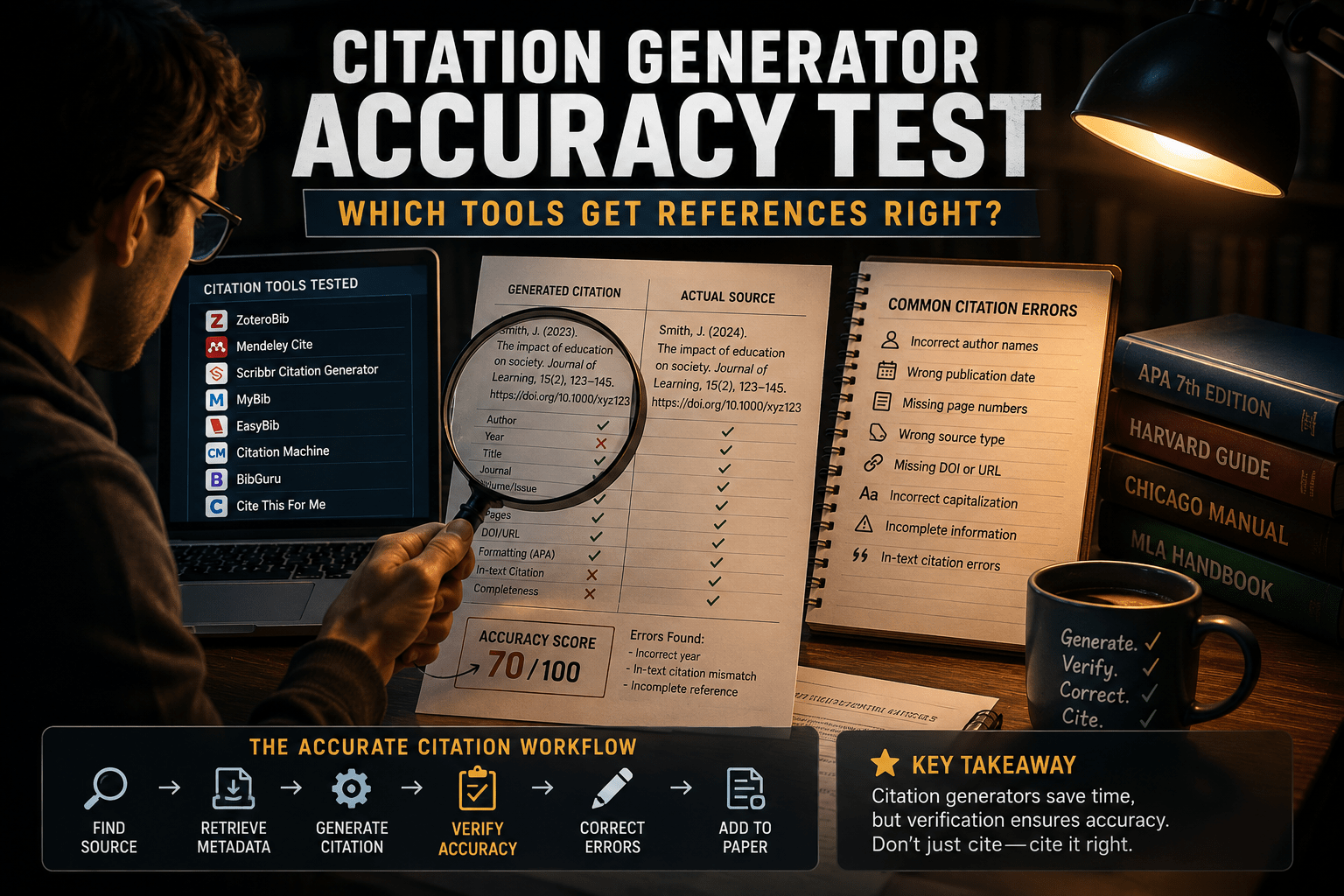
Citation generators can turn a DOI, URL, ISBN, article title, or manually entered source into a formatted reference in seconds.
That speed is extremely useful when you are writing an essay with 20 references, a dissertation with 100 sources, or a literature review containing hundreds of papers.
But there is a more important question:
Is the generated citation actually correct?
A citation can look professional while containing the wrong publication year. It can follow the punctuation rules of a citation style while missing an author. It can include the right article title but the wrong source type. It can even be generated from incomplete metadata without the student immediately noticing.
This makes citation-generator accuracy more complicated than simply asking whether a reference “looks right.”
A meaningful accuracy test needs to examine the source metadata, source type, citation-style formatting, completeness, identifiers, and in-text citation—not just the final appearance.
This guide explains how citation generators should be tested, which types of sources are easier or harder to generate accurately, the most common errors students should watch for, and how to check an automatically generated reference before submitting academic work.
Quick Answer: How Accurate Are Citation Generators?
Citation generators can produce accurate references, particularly when they begin with complete and reliable bibliographic metadata.
However, no citation generator should be assumed to be 100% accurate for every source.
Errors can occur when:
- Metadata is incomplete
- Source information is incorrect
- A source type is misidentified
- Citation-style rules are applied incorrectly
- A webpage has no clear author or publication date
- A chapter is confused with an entire book
- Edition or page information is missing
- Imported metadata is outdated or incomplete
For students, the safest workflow is:
Generate → Verify → Correct → Cite
The generator handles repetitive formatting.
The student verifies that the information being formatted is actually correct.
What Does “Citation Accuracy” Actually Mean?
When students talk about an “accurate citation,” they often mean that the citation looks correctly formatted.
That is only one part of accuracy.
A proper citation accuracy test should evaluate several separate dimensions.
Metadata Accuracy
First, does the citation contain the correct information about the source?
Depending on the source, this could include:
- Author names
- Article or chapter title
- Book title
- Journal title
- Publication year
- Publisher
- Volume
- Issue
- Page range
- Edition
- DOI
- URL
A citation generator cannot compensate for incorrect metadata simply by formatting it beautifully.
For example, imagine the correct publication year is 2025 but imported metadata says 2024.
The generator may apply every punctuation and italicization rule correctly.
The reference is still wrong.
Citation-Style Accuracy
The next question is whether the source information has been formatted according to the required style.
Students may need styles such as:
- APA
- Harvard
- Chicago
- MLA
- IEEE
- Vancouver
Each system has its own rules.
Citation-style accuracy can involve:
- Author formatting
- Date placement
- Title capitalization
- Italics
- Punctuation
- Page formatting
- DOI presentation
- URL treatment
- Ordering of elements
A generator therefore needs both correct metadata and correct style implementation.
Source-Type Accuracy
Citation rules depend heavily on what is being cited.
A journal article is not formatted exactly like a book.
A chapter is not the same as an entire edited book.
A conference paper is not necessarily a journal article.
A government report may require different information from a standard webpage.
If a citation generator identifies the source incorrectly, the resulting reference may use the wrong structure even when much of the metadata is correct.
In-Text Citation Accuracy
Reference-list accuracy is only half the problem for citation styles that use in-text citations.
The generated in-text citation should also follow the required rules.
Depending on the style and context, this can involve:
- Author names
- Publication year
- Number of authors
- Page numbers for direct quotations
- Narrative versus parenthetical citations
Students should therefore check both sides:
In-text citation ↔ Reference-list entry
Completeness
Finally, is important information missing?
A reference may contain correct information while still being incomplete.
Examples include a missing:
- DOI
- Page range
- Editor
- Edition
- Publication date
- Publisher
- Volume
- Issue
What is required depends on the source type and citation style.
How Should Citation Generator Accuracy Be Tested?
If we genuinely want to determine which citation generator gets references right, every tool should face the same test.
Testing one easy journal article on one tool and an obscure archival source on another would tell us very little.
A fair citation-generator accuracy test needs a fixed benchmark.
A 10-Source Citation Accuracy Test
A useful benchmark could include:
Test 1: Journal Article With a DOI
This tests whether the generator can retrieve structured scholarly metadata and format it correctly.
Check:
- Authors
- Article title
- Journal
- Year
- Volume
- Issue
- Pages
- DOI
Test 2: Book With an ISBN
This tests book metadata retrieval.
Check:
- Author
- Book title
- Edition
- Publication year
- Publisher
Test 3: Chapter in an Edited Book
This is more challenging because the generator must distinguish the chapter from the complete book.
Check:
- Chapter author
- Chapter title
- Editor
- Book title
- Pages
- Publisher
- Year
Test 4: Standard Webpage
Use a webpage with a clearly identifiable:
- Author or organization
- Title
- Publication date
- URL
This provides a relatively clean web test.
Test 5: Webpage Without a Named Author
Now remove one of the easy metadata signals.
Does the generator correctly handle an organizational author or an absent author according to the selected citation style?
Test 6: Webpage Without a Publication Date
This tests how the generator handles incomplete date information.
The tool should follow the relevant citation rules rather than inventing a date.
Test 7: Conference Paper
Check whether the tool recognizes conference proceedings correctly instead of treating the paper as a journal article.
Test 8: Government or Institutional Report
This tests organizational authorship, report information, publication details, and URLs or identifiers.
Test 9: Thesis or Dissertation
Check:
- Author
- Year
- Thesis title
- Degree or publication type where required
- Institution
- Repository information where applicable
Test 10: Source With Multiple Authors
This tests whether author names and ordering are handled correctly.
It also helps evaluate the corresponding in-text citation.
Citation Generator Accuracy Scorecard
Each citation could be evaluated using the same 100-point framework.
| Accuracy Test | Points |
|---|---|
| Author information | 15 |
| Title | 10 |
| Publication date | 10 |
| Journal/publisher/source | 10 |
| Volume, issue and pages | 10 |
| DOI or URL | 10 |
| Correct source type | 10 |
| Citation-style formatting | 15 |
| In-text citation | 5 |
| Completeness | 5 |
| Total | 100 |
The same benchmark sources, citation style, reference standard, and scoring rules should be used for every generator.
That creates a much more meaningful comparison than simply saying one tool “looks accurate.”
What Would Count as a Citation Error?
Suppose a generator creates this hypothetical journal reference.
The authors are correct.
The title is correct.
The journal is correct.
The DOI is correct.
But the publication year is wrong.
That should lose points under publication-date accuracy.
If the metadata is correct but the citation style uses the wrong capitalization or punctuation, points should instead be deducted under citation-style formatting.
This distinction is important because it tells us why the citation failed.
A tool may be good at formatting but poor at retrieving metadata.
Another may retrieve excellent metadata but mishandle a particular citation style.
Those are different problems.
Which Sources Are Usually Easier for Citation Generators?
Not all references present the same difficulty.
Journal Articles With DOIs
Journal articles with DOIs can provide citation tools with a strong starting point because the DOI can be associated with structured scholarly metadata.
A tool may be able to retrieve fields such as:
- Authors
- Article title
- Journal
- Publication year
- Volume
- Issue
- Pages
- DOI
This does not guarantee that every retrieved field will be complete or correct.
It does, however, give the citation system structured information to work with.
Books With Clear ISBN Metadata
Books can also be relatively straightforward when reliable ISBN and publication metadata are available.
However, students should pay attention to editions.
The first edition and third edition of a textbook should not automatically be treated as the same source.
Sources With Complete Publisher Metadata
In general, citation generation becomes easier when the original source provides clear structured bibliographic information.
The more ambiguity the generator has to resolve, the greater the opportunity for error.
Which Sources Can Cause More Citation Problems?
Citation generators become more interesting to test when the source is messy.
Websites With Missing Authors
Many webpages do not have an obvious individual author.
The correct approach may involve an organization or another treatment depending on the citation style.
A generator needs to interpret this correctly.
Pages With No Publication Date
A citation generator should not invent a publication date simply because the citation format normally expects one.
Missing information needs to be handled according to the relevant citation rules.
Book Chapters
Book chapters contain multiple layers of metadata:
Chapter author → Chapter title → Editor → Book title → Publisher → Pages
This makes them more complicated than citing an entire book.
Conference Proceedings
Conference papers can also cause classification problems.
A generator needs to distinguish the individual paper from the proceedings in which it appears.
This is particularly relevant in fields such as:
- Computer science
- Artificial intelligence
- Engineering
where conference publications can form an important part of the literature.
Government and Institutional Reports
Reports may use an organization rather than an individual as the author.
They can also include:
- Report numbers
- Departments
- Government agencies
- Institutional publishers
- URLs
- Publication dates
Incorrectly interpreting organizational information can produce an inaccurate reference.
Theses and Dissertations
These can require information about:
- Author
- Title
- Year
- Institution
- Degree or thesis type
- Repository
- URL
The exact requirements depend on the citation style.
Unusual Online Sources
Online material is extremely diverse.
A “website” might actually be:
- A news article
- A government publication
- A dataset
- A blog post
- An online report
- A documentation page
- An organizational webpage
Correctly identifying what the source actually is matters.
The Most Common Citation Generator Errors
Students do not need to memorize every citation rule to spot suspicious output.
Several problems are worth checking every time.
Wrong Author Names
Imported metadata can contain:
- Missing authors
- Incorrect initials
- Reversed names
- Organizational-author problems
- Incorrect author order
Author errors are particularly serious because author information often appears in both the reference and the in-text citation.
Incorrect Publication Dates
Webpages are especially vulnerable to date confusion.
A tool might encounter several dates on the same page:
- Original publication
- Last updated
- Copyright
- Current year
- Access date
These dates are not necessarily interchangeable.
Missing Page Numbers
Journal articles and book chapters may require page information.
Missing page metadata can make a reference incomplete.
Wrong Source Type
This can affect the entire citation structure.
A book chapter formatted as a book is not merely a punctuation mistake.
It represents a classification error.
Incorrect Capitalization
Different citation styles apply different capitalization rules.
Automatic tools need to distinguish between ordinary title words and terms whose capitalization matters.
Examples can include:
- AI
- DNA
- Python
- LaTeX
- GPT
Students should pay particular attention to acronyms, proper nouns, and technical terminology.
Missing DOI
If a scholarly source has a DOI and the relevant style calls for it, omitting it may make the citation incomplete.
Incorrect URL
URLs can also be problematic.
A generator might capture:
- A search-results URL
- A tracking URL
- A temporary link
- A database session URL
instead of the appropriate persistent source location.
Missing Editors
Edited books and book chapters can expose weaknesses in citation metadata.
If the editor information is required but absent, the final reference may be incomplete.
Wrong Edition
This is particularly important for textbooks and academic books with multiple editions.
A citation should represent the version the student actually used.
Incorrect In-Text Citation
Even when the reference list looks correct, check the corresponding in-text citation.
A generator may mishandle multiple authors, page numbers, or other style-specific requirements.
DOI vs URL vs Manual Entry: Which Gives a Citation Generator the Best Starting Point?
How you enter a source can influence the quality of the resulting citation.
DOI Lookup
For scholarly publications with reliable DOI metadata, DOI lookup can be highly efficient.
Conceptually:
DOI → Retrieve metadata → Generate citation → Verify
This reduces manual typing.
But a DOI should not be interpreted as proof that every metadata field retrieved from a database is perfect.
URL Lookup
URL lookup can be convenient for webpages.
However, web pages are less structurally consistent.
A citation generator may need to identify:
- Page title
- Site title
- Author
- Organization
- Publication date
- URL
The information may not be presented consistently across websites.
Title Search
Searching by title can work well when the title is distinctive and the correct source is identified.
However, researchers need to make sure the generator has matched the right publication.
Similar titles can produce incorrect matches.
Manual Entry
Manual entry gives the student greater control over the metadata.
It also introduces human error.
A student might mistype:
- Author name
- Year
- Volume
- Pages
- DOI
Manual entry is therefore not automatically more accurate.
The better principle is:
Use the most reliable available source information, then verify the result.
Why DOI Metadata Can Help—But Does Not Eliminate Verification
DOIs are extremely useful in academic citation workflows because they can connect scholarly works with structured bibliographic metadata.
That makes DOI-based citation generation particularly efficient for many journal articles and other registered scholarly works.
But there is an important distinction:
A DOI identifies a research object. It does not independently guarantee that every descriptive metadata field associated with that object is complete and error-free.
For citation accuracy, students should still compare important fields with the publication itself.
Check:
Author → Title → Journal → Year → Volume → Issue → Pages → DOI
Are Paid Citation Generators More Accurate Than Free Ones?
Not necessarily.
This is why citation-generator accuracy should be tested separately from pricing.
A paid tool might provide:
- Larger reference libraries
- Better organization
- Additional citation styles
- Import/export functionality
- Collaboration
- Document integrations
- Research tools
Those features may make the tool more useful.
They do not automatically make every citation more accurate.
A free tool with correct metadata and a well-implemented citation style could outperform a premium tool on an individual reference.
Conversely, a sophisticated paid research platform may provide workflow advantages that a simple free generator cannot.
The two questions should therefore be separated:
How accurate is the citation?
and
How useful is the overall tool?
Can AI Citation Generators Make Mistakes?
Yes.
AI introduces another important distinction into citation generation.
There is a difference between:
Formatting verified bibliographic metadata
and
Asking an AI model to reconstruct or guess a reference from incomplete information.
Students should be especially cautious when an AI system supplies bibliographic information that was not provided or retrieved from an identifiable source.
An AI system should not simply invent a:
- DOI
- Author
- Journal
- Volume
- Issue
- Page range
- Publication date
to make a citation appear complete.
A citation that looks plausible is not necessarily a citation to a real source.
The safest workflow is to begin with an identifiable publication and verify its bibliographic information.
Citation Generator vs Manual Citation: Which Is More Accurate?
It is tempting to frame the choice as:
Human vs machine
But neither approach is automatically error-free.
Manual Citation Risks
Students can:
- Mistype authors
- Forget punctuation
- Use the wrong capitalization
- Omit a DOI
- Misplace the year
- Apply rules inconsistently
Citation Generator Risks
Automated systems can:
- Import incorrect metadata
- Misclassify sources
- Omit fields
- Apply style rules incorrectly
- Capture inappropriate URLs
The strongest approach combines the advantages of both.
Automation for speed.
Human verification for quality control.
The workflow becomes:
Source
↓
Retrieve metadata
↓
Generate citation
↓
Verify against source
↓
Correct errors
↓
Add to paper
How to Check Whether a Generated Citation Is Correct
Students can dramatically reduce citation errors by following a repeatable checking process.
Step 1: Open the Original Source
Do not verify one citation generator against another citation generator.
Go back to the publication.
Step 2: Check Every Author
Confirm:
- Names
- Initials
- Order
- Organizational authors
Step 3: Verify the Publication Year
Make sure the citation uses the relevant publication date.
Step 4: Check the Exact Title
Compare the generated title with the publication.
Look carefully at:
- Subtitles
- Acronyms
- Proper nouns
- Technical terms
Step 5: Verify the Journal or Publisher
For a journal article, confirm the journal.
For a book, check the publisher.
For a report, confirm the responsible organization.
Step 6: Check Volume, Issue and Pages
These fields are easy to overlook because they often appear as small numbers inside a long citation.
Step 7: Verify the DOI or URL
For DOI-based scholarly sources, check that the identifier resolves to the intended publication.
For online sources, make sure the URL points to the correct source rather than a temporary or irrelevant page.
Step 8: Confirm the Source Type
Ask:
What am I actually citing?
A journal article?
A chapter?
A whole book?
A report?
A webpage?
A conference paper?
The answer determines which citation rules should be applied.
Step 9: Compare With Your Required Citation Style
Use the style guide required by your:
- University
- Department
- Instructor
- Journal
- Conference
This is particularly important when institutions use their own referencing guidance.
Step 10: Check the In-Text Citation
Finally, make sure the citation inside your writing corresponds correctly to the reference-list entry.
The 30-Second Citation Accuracy Check
If you do not have time to inspect every formatting rule immediately, start with seven fields:
Author → Year → Title → Source → Pages → DOI/URL → Style
Ask:
Author: Is the author correct?
Year: Is this the actual publication year?
Title: Is the title exact?
Source: Is the journal, book, publisher, or website correct?
Pages: Are the relevant pages present and accurate?
DOI/URL: Does the identifier point to the right source?
Style: Does the citation follow the referencing system required for the assignment?
If anything looks suspicious, inspect the original source before submitting.
How ResearchPal Can Support a More Reliable Citation Workflow
Citation accuracy begins before the citation is generated.
Researchers first need to identify the correct source.
ResearchPal supports the broader workflow surrounding citation and academic research.
Academic Search
Academic Search helps researchers discover relevant scholarly sources.
This matters because correctly formatting the wrong paper does not improve the quality of a research project.
Citation and Reference Tools
Citation and reference tools can reduce repetitive formatting work and help researchers manage academic sources.
Generated references should still be verified.
Research Library
A research library can help students maintain sources across larger projects rather than repeatedly searching for the same papers.
This becomes increasingly useful for:
- Dissertations
- Theses
- Literature reviews
- Journal papers
- Long-term research projects
Paper Insights
Before citing a paper, researchers should understand why it matters.
Paper Insights can help users investigate aspects such as:
- Objectives
- Methods
- Findings
- Contributions
- Limitations
The goal is not simply to accumulate citations.
It is to cite relevant evidence.
PDF Chat
PDF Chat can help researchers explore longer academic documents.
When a specific claim, quotation, result, or page reference is important, researchers should verify it against the original document.
Literature Review Tools
Citation accuracy is important, but a strong literature review also requires synthesis.
Researchers need to identify:
- Themes
- Agreements
- Contradictions
- Methodological differences
- Limitations
- Research gaps
Literature review tools can support this broader analytical process.
Citation Accuracy Checklist for Students
Before submitting any automatically generated reference, check:
- Are all authors correct?
- Is the publication year correct?
- Is the title exact?
- Is capitalization appropriate?
- Is the source type correct?
- Is the journal or publisher correct?
- Is the volume correct?
- Is the issue correct?
- Are the pages correct?
- Is the edition correct?
- Is the DOI correct?
- Is the URL appropriate?
- Are editors included where required?
- Is important information missing?
- Does the in-text citation match?
- Does the citation follow the required style?
- Have you checked any university-specific requirements?
Frequently Asked Questions
Are citation generators accurate?
Citation generators can produce accurate references, especially when they begin with complete and reliable source metadata. However, they can also import incorrect information, omit fields, misidentify source types, or apply citation rules incorrectly. Students should verify generated references before submitting academic work.
Which citation generator is most accurate?
A meaningful answer requires a controlled comparison using the same sources, citation style, reference standard, and scoring criteria for every tool. Without such testing, claiming that one citation generator is definitively the most accurate would be unreliable.
Can citation generators make mistakes?
Yes. Common errors include incorrect authors, wrong publication dates, missing page numbers, incorrect capitalization, source-type errors, missing DOIs, inappropriate URLs, and incomplete publication information.
Are free citation generators accurate?
They can be. Price alone does not determine citation accuracy. A free citation generator can produce an accurate reference when it uses correct metadata and applies the citation rules properly. The output should still be checked.
Are paid citation generators more accurate?
Not automatically. Paid tools may provide more reference-management features, integrations, storage, or research functionality, but these features do not guarantee that every generated reference will be correct.
Are AI citation generators reliable?
AI can assist with citation workflows, but students should be cautious when bibliographic details are generated without being grounded in an identifiable source. Never assume a plausible-looking DOI, author, journal, or publication is real without verification.
Is DOI citation generation more accurate?
DOI lookup can provide a strong starting point because a DOI can be associated with structured scholarly metadata. However, retrieved metadata can still be incomplete or incorrect, so important fields should be checked against the publication.
Should I check citations generated automatically?
Yes. At minimum, check the author, year, title, publication source, pages, DOI or URL, source type, and required citation style.
Can universities detect citation-generator errors?
Citation errors can be visible to instructors, supervisors, editors, or reviewers when references contain incorrect metadata, inconsistent formatting, missing information, invalid identifiers, or sources that do not match the claims being made. Students are responsible for checking references before submission.
How do I know whether my citation is correct?
Compare the generated citation with the original publication and the citation guidelines required by your university, instructor, journal, or conference. Check both bibliographic information and formatting.
Can ResearchPal help generate and manage citations?
ResearchPal supports citation and reference workflows alongside academic search, research organization, Paper Insights, PDF Chat, literature review tools, and academic writing support. Generated references should still be checked against the original source.
Final Verdict: Can You Trust a Citation Generator?
Yes—but not blindly.
Citation generators are extremely useful because they automate repetitive work.
For a research paper with 60 references, manually reconstructing every citation from scratch can consume substantial time and introduce its own human errors.
But automation changes the researcher’s job.
Instead of spending most of your time formatting, spend some of that saved time verifying.
The strongest workflow is:
Find the source
↓
Retrieve its metadata
↓
Generate the citation
↓
Compare it with the original
↓
Correct any errors
↓
Check the required style
↓
Cite
The most important lesson from a citation accuracy test is therefore not that students should stop using citation generators.
It is that citation generation and citation verification are two different tasks.
Use automation for the first.
Keep human judgment in the second.
And if you want to claim that one specific tool is the “most accurate,” test it transparently against the same sources and rules as its competitors.
Generate for speed. Verify for accuracy.

