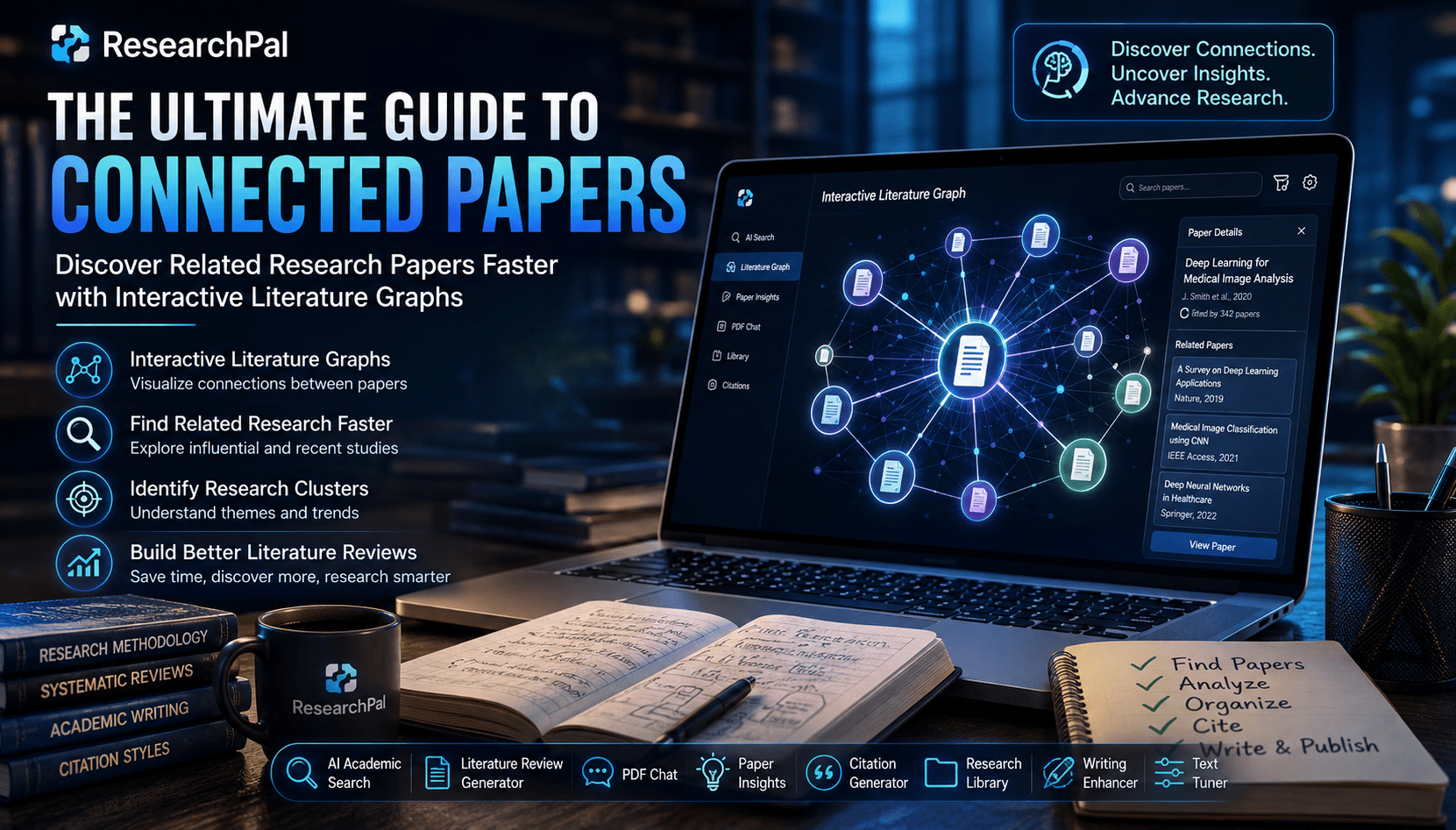
Finding relevant academic papers has always been one of the most time-consuming stages of research. Whether you’re preparing a literature review, writing a thesis, conducting a systematic review, or beginning a new research project, identifying the most important studies often requires hours of searching through databases, following citations, and refining keywords.
Traditional academic search engines such as Google Scholar, PubMed, IEEE Xplore, Scopus, and Web of Science primarily rely on keyword matching. While these platforms are invaluable for locating papers, they don’t always reveal how studies are connected or help researchers discover influential work outside their initial search terms.
This is where Connected Papers and interactive literature graphs have transformed academic discovery. Instead of presenting a long list of search results, literature graphs visually display relationships between papers, allowing researchers to explore citation networks, identify influential publications, discover emerging research clusters, and understand how ideas evolve over time.
Modern AI-powered research platforms are extending these capabilities even further. Rather than simply visualizing paper connections, they integrate graph exploration with academic search, AI-powered literature reviews, PDF analysis, citation management, and writing assistance.
In this comprehensive guide, you’ll learn how Connected Papers works, why interactive literature graphs are changing academic research, how to use them effectively, and how ResearchPal helps students and researchers move beyond traditional literature mapping by supporting the complete research workflow.
Connected Papers: Interactive Literature Graphs Explained
Connected Papers is a visual literature discovery approach that helps researchers explore relationships between academic papers using interactive graphs instead of traditional keyword-based search results. Literature graphs make it easier to identify foundational studies, influential research clusters, emerging trends, and related publications. ResearchPal extends this concept by combining Interactive Literature Graphs with AI-powered Academic Search, Literature Review Generator, PDF Chat, Paper Insights, Citation Generator, Research Library management, and Writing Enhancer to support the complete research workflow.
What You’ll Learn
- What Connected Papers is
- How interactive literature graphs work
- Why literature graphs improve research discovery
- How to find related research papers faster
- Best practices for literature reviews
- How ResearchPal expands literature graph capabilities
Why Interactive Literature Graphs Matter
Interactive literature graphs reveal relationships between research papers that traditional keyword searches may overlook. Researchers can identify influential publications, discover hidden connections, explore research clusters, and understand how scientific ideas evolve over time.
Who Should Use Literature Graphs?
- University students
- Master’s and PhD researchers
- Literature review authors
- Academic researchers
- Research supervisors
- Scientific writers
How ResearchPal Goes Further
Unlike standalone literature graph tools, ResearchPal integrates Interactive Literature Graphs with AI Academic Search, Literature Review Generator, Paper Insights, PDF Chat, Citation Generator, Research Library, Writing Enhancer, and Text Tuner—allowing researchers to discover, analyze, organize, cite, and write from one unified academic platform.
Key Takeaways
- Connected Papers helps visualize relationships between academic publications.
- Interactive literature graphs reveal citation networks and research clusters.
- Literature graphs complement traditional academic keyword searching.
- ResearchPal combines literature visualization with AI-powered research and writing tools.
- Using interactive graphs can improve literature reviews and accelerate academic discovery.
Quick Answer
Connected Papers helps researchers discover related academic papers by visualizing connections between publications through interactive literature graphs. Instead of browsing long keyword-based search results, researchers can identify influential studies, explore research clusters, and understand topic evolution more efficiently. ResearchPal builds on this approach by combining literature graphs with AI-powered academic search, literature review generation, PDF analysis, citation management, and academic writing assistance within a single research platform.
Quick Answer
Connected Papers is a literature discovery approach that visualizes relationships between research papers using interactive graphs. Instead of relying solely on keyword searches, researchers can explore connected publications, identify foundational studies, discover influential research clusters, and follow the evolution of scientific ideas.
While graph-based discovery tools focus primarily on visualization, ResearchPal extends this process by combining Interactive Literature Graphs with academic search, AI-powered literature review generation, PDF Chat, Paper Insights, citation management, and writing assistance—creating a complete research environment from discovery to publication.
What Is Connected Papers?
Connected Papers is an interactive literature discovery method that helps researchers explore relationships between academic publications through a visual graph.
Instead of displaying papers in a traditional ranked list, related studies are represented as interconnected nodes. Each node represents a research paper, while the connections illustrate relationships based on citation patterns and similarities within the academic literature.
This visual approach allows researchers to understand an entire research landscape much faster than manually opening dozens of search results.
Rather than asking:
“Which papers contain my keywords?”
Researchers can ask:
- Which studies are closely related?
- Which papers are foundational?
- Which authors influence this field?
- Which research directions are emerging?
- How has this topic evolved over time?
How Connected Papers Works
Interactive literature graphs analyze relationships between research publications using citation information and similarity measures.
When a researcher selects a single “seed paper,” the graph expands to display publications that are closely related based on shared citation patterns rather than exact keyword matches.
Each connected node represents another relevant publication, allowing users to explore the broader research landscape naturally.
This approach helps researchers discover papers they may never have found using traditional keyword searches alone.
Literature Graphs Instead of Search Lists
Traditional search engines typically produce pages of ranked results.
Literature graphs instead provide:
- Connected research papers
- Citation relationships
- Research clusters
- Influential publications
- Related authors
- Topic evolution
Researchers can immediately identify which studies are central to a field and which represent newer developments.
Citation Networks
Every academic paper builds upon previous research.
Citation networks reveal these relationships by showing how papers influence one another across time.
Instead of reading papers individually, researchers can visualize the broader structure of knowledge surrounding a topic.
This makes it easier to understand:
- Foundational research
- Frequently cited studies
- Emerging research areas
- Interdisciplinary connections
Why Traditional Academic Search Isn’t Always Enough
Academic databases remain essential, but keyword-based searching has several limitations.
Keyword Dependence
Traditional search engines rely heavily on the exact words entered by the researcher.
If a paper uses different terminology to describe the same concept, it may never appear in search results.
For example:
A researcher searching for “AI in healthcare” might miss important studies using phrases such as:
- Clinical machine learning
- Intelligent medical systems
- Computational healthcare
- Medical decision support
- Deep learning diagnostics
Although these studies are highly relevant, keyword searches may not retrieve them immediately.
Hidden Relationships
Many important papers share strong conceptual connections despite using different terminology.
Traditional search results rarely highlight these relationships.
Interactive literature graphs help reveal:
- Similar research themes
- Shared methodologies
- Common citation patterns
- Overlapping research communities
Information Overload
Large databases often return thousands—or even millions—of search results.
Researchers then spend hours:
- Reading abstracts
- Opening PDFs
- Comparing references
- Following citations manually
Literature graphs simplify this process by visually organizing related work.
Difficulty Identifying Foundational Papers
New researchers often struggle to determine:
- Which papers started the field?
- Which studies are most influential?
- Which publications are widely cited?
Interactive graphs make foundational papers much easier to identify.
Benefits of Interactive Literature Graphs
Graph-based literature exploration offers several advantages over traditional keyword searching.
Discover Foundational Papers Faster
Highly influential studies often appear near the center of literature graphs, making them easier to recognize.
Reading these foundational papers provides essential background before exploring newer research.
Find Recent Research
Literature graphs also highlight newer publications connected to established work.
This helps researchers stay current with:
- Emerging methodologies
- New datasets
- Recent discoveries
- Developing research trends
Explore Research Clusters
Interactive graphs naturally group related papers into clusters.
Each cluster may represent:
- A research theme
- A methodology
- An application area
- A theoretical framework
This helps researchers understand how different branches of a field relate to one another.
Identify Influential Authors
Citation networks often reveal researchers who contribute extensively to a topic.
Following these authors can uncover:
- Additional publications
- Collaborative research
- Emerging ideas
- Related projects
Understand Research Evolution
Interactive graphs allow researchers to observe how scientific knowledge develops over time.
Instead of reading isolated papers, users can follow the progression of ideas from foundational studies to modern applications.
This broader perspective strengthens literature reviews and helps identify gaps for future research.
Improve Literature Review Efficiency
Building a literature review requires more than collecting references—it requires understanding how studies connect.
Interactive literature graphs make it easier to:
- Discover related papers
- Compare research directions
- Organize evidence
- Build coherent literature reviews
- Identify missing perspectives
For students, postgraduate researchers, and academics, this can significantly reduce the time spent searching while improving the quality and completeness of their literature reviews
Connected Papers vs Traditional Academic Search
Researchers today have access to powerful academic search engines, but each tool approaches literature discovery differently. Traditional search engines excel at finding papers that match specific keywords, while interactive literature graphs help researchers understand how those papers relate to one another.
The most effective research workflow often combines both approaches.
| Feature | Traditional Academic Search | Connected Papers | ResearchPal |
|---|---|---|---|
| Keyword Search | ✅ | Limited | ✅ |
| Interactive Literature Graphs | ❌ | ✅ | ✅ |
| Discover Related Papers | Limited | ✅ | ✅ |
| Citation Network Visualization | ❌ | ✅ | ✅ |
| AI Academic Search | ❌ | ❌ | ✅ |
| Literature Review Generator | ❌ | ❌ | ✅ |
| PDF Chat | ❌ | ❌ | ✅ |
| Paper Insights | ❌ | ❌ | ✅ |
| Citation Generator | ❌ | ❌ | ✅ |
| Research Library | ❌ | ❌ | ✅ |
| AI Writing Assistance | ❌ | ❌ | ✅ |
Traditional academic search helps researchers locate papers, while Connected Papers helps visualize relationships. ResearchPal combines both capabilities with AI-powered research, literature review generation, citation management, and academic writing tools, creating a complete research ecosystem.
Connected Papers vs ResearchPal
Connected Papers is an excellent tool for visualizing relationships between research papers. However, discovering related papers is only one stage of the academic research process.
Researchers also need to:
- Search academic databases
- Read and analyze papers
- Extract methodologies
- Organize references
- Generate literature reviews
- Create citations
- Improve academic writing
ResearchPal integrates these tasks into one platform.
Interactive Literature Graphs
ResearchPal includes interactive literature graphs that help researchers visualize connections between publications, identify research clusters, and discover influential studies.
Unlike simple graph visualization, these graphs are integrated directly into the broader research workflow.
AI Academic Search
ResearchPal enables users to search millions of scholarly publications using AI-powered search capabilities.
Instead of relying only on keyword matching, researchers can explore broader research contexts and identify relevant literature more efficiently.
Literature Review Generator
Preparing literature reviews often requires reading dozens—or even hundreds—of papers.
ResearchPal accelerates this process by helping users synthesize multiple research papers into structured literature reviews, highlighting themes, methodologies, findings, limitations, and research gaps.
PDF Chat
Understanding lengthy research papers can be challenging.
ResearchPal’s PDF Chat allows researchers to upload academic papers and ask questions such as:
- What is the research objective?
- Which methodology was used?
- What are the main findings?
- What limitations were identified?
- What future work is suggested?
This significantly reduces the time required to review complex publications.
Paper Insights
ResearchPal automatically extracts valuable information from academic papers, including:
- Research objectives
- Methodologies
- Key findings
- Contributions
- Limitations
- Future research directions
These summaries help researchers evaluate papers before investing time in reading the entire document.
Citation Generator
After discovering relevant papers, researchers must cite them correctly.
ResearchPal includes an AI-powered Citation Generator supporting multiple academic styles, helping users create accurate in-text citations and bibliographies while maintaining academic integrity.
Research Library
Managing large collections of papers can quickly become overwhelming.
ResearchPal’s Research Library allows users to:
- Save papers
- Organize projects
- Store PDFs
- Manage citations
- Categorize literature
- Reuse references across assignments
AI Writing Assistance
ResearchPal extends beyond research discovery by helping users improve academic writing.
Features include:
- Writing Enhancer
- Text Tuner
- AI-assisted paraphrasing
- Academic writing refinement
These tools help transform research findings into polished academic content.
How to Use Interactive Literature Graphs Effectively
Interactive literature graphs become even more valuable when used strategically.
Start with One High-Quality Seed Paper
Choose a well-cited paper closely related to your research topic.
The quality of your initial paper often determines the relevance of the connected literature you discover.
Explore Nearby Papers
Rather than opening every paper immediately, first identify clusters of related studies.
These clusters often represent:
- Similar methodologies
- Shared datasets
- Common theoretical frameworks
- Closely related research questions
Identify Foundational Studies
Foundational papers typically receive large numbers of citations and appear as central nodes within literature graphs.
Reading these papers first provides essential background knowledge before exploring newer research.
Compare Recent Publications
Once foundational papers have been identified, examine newer connected studies to understand how the field has evolved.
Look for:
- Updated methodologies
- New datasets
- Emerging technologies
- Recent findings
Organize Papers Immediately
Avoid collecting dozens of papers without organization.
As you discover relevant studies:
- Save them into folders.
- Add notes.
- Store PDFs.
- Record citations.
- Tag research themes.
ResearchPal’s Research Library simplifies this process by keeping papers, notes, citations, and projects organized in one workspace.
Common Mistakes Researchers Make
Even experienced researchers can misuse literature graphs.
Following Only Highly Cited Papers
Highly cited papers are valuable but may overlook recent breakthroughs.
Balance foundational studies with newer publications.
Ignoring Research Clusters
Many researchers focus only on individual papers.
Examining clusters often reveals broader trends and related subtopics.
Reading Without Organizing
Saving papers without notes or categorization makes future retrieval difficult.
Organizing research as you go improves long-term productivity.
Depending Only on Literature Graphs
Graphs complement—not replace—traditional academic searching.
Keyword searches remain essential for locating niche or newly published research.
Skipping Critical Evaluation
A paper’s position in a graph does not guarantee its quality.
Researchers should still evaluate:
- Methodology
- Sample size
- Limitations
- Publication venue
- Relevance
Best Practices for Literature Discovery
Researchers can maximize the value of interactive literature graphs by following these practices:
- Begin with a high-quality seed paper.
- Explore connected research clusters.
- Combine graph exploration with keyword searching.
- Read abstracts before downloading full papers.
- Compare methodologies across related studies.
- Organize papers throughout the research process.
- Generate citations as papers are collected.
- Build literature reviews continuously rather than waiting until the end.
Why ResearchPal Goes Beyond Connected Papers
Connected Papers is highly effective for visualizing relationships among academic publications, but academic research involves far more than discovering related papers.
ResearchPal supports researchers throughout the complete research lifecycle by combining:
- Interactive Literature Graphs
- AI Academic Search
- Literature Review Generator
- PDF Chat
- Paper Insights
- Citation Generator
- Research Library
- Writing Enhancer
- Text Tuner
- AI-powered research assistance
Instead of moving between multiple applications, researchers can discover literature, analyze papers, organize references, generate literature reviews, and improve academic writing from one integrated platform.
Frequently Asked Questions About Connected Papers
Learn how Connected Papers, interactive literature graphs, and AI-powered research tools help students and researchers discover related academic papers faster.
Connected Papers is a literature discovery tool that visualizes relationships between academic papers using interactive graphs instead of traditional keyword-based search results. It helps researchers identify related publications, influential studies, and research clusters. ResearchPal extends this concept with Interactive Literature Graphs, AI Academic Search, Literature Review Generator, PDF Chat, Paper Insights, Citation Generator, and Research Library management.
Interactive literature graphs analyze citation relationships and similarities between research papers. Instead of showing isolated search results, they visualize how publications are connected, making it easier to explore research fields. ResearchPal integrates these graphs directly into its AI-powered research workflow.
Literature graphs and keyword searches complement each other. Keyword searches locate papers using specific terms, while literature graphs reveal relationships between publications. ResearchPal combines both approaches, helping researchers discover papers and understand their connections more effectively.
Yes. Literature graphs help researchers identify foundational papers, emerging studies, research clusters, and influential authors. ResearchPal further supports literature reviews with its AI-powered Literature Review Generator, making it easier to synthesize findings from multiple studies.
Yes. Interactive literature graphs reveal recently published papers connected to foundational research, helping researchers stay current with emerging methodologies and discoveries. ResearchPal combines graph exploration with AI Academic Search to identify both established and recent publications.
Several literature discovery tools exist, but ResearchPal offers a broader research environment by combining Interactive Literature Graphs, Academic Search, PDF Chat, Paper Insights, Literature Review Generator, Citation Generator, Research Library, and AI Writing tools in one platform.
ResearchPal enables researchers to search scholarly literature, explore Interactive Literature Graphs, analyze PDFs with AI, extract key findings through Paper Insights, generate literature reviews, organize references, and create citations—all from one integrated academic research platform.
AI can assist in organizing, comparing, and synthesizing multiple connected research papers. ResearchPal’s Literature Review Generator helps researchers create structured literature reviews while encouraging careful review and verification of AI-generated content.
Final Thoughts
Interactive literature graphs have transformed the way researchers discover academic knowledge. Rather than relying solely on keyword searches, graph-based exploration helps reveal relationships between studies, identify influential research, and understand how ideas evolve across disciplines.
However, finding papers is only the beginning. Researchers also need tools to analyze publications, organize references, generate citations, write literature reviews, and refine academic writing.
By combining Interactive Literature Graphs, AI-powered Academic Search, Literature Review Generator, PDF Chat, Paper Insights, Citation Generator, Research Library, and Writing Enhancer, ResearchPal provides a unified research environment that supports every stage of the academic journey—from discovery to publication.
From The Web
- Connected Papers: How to Use It for Research and Literature Review 2026
https://www.thesisacewriters.com/blog/connected-papers-how-to-use-for-research-guide
- Understanding Connected Papers Features
https://www.scribd.com/document/562087447/Connectedpapers-Perpusft-3-Juni-2021