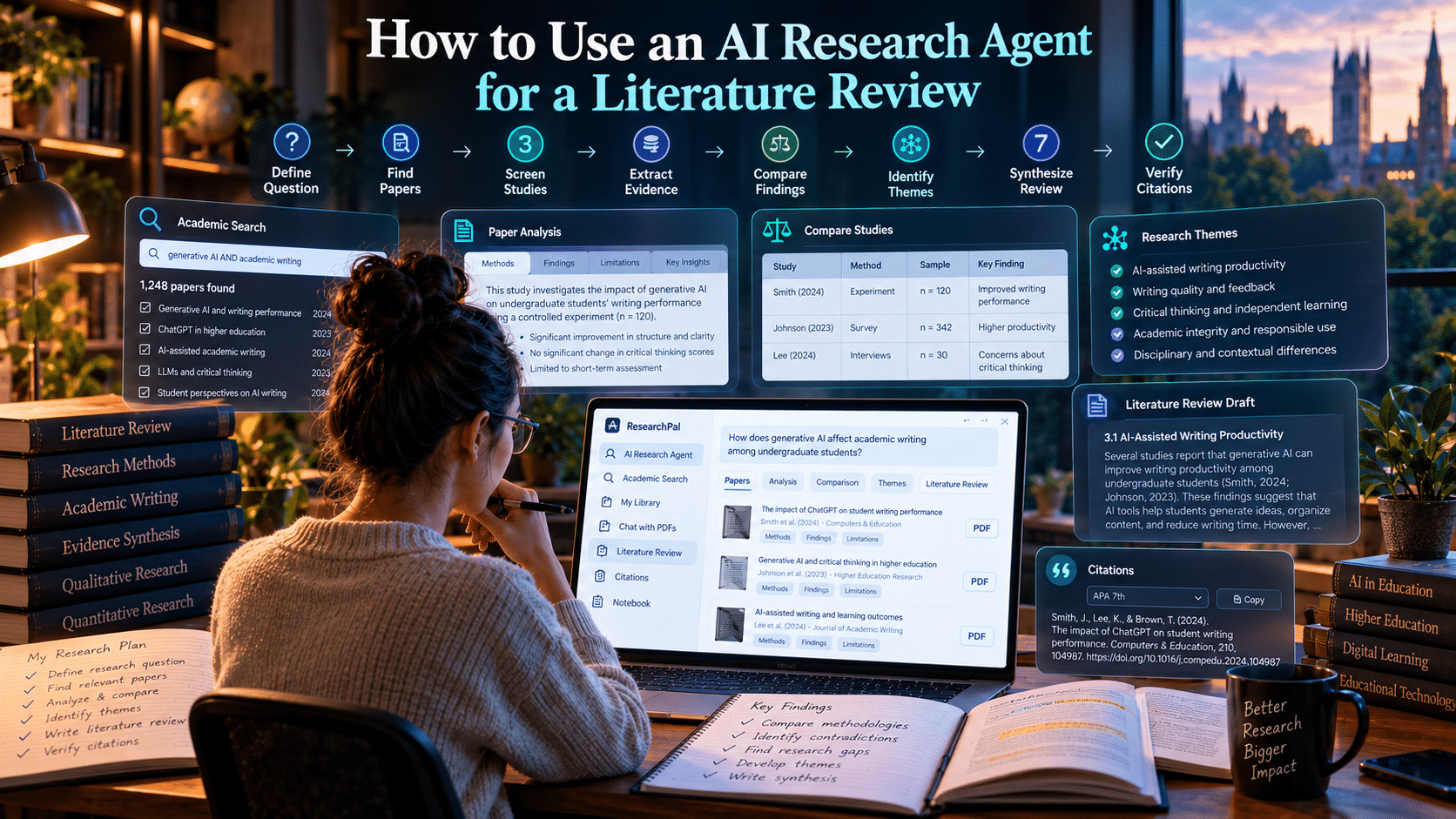
Writing a literature review can be one of the most time-consuming parts of academic research. You begin with a research question, search academic databases, open dozens of papers, read abstracts, examine methodologies, compare findings, organize references, and eventually try to turn everything into a coherent discussion. The challenge is not simply finding information.
It is understanding how different studies connect, where researchers agree, which findings contradict one another, and what questions remain unanswered.
AI research agents can help researchers manage this process more efficiently.
Unlike a basic chatbot that generates a response to a single prompt, an AI research agent can support a connected workflow involving academic paper discovery, research analysis, evidence comparison, literature synthesis, and citations.
But using an AI agent effectively requires more than asking it to write a literature review.
You need a structured research process.
In this guide, you’ll learn how to use an AI research agent for a literature review, from defining your research question to verifying the final references.
Quick Answer: How Do You Use an AI Research Agent for a Literature Review?
To use an AI research agent for a literature review, begin with a clearly defined research question. Use the agent to discover relevant academic papers, screen studies, extract methodologies and findings, compare evidence, identify themes and contradictions, and organize the results into a structured literature review.
The recommended workflow is:
Research Question → Academic Search → Paper Screening → Evidence Extraction → Study Comparison → Thematic Synthesis → Literature Review Draft → Citation Verification
AI can assist with each stage, but researchers remain responsible for evaluating source quality, interpreting evidence, and ensuring academic accuracy.
What Is an AI Research Agent for Literature Reviews?
An AI research agent for literature reviews is an AI-powered system designed to assist with multiple connected research tasks.
Depending on the platform, it may help researchers:
- Discover relevant academic papers.
- Refine research questions and search terminology.
- Screen potentially relevant studies.
- Extract methodologies, findings, and limitations.
- Compare evidence across publications.
- Identify recurring research themes.
- Investigate contradictory findings.
- Explore potential research gaps.
- Develop structured literature-review drafts.
- Organize sources and citations.
The main advantage is workflow continuity.
Instead of using unrelated tools for every stage, researchers can connect more of the literature-review process within a single environment.
For example, the ResearchPal AI Research Agent is designed to support academic research workflows involving paper discovery, analysis, literature reviews, and research organization.
However, no AI system should be assumed to have searched every relevant source or verified every generated claim automatically.
Why Literature Reviews Are Difficult Without a Structured Workflow
A literature review is not simply a summary of published research.
It is a critical synthesis of existing knowledge about a research problem.
Finding Relevant Studies
Academic literature uses different terminology across disciplines, countries, and research traditions.
A researcher studying artificial intelligence in education might encounter papers discussing:
- Generative AI in higher education
- Large language models in learning
- AI-assisted instruction
- Intelligent tutoring systems
- Human-AI collaboration
- Automated educational support
These concepts are not identical, but several may be relevant to the research question.
A search using only one phrase could miss important studies.
Managing Large Numbers of Papers
A review involving 40 or 50 publications requires consistent organization.
Researchers need to track which papers they have screened, included, excluded, analyzed, and cited.
Without a clear system, important information can become scattered across PDFs, spreadsheets, browser tabs, and notes.
Comparing Evidence
Different studies may examine similar questions using different methodologies.
One paper might use a randomized experiment.
Another might use interviews.
A third might analyze survey responses.
Their findings cannot always be compared directly without understanding those differences.
Moving From Summary to Synthesis
One of the most common literature-review problems is producing a sequence of summaries:
“Study A found…”
“Study B reported…”
“Study C concluded…”
A strong review instead explains the relationships between studies.
The goal is not to describe every paper independently. It is to explain what the body of evidence collectively shows.
How to Use an AI Research Agent for a Literature Review: 10 Steps
The following workflow can be adapted for undergraduate assignments, postgraduate dissertations, narrative reviews, and early-stage doctoral research.
For systematic reviews, researchers should additionally follow an appropriate registered or documented protocol, including database-specific search strategies, screening procedures, and reporting standards.
Step 1: Define a Clear Research Question
Start with the question your review needs to answer.
A broad topic such as:
Artificial intelligence in education
is usually too general.
A more focused question could be:
How does generative AI influence academic writing skills among undergraduate university students?
This identifies three important concepts:
- Technology: Generative AI
- Population: Undergraduate students
- Outcome: Academic writing skills
A clear question helps determine which studies are relevant.
Example AI research agent prompt:
“Help me refine the research question ‘How does generative AI affect academic writing among undergraduate students?’ Identify the main concepts, possible subquestions, and appropriate inclusion boundaries. Do not invent supporting studies.”
The agent’s suggestions should help you refine your question, not replace your academic judgment.
Step 2: Develop Search Keywords and Synonyms
Once the question is defined, identify alternative terminology.
For example:
| Research concept | Possible search terms |
|---|---|
| Generative AI | Generative artificial intelligence, ChatGPT, large language models, LLMs |
| Academic writing | Scholarly writing, essay writing, academic composition, writing performance |
| Undergraduate students | University students, college students, higher education students |
| Educational outcomes | Writing quality, learning outcomes, critical thinking, writing skills |
An example Boolean search could be:
("generative AI" OR ChatGPT OR "large language model*") AND ("academic writing" OR "essay writing") AND (undergraduate* OR "university students")
The exact syntax should be adjusted for the database.
Example prompt:
“Generate synonyms, abbreviations, related academic terminology, and Boolean search strings for my literature-review question. Separate broad terms from narrow terms and explain possible sources of irrelevant results.”
AI-generated search strategies should be tested and revised.
Step 3: Discover Relevant Academic Papers
Now begin searching for actual academic literature.
Depending on the tools available, an AI research agent may help search scholarly indexes, retrieve publication metadata, identify related papers, or explore relevant academic sources.
Start with the central research question, then broaden or narrow the search based on the results.
Avoid relying exclusively on one AI-generated result set.
For more comprehensive work, use appropriate academic databases and citation searching alongside AI-supported discovery.
Example prompt:
“Find academic studies relevant to generative AI and undergraduate academic writing. Prioritize research that directly measures writing outcomes. Provide titles, authors, publication years, source identifiers where available, and brief relevance explanations. Distinguish verified records from uncertain matches.”
At this stage, the goal is discovery rather than writing.
Step 4: Screen Papers for Relevance
Not every paper returned by a search belongs in your review.
Screening helps determine which studies meet your criteria.
You might establish:
Inclusion criteria
- Studies involving university students.
- Research investigating generative AI or closely related tools.
- Studies examining academic writing outcomes.
- Publications within the chosen time period.
- Relevant empirical or theoretical work.
Exclusion criteria
- Papers unrelated to higher education.
- Studies focusing on unrelated AI applications.
- Publications without sufficient relevant evidence.
- Duplicates.
These are illustrative criteria; your actual criteria should reflect your research question.
Example prompt:
“Using my stated inclusion and exclusion criteria, create a screening table for these papers. Identify likely inclusions, likely exclusions, and uncertain cases. Explain each decision using the available title and abstract. Do not treat missing information as proof of exclusion.”
Researchers should review screening decisions, especially uncertain cases.
For systematic reviews, retain documented decisions and reasons for exclusion at the appropriate stage.
Step 5: Extract Evidence From Selected Papers
After selecting relevant studies, extract the information needed for comparison.
This is one of the most useful stages for AI-assisted research.
A literature-review evidence matrix might include:
| Field | Information to extract |
|---|---|
| Citation | Author, year, title |
| Research objective | Main research question |
| Population | Participants or study setting |
| Methodology | Research design |
| Sample | Sample size and characteristics |
| Findings | Main results |
| Limitations | Reported weaknesses |
| Relevance | Connection to your review question |
Example prompt:
“Analyze the attached papers and extract the research objective, methodology, sample, key findings, limitations, and relevance to my literature-review question. Include page references or supporting passages where available. Mark any information that cannot be confirmed.”
An AI-generated evidence table is a working document, not a verified dataset.
Check important extracted details against the papers.
Step 6: Compare Findings Across Multiple Studies
Once the evidence is structured, begin comparing studies.
This is where the review moves beyond collecting information.
Ask:
- Which studies report similar findings?
- Which studies disagree?
- Are differences associated with methodology?
- Do sample characteristics matter?
- Are outcomes measured consistently?
- Are there important contextual differences?
Consider this hypothetical example:
| Study | Method | Illustrative finding |
|---|---|---|
| Study A | Controlled experiment | Improvement in writing task completion |
| Study B | Student survey | Higher perceived writing productivity |
| Study C | Interviews | Concerns about independent critical thinking |
These are hypothetical examples, not findings from identified publications.
The studies examine different outcomes and use different methods.
A useful synthesis would explain those differences rather than simply declaring that AI improves or harms writing.
Example prompt:
“Compare the selected studies by methodology, population, measured outcomes, findings, and limitations. Identify genuine agreements and disagreements. Do not treat differences in outcome measures as direct contradictions.”
Step 7: Identify Major Themes
A strong literature review is usually organized around meaningful research themes.
Themes should emerge from the evidence rather than being imposed without justification.
For the example topic, potential themes might include:
Theme 1: AI-Assisted Writing Productivity
Studies investigating efficiency, task completion, and writing support.
Theme 2: Writing Quality and Feedback
Research examining grammar, organization, clarity, and revision.
Theme 3: Critical Thinking and Student Independence
Studies exploring how AI assistance interacts with reasoning and independent writing.
Theme 4: Academic Integrity and Responsible Use
Research concerning disclosure, authorship, acceptable assistance, and academic practices.
Theme 5: Differences Across Student Populations
Studies examining experience, educational level, discipline, or prior AI familiarity.
These themes are possible organizational categories, not claims that the literature necessarily supports each one equally.
Example prompt:
“Using only the findings from the included studies, propose a thematic structure for the literature review. For each theme, list supporting papers, contradictory evidence, methodological limitations, and questions requiring further investigation.”
Step 8: Investigate Contradictions and Potential Research Gaps
A useful literature review does not hide disagreement.
Suppose some studies report improved writing performance while others raise concerns about independent reasoning.
A researcher should investigate:
- Whether the studies measured the same outcome.
- Whether participants had different levels of experience.
- Whether AI use was guided or unrestricted.
- Whether outcomes were measured immediately or over time.
- Whether the study designs support causal conclusions.
Research gaps should be treated with similar care.
An AI agent might identify that several papers report small samples or limited follow-up periods.
That may suggest a potential gap.
But it does not prove that no other studies have addressed the issue.
Example prompt:
“Identify potential research gaps supported by recurring limitations in the selected studies. For each gap, cite the supporting papers and recommend targeted search terms to check whether newer or overlooked research has already addressed it.”
The correct workflow is:
Potential Gap → Supporting Evidence → Additional Search → Verification → Research Justification
Step 9: Develop a Structured Literature Review
Once the evidence has been examined and organized, begin drafting.
A common structure is:
Introduction
Explain the topic, research question, scope, and purpose of the review.
Conceptual or Theoretical Background
Introduce important concepts, theories, and definitions.
Thematic Synthesis
Organize the evidence around major research themes.
Critical Evaluation
Discuss methodological differences, contradictions, and limitations.
Research Gaps
Identify questions that remain insufficiently answered, supported by the evidence and additional searching.
Conclusion
Summarize what the literature establishes and explain how the review informs the next stage of research.
Example prompt:
“Create a detailed literature-review outline using the verified evidence matrix. Organize sections by themes rather than by individual paper. Identify which studies support each argument, where contradictory evidence should be discussed, and where evidence is insufficient.”
After approving the outline, draft sections one at a time.
This gives the researcher greater control over the argument.
Step 10: Verify Citations, Claims, and Final Interpretation
This final stage is essential.
AI-generated literature reviews can contain:
- Incorrect author names
- Inaccurate publication dates
- Missing citation details
- Unsupported conclusions
- Misinterpreted findings
- References that do not match the cited claim
A reference can be formatted correctly while supporting the wrong statement.
For every important claim, check:
Does the source exist?
Is the bibliographic information accurate?
Does the cited study support the claim?
Does the interpretation match the actual finding?
Are quotations and page references correct?
Are the methods and limitations represented fairly?
The final workflow should always end with:
Generate → Inspect → Correct → Verify → Cite
AI Research Agent vs AI Chatbot for Literature Reviews
A general AI chatbot and a research agent may both help with literature reviews, but their workflows can differ.
| Capability | General AI Chatbot | Academic AI Research Agent |
|---|---|---|
| Explain a research topic | Yes | Yes |
| Suggest keywords | Yes | Yes |
| Discover academic papers | Depends on available tools | Often integrated |
| Screen studies | Possible with supplied data | May support structured workflows |
| Extract paper findings | Possible with documents | Often research-oriented |
| Compare multiple studies | Possible | Can be part of workflow |
| Organize evidence | Depends on tools | May be integrated |
| Generate review outlines | Yes | Yes |
| Connect claims to sources | Depends on retrieval and citations | Important research capability |
| Maintain research library | Usually separate | Platform-dependent |
| Verify every claim automatically | No | No |
The distinction is not absolute. Some general-purpose chatbots now offer sophisticated search and research capabilities.
What matters is whether the system can support an evidence-driven, inspectable workflow—not whether its name contains the word “agent.”
How to Use ResearchPal’s AI Research Agent for a Literature Review
ResearchPal is designed to connect academic discovery, paper analysis, literature reviews, PDF interaction, citations, and research organization.
This makes it relevant for researchers who want to reduce the number of disconnected tools involved in reviewing literature.
Discover Academic Papers
Begin with your research question and use ResearchPal’s academic discovery capabilities to identify potentially relevant scholarly publications.
Refine your search using concepts, keywords, and related terminology.
Analyze Papers With Paper Insights
Use Paper Insights to examine important information from selected studies, such as methodologies, findings, contributions, and limitations.
This can help create a more consistent foundation for comparing papers.
Investigate Sources With PDF Chat
When a paper requires deeper examination, use PDF Chat to ask focused questions about its methods, results, or limitations.
Verify important answers in the original PDF.
Build a Thematic Literature Review
Use literature-review tools to help organize evidence into themes and develop a coherent synthesis.
The objective should be to compare studies, not simply generate one paragraph per paper.
Organize Research in the Library
Save relevant sources and maintain a structured research collection.
For longer projects, consider organizing papers by theme, method, publication period, or relevance.
Manage Citations
Use citation tools to format references in the style required by your institution or journal.
Check the metadata and confirm that every cited source supports its associated claim.
The complete ResearchPal-oriented workflow becomes:
AI Research Agent → Academic Search → Paper Insights → PDF Chat → Literature Review → Research Library → Citations
Explore the ResearchPal AI Research Agent to see how these research activities can fit into a connected academic workflow.
Example: Using an AI Research Agent for a Realistic Literature Review
Consider a postgraduate student investigating:
“How does generative AI affect critical thinking among undergraduate students?”
The student could use the following process.
Research Question
Define the population, technology, and outcome.
Literature Discovery
Search for studies using terminology such as generative AI, large language models, critical thinking, reasoning, and higher education.
Screening
Identify studies that directly examine critical thinking or related, clearly defined outcomes.
Evidence Extraction
Record study design, population, measures, findings, and limitations.
Comparison
Examine whether studies use comparable definitions and measures of critical thinking.
Thematic Organization
Develop evidence-supported themes, such as instructional context, student dependence, learning outcomes, and assessment design.
Gap Investigation
Investigate recurring limitations and check whether additional literature addresses them.
Literature Review Draft
Write a synthesis explaining the evidence and its limitations.
Verification
Check all references, interpretations, and important claims.
This approach makes AI part of the research process rather than a substitute for it.
Common Mistakes When Using AI for Literature Reviews
Asking AI to Write the Entire Review Immediately
A broad prompt such as “Write a literature review about AI in education” skips important research decisions.
Start with a defined question and evidence-gathering process.
Using Only AI-Suggested Papers
AI retrieval may overlook relevant publications.
Supplement discovery with appropriate databases, citation searching, and manual screening.
Treating Every Paper as Equally Credible
Studies differ in design, quality, relevance, and evidential strength.
Evaluate them accordingly.
Summarizing Without Synthesizing
A series of individual summaries does not automatically form a strong literature review.
Explain relationships between studies.
Accepting Research Gaps Without Checking
A system’s inability to find a paper is not evidence that the research does not exist.
Trusting Citations Without Verification
Always check bibliographic metadata and claim-to-source accuracy.
Ignoring Institutional AI Policies
Universities and journals may have specific rules about AI assistance, disclosure, research integrity, and authorship.
Follow the requirements relevant to your work.
Can AI Research Agents Be Used for Systematic Literature Reviews?
Yes, AI tools can support parts of systematic-review workflows, but additional methodological safeguards are required.
A systematic review generally demands a transparent and reproducible approach to identifying, screening, appraising, and synthesizing evidence.
Depending on the review type, researchers may need:
- A predefined protocol
- Explicit eligibility criteria
- Database-specific search strategies
- Documented search dates
- Duplicate removal
- Consistent screening decisions
- Risk-of-bias or quality assessment
- A transparent synthesis method
- Appropriate reporting standards
For applicable systematic reviews, PRISMA 2020 provides a reporting framework.
AI assistance should be documented as appropriate, and researchers should not assume that semantic retrieval or automated screening alone constitutes a comprehensive search.
How to Evaluate an AI Research Agent for Literature Reviews
Before choosing a platform, ask these questions.
Does It Search Relevant Academic Sources?
Check the databases, indexes, repositories, and documents the system can access.
Can It Analyze Full Papers?
Abstracts alone may not contain the information required for detailed evidence extraction.
Can It Compare Multiple Studies?
Look for structured comparison rather than isolated summaries.
Are Citations Traceable?
You should be able to inspect the source behind important statements.
Can You Organize Your Evidence?
A persistent research library or export workflow can be valuable for longer projects.
Can You Correct the Agent’s Output?
Researcher oversight should remain central.
Does It Support Your Review Type?
A narrative literature review, scoping review, systematic review, and meta-analysis have different methodological requirements.
Choose tools accordingly.
Frequently Asked Questions
Can an AI research agent write a literature review?
An AI research agent can support literature discovery, screening, evidence extraction, comparison, thematic organization, and drafting. However, researchers remain responsible for evaluating the sources, interpreting findings, verifying citations, and ensuring the review meets academic standards.
What is the best way to use AI for a literature review?
Use AI throughout a structured process: define the research question, discover papers, screen relevant studies, extract evidence, compare findings, develop themes, draft the synthesis, and verify claims against original sources.
Can AI research agents find relevant academic papers?
Academic-focused agents can help discover potentially relevant publications through scholarly search and related-paper discovery. Researchers should still check source coverage and use appropriate additional search methods.
Can AI summarize multiple research papers?
Yes. AI can help summarize and extract information from multiple papers, including methods, findings, and limitations. Important extracted information should be checked against the original documents.
Can AI identify research gaps in a literature review?
AI can help identify potential gaps by comparing study limitations, populations, methodologies, and unanswered questions. Researchers should validate proposed gaps through targeted additional searches.
Is an AI-generated literature review academically acceptable?
Acceptability depends on institutional, journal, and assignment policies, as well as how AI was used. Researchers should follow applicable disclosure requirements and remain responsible for the accuracy, originality, and integrity of their work.
Can AI research agents generate references?
Many research platforms provide citation-generation capabilities. However, generated references should be checked for correct authors, titles, dates, identifiers, publication details, and citation style.
How many papers should an AI literature review include?
There is no universal number. The appropriate evidence base depends on the research question, scope, review type, field, and available literature. A rigorous review should prioritize relevance and appropriate coverage rather than an arbitrary paper count.
Can PhD students use AI research agents for literature reviews?
Yes, subject to their institution’s policies. AI agents can assist doctoral researchers with paper discovery, evidence organization, comparison, literature synthesis, and research management, while methodological decisions and final interpretations remain the researcher’s responsibility.
How can ResearchPal help with a literature review?
ResearchPal provides a connected academic research environment with paper discovery, Paper Insights, PDF Chat, literature-review tools, citation support, and a research library. These capabilities can help researchers move from finding studies to organizing and synthesizing evidence.
Final Thoughts
An AI research agent can make literature-review work more manageable, but the value comes from using it correctly.
The objective should not be to generate a long review as quickly as possible.
It should be to build a clearer, more traceable understanding of the research evidence.
A strong AI-assisted literature review follows a deliberate process:
Define → Discover → Screen → Extract → Compare → Synthesize → Write → Verify
Each stage contributes something important.
Search identifies the evidence.
Screening determines relevance.
Extraction organizes information.
Comparison reveals relationships.
Synthesis develops understanding.
Verification protects academic accuracy.
The most effective way to use an AI research agent is to automate repetitive research tasks while keeping academic judgment in human hands.
For researchers who want to connect academic search, paper analysis, PDF exploration, literature reviews, research organization, and citations, the ResearchPal AI Research Agent provides a research-focused environment for working through these stages.

