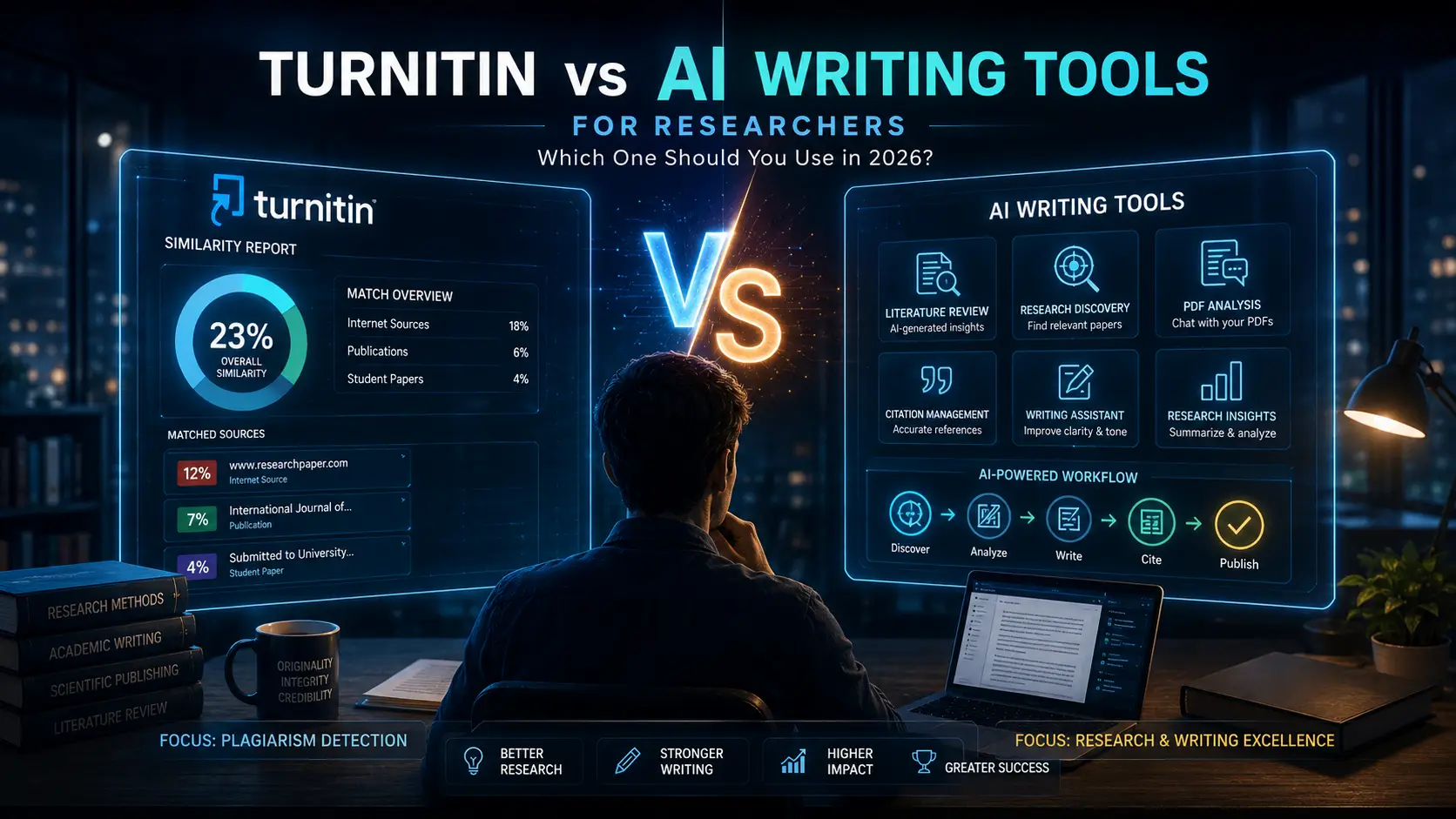
For years, Turnitin has been the standard tool for plagiarism detection in academia. Universities worldwide use it to check assignments, theses, dissertations, and research papers for originality.
However, the rise of AI-powered research assistants has changed how researchers approach writing. Instead of simply checking for plagiarism after a paper is completed, modern AI tools help researchers improve originality, structure arguments, manage citations, and strengthen academic writing throughout the research process.
This raises an important question:
Turnitin vs AI writing tools for researchers — which one is better in 2026?
The answer depends on what you’re trying to achieve.
What Is Turnitin?
Turnitin is primarily a plagiarism detection platform used by educational institutions and publishers.
Its core purpose is to:
- Compare text against large databases
- Generate similarity reports
- Identify potential plagiarism
- Verify originality
For many universities, Turnitin remains a required final submission check.
What Are AI Writing Tools?
AI writing tools help researchers throughout the entire writing process.
Instead of only identifying issues, they assist with:
- Literature reviews
- Research discovery
- Citation management
- Academic writing
- Paper structuring
- Research gap identification
- Manuscript refinement
Examples include:
- ResearchPal
- Paperpal
- Jenni AI
- SciSpace
The Fundamental Difference
Turnitin Answers:
“Is this paper original?”
AI Writing Tools Answer:
“How can this paper become better?”
That distinction is important.
Turnitin is largely reactive.
AI writing tools are proactive.
Feature Comparison: Turnitin vs AI Writing Tools
| Feature | Turnitin | ResearchPal | Paperpal | Jenni AI |
|---|---|---|---|---|
| Plagiarism Detection | ✅ Excellent | ⚠️ Limited | ⚠️ Limited | ❌ No |
| Similarity Reports | ✅ Yes | ❌ No | ❌ No | ❌ No |
| Literature Review Generation | ❌ No | ✅ Advanced | ❌ No | ❌ No |
| Search Academic Papers | ❌ No | ✅ Yes | ❌ No | ❌ No |
| Citation Generator | ❌ No | ✅ Yes | ⚠️ Limited | ⚠️ Limited |
| Research Library Management | ❌ No | ✅ Yes | ❌ No | ❌ No |
| PDF Chat | ❌ No | ✅ Yes | ❌ No | ❌ No |
| Paper Insights & Analysis | ❌ No | ✅ Yes | ❌ No | ❌ No |
| Academic Writing Assistance | ❌ No | ✅ Strong | ✅ Strong | ✅ Strong |
| End-to-End Research Workflow | ❌ No | ✅ Complete | ❌ No | ❌ No |
Why Researchers Use Turnitin
Turnitin remains valuable because it:
1. Provides Institutional Compliance
Many universities require Turnitin reports.
Researchers often cannot avoid using it.
2. Detects Direct Text Matches
Turnitin excels at:
- Identifying copied text
- Highlighting overlapping content
- Producing similarity scores
3. Supports Academic Integrity
Similarity reports help researchers identify sections that may need revision before submission.
Limitations of Turnitin
Turnitin was not designed to help researchers write better papers.
It does not help with:
- Finding literature
- Building arguments
- Managing citations
- Understanding research papers
- Conducting literature reviews
Researchers still need additional tools for these tasks.
Why Researchers Are Using AI Writing Tools
AI tools support researchers throughout the research lifecycle.
Literature Reviews
Instead of manually reviewing dozens of papers, researchers can use tools like ResearchPal to:
- Generate structured literature reviews
- Compare studies
- Identify themes
- Find research gaps
Research Discovery
Researchers can search and explore relevant papers faster through AI-powered search and analysis.
Citation Management
AI tools can help:
- Generate citations
- Organize references
- Build bibliographies
Writing Assistance
Researchers can improve:
- Clarity
- Structure
- Academic tone
- Grammar
Research Analysis
Advanced AI systems can analyze papers and extract:
- Methodology
- Findings
- Limitations
- Future directions
ResearchPal vs Turnitin: A Researcher’s Perspective
While Turnitin focuses on plagiarism detection, ResearchPal focuses on the broader research workflow.
Turnitin Workflow
- Write paper
- Upload to Turnitin
- Receive similarity report
- Revise manually
ResearchPal Workflow
- Discover papers
- Build literature review
- Manage research library
- Analyze PDFs
- Generate citations
- Improve writing
- Prepare manuscript
The difference is that ResearchPal assists before submission, while Turnitin primarily evaluates after writing is complete.
Which Tool Is Better?
The answer depends on your goal.
If You Need:
- Similarity reports
- Institutional compliance
- Plagiarism detection
➡️ Turnitin is the better choice.
If You Need:
- Literature reviews
- Research discovery
- Citation management
- Writing assistance
- Paper analysis
➡️ ResearchPal is the better choice.
The Best Approach: Use Both
Most researchers should not view this as an either/or decision.
A modern workflow looks like this:
Step 1
Use ResearchPal to:
- Find papers
- Build literature reviews
- Manage references
- Improve writing
Step 2
Use Turnitin before submission to:
- Check originality
- Review similarity reports
- Ensure compliance
This provides the benefits of both systems.
Final Verdict
| Category | Winner |
|---|---|
| Plagiarism Detection | Turnitin |
| Similarity Reports | Turnitin |
| Literature Reviews | ResearchPal |
| Citation Management | ResearchPal |
| Research Discovery | ResearchPal |
| PDF Analysis | ResearchPal |
| Writing Assistance | ResearchPal |
| Research Workflow | ResearchPal |
| Final Submission Check | Turnitin |
Overall Recommendation
For researchers in 2026:
Turnitin is a verification tool.
ResearchPal is a research workflow platform.
The strongest academic workflow combines both.
Researchers can use ResearchPal to conduct, organize, analyze, and write research more efficiently—and then use Turnitin as a final originality check before submission.
Related Reading
From The Web
- Turnitin Review 2026: Is the AI Detection Worth the Hype?
https://fritz.ai/turnitin-review/
- Turnitin 2026 vs AI Humanizers – The Truth Researchers Must Know

