Finding a strong research gap is one of the hardest parts of academic research. Many students and researchers struggle with:
- Knowing what has already been studied
- Identifying what is missing
- Avoiding repeated or redundant topics
This is where AI becomes extremely useful. Learning how to identify research gaps using AI can help you discover unique, high-impact research ideas faster and more efficiently.
What Is a Research Gap?
A research gap is:
- A missing piece in existing research
- An unanswered question
- A limitation in previous studies
- An opportunity for further investigation
Strong research papers are built on clear and well-defined gaps.
Why Identifying Research Gaps Is Difficult
Traditional methods require:
- Reading dozens of papers
- Comparing findings manually
- Identifying inconsistencies
- Synthesizing large amounts of information
This process is:
- Time-consuming
- Mentally exhausting
- Prone to oversight
How AI Helps Identify Research Gaps
AI tools can:
- Analyze multiple research papers quickly
- Identify patterns and trends
- Highlight limitations in studies
- Detect underexplored areas
- Summarize research themes
This reduces the time required from weeks to hours.
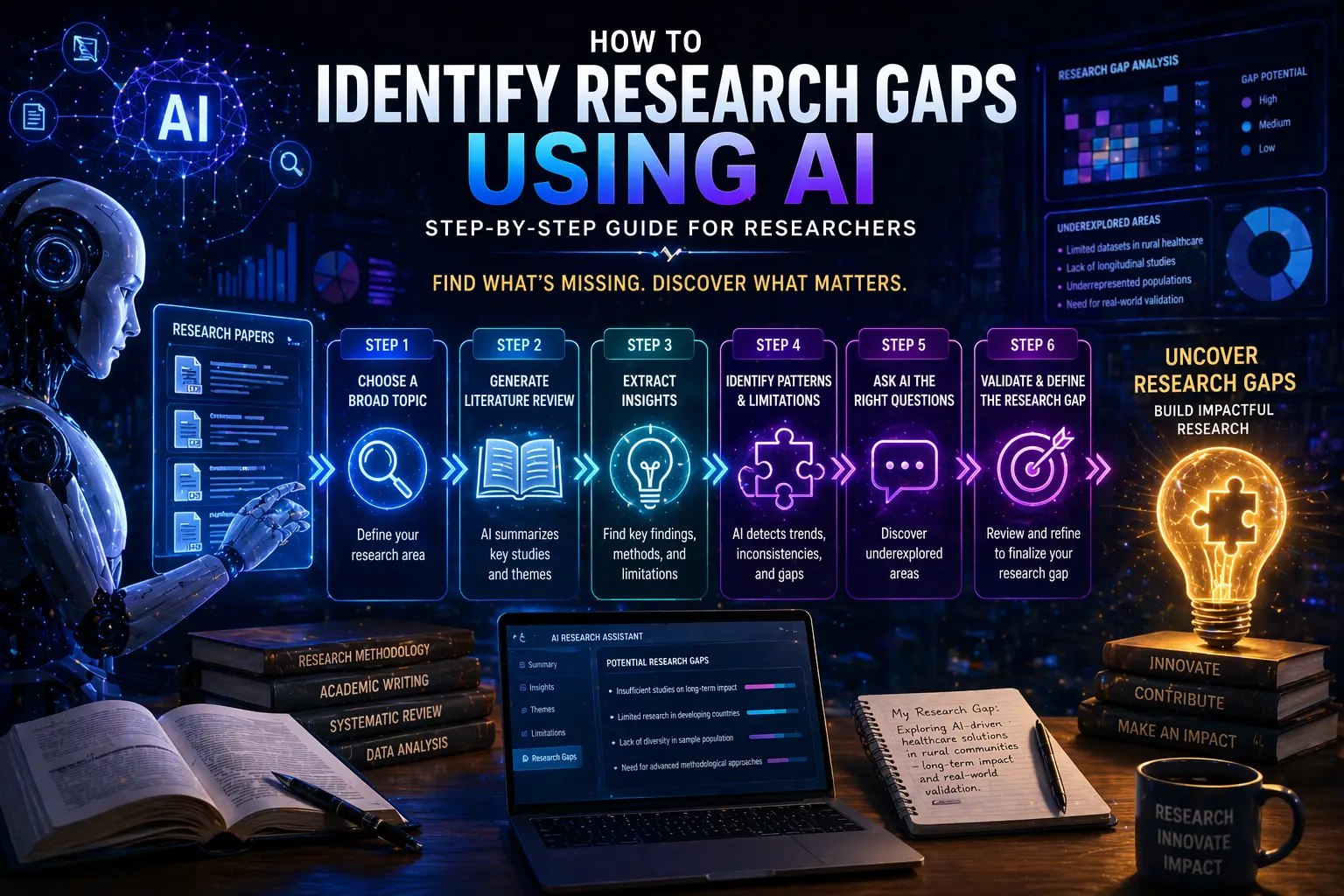
Step-by-Step: Identify Research Gaps Using AI
Step 1: Start With a Broad Topic
Example:
“AI in Healthcare Diagnosis”
Use AI to:
- Search relevant papers
- Generate summaries
- Understand the research landscape
Step 2: Generate a Literature Review
AI tools can:
- Combine multiple studies
- Organize themes
- Highlight key findings
This gives you a big-picture view.
Step 3: Extract Insights From Papers
Use AI features like:
- Paper insights
- Key findings extraction
- Methodology summaries
Look for:
- Repeated conclusions
- Common limitations
- Frequently used methods
Step 4: Identify Patterns and Limitations
AI can help surface:
- Gaps in datasets
- Lack of diversity in samples
- Missing variables
- Inconsistent results
These are strong indicators of research gaps.
Step 5: Ask AI the Right Questions
Example prompts:
- “What are the limitations of current research on this topic?”
- “What areas are underexplored?”
- “What future research directions are suggested?”
AI can highlight potential gap areas instantly.
Step 6: Validate the Gap Manually
AI helps identify gaps, but you must:
- Verify findings
- Check original papers
- Ensure relevance
Human validation is essential.
Types of Research Gaps You Can Find
1. Methodological Gaps
When studies use outdated or limited methods.
2. Theoretical Gaps
When theories are incomplete or inconsistent.
3. Empirical Gaps
When there is lack of data or evidence.
4. Population Gaps
When specific groups are not studied.
5. Contextual Gaps
When research is limited to certain regions or conditions.
Example: AI-Identified Research Gap
Topic: AI in Healthcare
AI might identify:
- Limited studies in rural healthcare systems
- Lack of long-term impact analysis
- Insufficient data diversity
These become research opportunities.
Benefits of Using AI for Research Gaps
Faster Discovery
AI reduces research time significantly.
Better Coverage
Analyzes more papers than manual reading.
Improved Insights
Identifies patterns humans may miss.
Common Mistakes to Avoid
Blindly Trusting AI
Always verify results.
Choosing Generic Gaps
Ensure originality and specificity.
Ignoring Relevance
Your gap must align with your research goals.
When NOT to Rely on AI
Avoid using AI alone when:
- Your research requires deep domain expertise
- Interpretation is highly complex
- Ethical considerations are involved
Best Workflow (AI + Human)
- Use AI for discovery
- Use AI for summarization
- Identify potential gaps
- Validate manually
- Develop your research idea
Final Thoughts
Learning how to identify research gaps using AI gives researchers a significant advantage. AI can process large volumes of research, highlight patterns, and uncover hidden opportunities.
However, the best results come from combining AI efficiency with human critical thinking.
Platforms like ResearchPal make this process easier by integrating literature review, insights extraction, and research organization into one workflow.
Related Reading
- How to Identify Research Gaps in Literature Using AI
- When Should You NOT Use AI in Academic Research? (A Practical Guide for Researchers)
From The Web
- How to find research gaps: tools and steps
https://anara.com/blog/ai-for-finding-research-gaps
- Finding Research Gaps: A Step by Step Strategy

