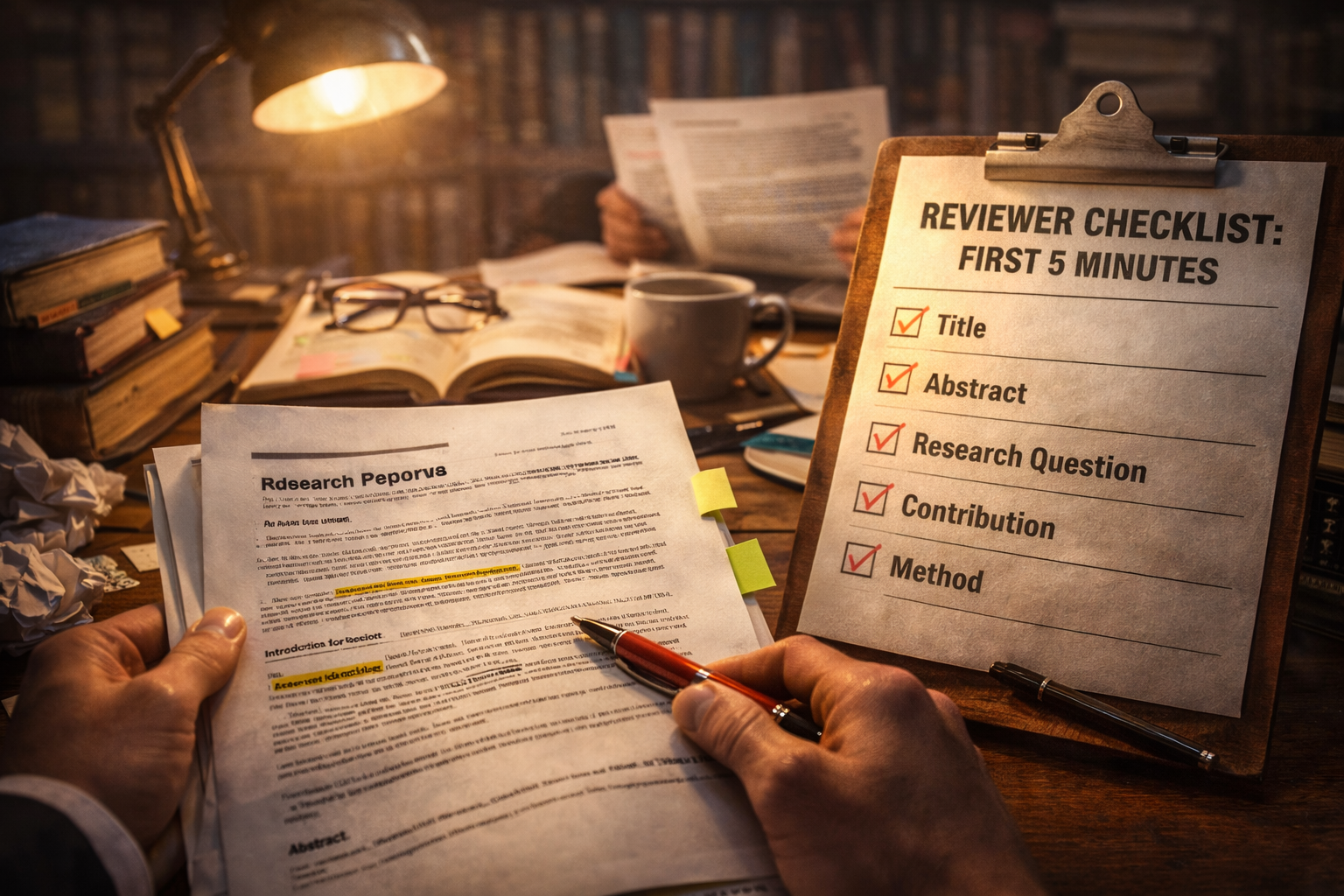
Peer reviewers rarely read a research paper line by line from the start. In reality, most reviewers form a strong initial judgment within the first five minutes. That early impression often determines whether the paper is read generously, critically, or dismissed with skepticism. Understanding what reviewers look for in those first few minutes can dramatically improve your chances of receiving constructive feedback and ultimately acceptance. This article explains how reviewers scan papers, what they evaluate almost instantly, and how you can structure your work to survive those critical first moments.
Why the First 5 Minutes Matter So Much
Reviewers are usually:
- Overworked
- Reviewing multiple papers at once
- Reading outside normal working hours
- Unpaid for peer review
As a result, they rely on heuristics quick signals that indicate whether a paper is worth deeper attention. These signals are not arbitrary. They reflect long-standing academic norms and expectations.
A strong early impression doesn’t guarantee acceptance, but a weak one almost always leads to:
- Harsher scrutiny
- Less patience with minor issues
- Greater focus on flaws rather than contributions
1. Title: Clarity Over Cleverness
The title is often the first and only line a reviewer reads carefully at the start.
Within seconds, reviewers ask:
- Is the topic clear?
- Is the scope appropriate?
- Does this sound like a real research contribution?
Titles that are vague, overly clever, or inflated with buzzwords create immediate doubt.
What works:
- Specific terminology
- Clear subject and method cues
- Honest representation of the study
What doesn’t:
- Overpromising claims
- Catchy but unclear phrasing
- Broad, unfocused titles
A reviewer should know exactly what your paper is about without guessing.
2. Abstract: Does This Paper Earn a Full Read?
After the title, reviewers jump straight to the abstract. This is where many papers quietly fail.
In the first minute, reviewers look for:
- A clearly stated problem
- Context within existing research
- What the study actually does
- Why it matters
Common abstract problems include:
- Too much background
- Vague claims about “significance”
- No clear outcome or contribution
- Methods mentioned only superficially
If the abstract feels generic, reviewers often assume the paper itself will be too.
3. Research Question or Objective: Is There a Point?
Reviewers quickly scan for a clear research question, aim, or objective—often in the introduction.
They ask:
- Is the problem well-defined?
- Is this question worth answering?
- Is it appropriate for this journal?
A paper without a sharp research focus immediately raises concerns about:
- Weak contribution
- Poor study design
- Misalignment between sections
Even strong data cannot rescue a paper that lacks a clear purpose.
4. Contribution: What Is New Here?
One of the most important judgments reviewers make early is whether the paper offers something new.
Within minutes, they want to understand:
- What does this add to the literature?
- How is this different from existing studies?
- Why does this need to be published now?
Problems reviewers often notice quickly:
- Contributions implied but never stated
- Claims of novelty without comparison
- Incremental results presented as breakthroughs
A paper doesn’t need to be revolutionary—but it must be honest and explicit about its contribution.
5. Structure and Organization: Can This Be Followed?
Reviewers skim headings and section flow almost immediately.
They look for:
- Logical progression
- Standard academic structure
- Clear section labeling
Early red flags include:
- Overly long introductions
- Methods buried in unclear sections
- Results mixed with discussion
- Inconsistent or confusing headings
Good structure signals that the author understands academic conventions and respects the reader’s time.
6. Methodology Signals: Is This Study Trustworthy?
Even before reading the full methods section, reviewers scan for methodological cues.
They ask:
- Is the approach appropriate for the question?
- Is the design plausible?
- Are key details mentioned early?
For example:
- Quantitative studies should clearly signal data sources and analysis type
- Qualitative studies should indicate framework and sampling logic
- AI-based studies should clarify tool usage and validation approach
If reviewers sense methodological weakness early, they read the rest of the paper defensively.
7. Writing Quality: Is This Polished or Rushed?
Language quality plays a larger role than many authors admit.
Within minutes, reviewers notice:
- Sentence clarity
- Grammar and punctuation
- Academic tone consistency
Common early issues:
- Awkward phrasing
- Excessive jargon
- Informal or promotional language
- Poor transitions between paragraphs
Poor writing doesn’t just affect readability—it makes reviewers question the rigor of the research itself.
8. Engagement With Existing Literature
Reviewers quickly scan citations in the introduction and literature review.
They assess:
- Are key studies cited?
- Are references recent and relevant?
- Is the field understood accurately?
Early warning signs include:
- Overreliance on outdated sources
- Missing foundational papers
- Citations that don’t clearly support claims
Weak literature engagement suggests the paper may be disconnected from current academic conversations.
9. Journal Fit: Does This Belong Here?
Reviewers are very sensitive to journal scope.
In the first few minutes, they evaluate:
- Topic alignment
- Methodological fit
- Audience relevance
A well-written paper can still be rejected if it feels misplaced. Reviewers often recommend desk rejection when a paper appears better suited to a different journal.
10. Ethical and Transparency Signals
Finally, reviewers look for subtle but important ethical cues:
- Clear data descriptions
- Proper citations
- Disclosure statements where relevant
- Responsible use of AI tools
Missing or vague ethical signals can trigger concerns, even if no explicit misconduct is present.
How to Optimize Your Paper for the First 5 Minutes
To improve early reviewer perception:
- Write the title for clarity, not marketing
- Treat the abstract as a standalone summary
- State your contribution explicitly
- Use standard, readable structure
- Signal methodological credibility early
- Polish language before submission
- Align carefully with journal scope
Tools can help with organization, clarity, and reference management, but final responsibility always rests with the researcher.
Final Thoughts
The first five minutes of peer review are not about proving everything—they are about earning trust. Reviewers want to believe that your paper is thoughtful, rigorous, and worth their time.
what reviewers look for:
By understanding what reviewers look for in the first 5 minutes of reading your paper, you can design your manuscript to pass this crucial initial filter. When those early signals are strong, reviewers are far more likely to engage with your work fairly and constructively.
Strong research deserves careful reading—but careful reading must first be earned.
Related Reading
From the Web
- COPE (Committee on Publication Ethics) – peer review guidance
https://publicationethics.org/guidance/guideline/ethical-guidelines-peer-reviewers
- Elsevier or Springer author guidelines on peer review
https://link.springer.com/brands/springer/journal-policies

