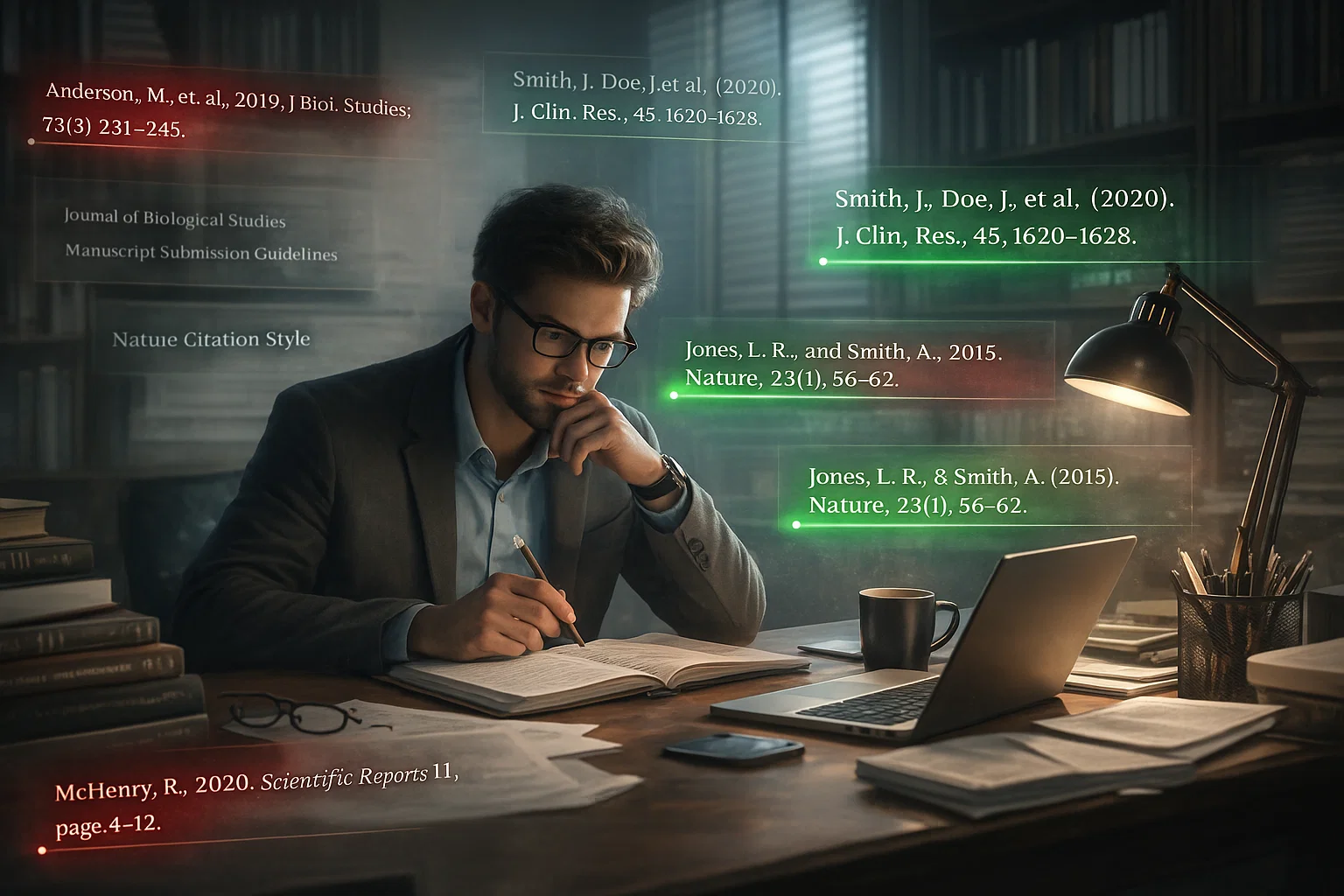
Citation mistakes are one of the easiest ways for a strong paper to get delayed, returned, or even desk-rejected. Editors often treat citation accuracy as a proxy for academic rigor: if references are sloppy, they assume the research may be too. The frustrating part? Most of these citation errors are preventable—and quick to fix once you know what to look for.
This guide walks through the most common citation errors that still get papers rejected and shows you how to fix them efficiently before submission.
Why Citation Errors Matter to Editors
Journals care about citations because they affect:
- Academic credibility ~Learn more
- Traceability of sources
- Indexing and metadata accuracy
- Ethical attribution
- Editorial workload
Even minor inconsistencies can trigger:
- Technical revisions
- Delayed peer review
- Immediate return without review
Correct citations won’t get your paper accepted—but incorrect ones can absolutely stop it.
The Most Common Citation Errors (And Why They Happen)
1. Mismatch Between In-Text Citations and Reference List
What happens:
- In-text citation appears, but reference is missing
- Reference exists, but never cited in text
Why journals reject this:
It signals poor manuscript control and weak proofreading.
Quick fix:
Run a citation audit:
- Every in-text citation must appear in the reference list
- Every reference must be cited at least once
2. Using the Wrong Citation Style (or Wrong Version)
Many authors assume:
- “APA is APA”
- “Harvard is universal”
They’re not.
Common issues:
- APA 6 used instead of APA 7
- Generic Harvard instead of journal-specific Harvard
- Vancouver rules applied incorrectly
- Mixed Chicago styles
Quick fix:
Check the journal’s Instructions for Authors and match:
- Style name
- Edition
- Journal-specific variants
3. Inconsistent Formatting Within the Same Paper
Editors often see:
- Mixed capitalization rules
- Inconsistent italics
- Different punctuation patterns
- Varied use of “et al.”
This usually happens when references are copied from multiple sources.
Quick fix:
Standardize using one reference manager output style and regenerate the entire reference list at once.
4. Missing or Incorrect DOIs
Many journals now require DOIs whenever available.
Common mistakes:
- DOI missing entirely
- Old “doi:” format instead of full URL
- Broken or incorrect DOI
Quick fix:
Use the format:
https://doi.org/xxxxx
and verify each DOI resolves correctly.
5. Incorrect Author Names or Order
Citation metadata errors include:
- Misspelled names
- Missing middle initials (where required)
- Incorrect author order
- Using “et al.” incorrectly
These errors affect attribution and indexing.
Quick fix:
Pull metadata directly from trusted sources (Crossref, PubMed, journal sites) instead of typing manually.
6. Capitalization Errors in Titles
Different styles handle capitalization differently:
- APA → sentence case
- Chicago → title case
- MLA → title case
A very common citation error is mixing these rules within one reference list.
Quick fix:
Let your reference manager control capitalization—don’t override it manually unless required.
7. Incorrect Journal Names or Abbreviations
Problems include:
- Full journal name when abbreviation is required
- Incorrect or nonstandard abbreviations
- Inconsistent use across references
Quick fix:
Follow the journal’s rules or use standardized abbreviations (e.g., ISO, PubMed).
8. Citing Retracted or Outdated Sources
Editors increasingly check for:
- Retracted papers
- Superseded preprints
- Outdated guidelines
Quick fix:
Verify key citations—especially in methods and theory sections—before submission.
9. Improper Citation of AI-Assisted Content
A newer rejection trigger.
Common mistakes:
- Not disclosing AI use where required
- Citing AI tools incorrectly
- Treating AI as an author
Quick fix:
Follow the journal’s AI policy precisely. AI tools are not authors and usually should not appear in reference lists.
10. Manual Edits That Break Reference Manager Links
Once you manually edit references:
- Auto-updates break
- Style switching fails
- Errors multiply
Quick fix:
Avoid manual edits until the final submission stage—and even then, keep them minimal.
How to Catch Citation Errors Before Submission
A fast, reliable workflow:
- Select the exact journal citation style
- Clean reference metadata first
- Regenerate citations and references together
- Scan for:
- Missing references
- Missing DOIs
- Inconsistent formatting
- Compare with a recently published paper from the same journal
This takes 15–20 minutes and prevents weeks of delay.
How ResearchPal Helps Prevent Citation Errors
ResearchPal is built to reduce citation-related rejections:
- Citation Generator → Fetches clean metadata via DOI, title, arXiv, or PubMed ID
- Central Reference Management → One clean source of truth
- Automatic Citation Sync → In-text citations stay aligned
- Style Switching → Adjust text when changing journals
- AI Writing Tools → Maintain consistency across revisions
These tools dramatically reduce preventable citation errors.
Related Reading
From the Web
- APA — Reference Accuracy Guidelines
https://apastyle.apa.org/style-grammar-guidelines/references - Elsevier — Citation and Reference Style Guide
https://www.elsevier.com/connect/reference-formatting
Final Thoughts
Most papers rejected for citation errors are rejected unnecessarily. These mistakes don’t reflect poor research—only poor final checks. By standardizing your citation workflow, cleaning metadata early, and using reliable tools, you can eliminate one of the most avoidable reasons for journal rejection and submit with confidence.

