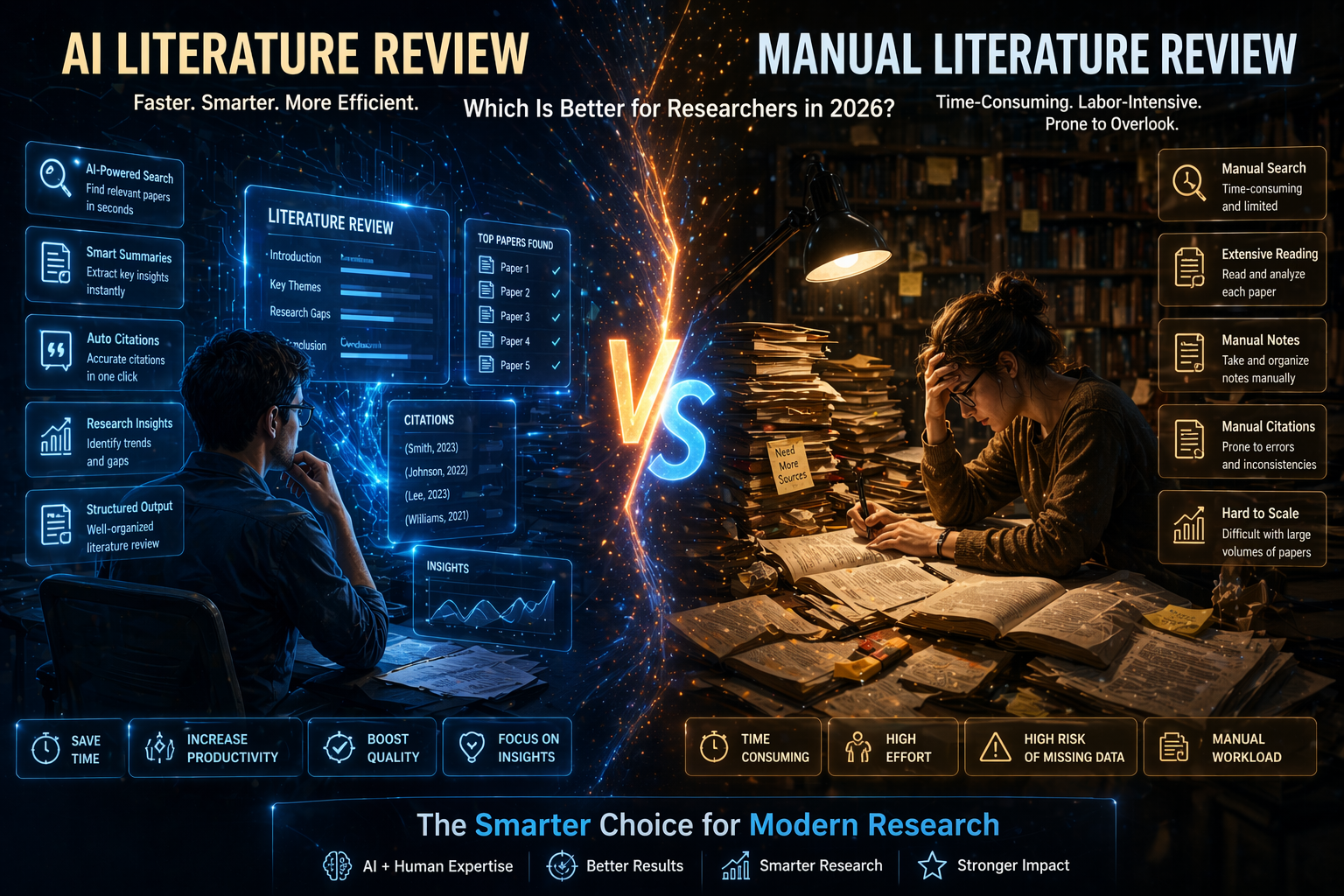
The way researchers conduct literature reviews is rapidly changing. Traditionally, literature reviews required hours of manual reading, note-taking, and synthesis. Today, AI tools are transforming this process.
But the key question remains:
AI Literature Review vs Manual Literature Review — which is actually better?
This guide provides a clear, practical comparison to help researchers understand the strengths, limitations, and ideal use cases of both approaches.
What Is a Manual Literature Review?
A manual literature review involves:
- Searching research papers manually
- Reading and analyzing each paper
- Taking notes and summarizing
- Identifying patterns and gaps
- Writing a structured review
This method relies entirely on human effort and expertise.
What Is an AI Literature Review?
An AI literature review uses AI tools to:
- Search relevant research papers
- Summarize findings
- Identify key themes
- Generate structured literature reviews
- Include citations automatically
It combines automation with research intelligence.
AI vs Manual Literature Review — Feature Comparison
| Feature | AI Literature Review | Manual Literature Review |
|---|---|---|
| Speed | ⚡ Very Fast | ⏳ Slow |
| Paper Discovery | Automated | Manual |
| Summarization | AI-generated | Manual |
| Citation Handling | Automated | Manual |
| Research Gap Identification | AI-assisted | Manual |
| Writing Effort | Low | High |
| Accuracy Control | Requires verification | Full control |
| Scalability | High | Limited |
Key Differences
1. Speed and Efficiency
AI can generate a literature review in minutes, while manual reviews can take days or weeks.
This makes AI ideal for:
- Initial drafts
- Quick research exploration
- Time-sensitive work
2. Depth and Understanding
Manual reviews offer deeper understanding because:
- Researchers read papers fully
- Interpret findings carefully
- Apply domain knowledge
AI provides summaries, but may:
- Miss nuances
- Oversimplify findings
3. Accuracy and Reliability
Manual reviews are more reliable when:
- Data interpretation is critical
- Research is highly specialized
AI reviews require:
- Verification
- Cross-checking citations
- Human refinement
4. Scalability
AI can process large volumes of research quickly.
Manual reviews struggle with:
- Large datasets
- Hundreds of papers
When to Use AI Literature Review
AI is best used for:
- Generating initial drafts
- Exploring new topics
- Identifying key papers
- Structuring literature reviews
When to Use Manual Literature Review
Manual reviews are essential for:
- Final research papers
- Critical analysis
- Discussion sections
- Data interpretation
Best Approach: Hybrid Model
The most effective strategy is combining both:
AI + Human Expertise
Workflow:
- Use AI for discovery and drafting
- Review and refine manually
- Validate sources and citations
- Add original insights
This approach balances speed and accuracy.
Why Researchers Are Adopting AI
Researchers are increasingly using AI because it:
- Saves time
- Reduces manual workload
- Improves workflow efficiency
- Helps manage large volumes of research
However, it is not a replacement for human thinking.
Common Mistakes to Avoid
Over-Reliance on AI
Do not submit AI-generated reviews without editing.
Ignoring Source Verification
Always check citations and references.
Skipping Critical Analysis
AI cannot replace domain expertise.
Final Verdict
- AI Literature Review → Best for speed and efficiency
- Manual Literature Review → Best for depth and accuracy
The best approach is not choosing one over the other — but combining both.
Comparison with AI Research Tools
Modern AI tools like ResearchPal go beyond basic AI literature reviews by offering:
- Structured literature generation
- Citation automation
- Paper insights extraction
- Research workflow management
Compared to basic AI tools, advanced platforms provide end-to-end research support.
Final Thoughts
The debate between AI literature review vs manual literature review is not about replacement — it’s about optimization.
Researchers who leverage AI intelligently while maintaining critical thinking will gain the biggest advantage in 2026 and beyond.
Related Reading
From The Web
- Comparing Artificial Intelligence and manual methods in systematic review processes: protocol for a systematic review
https://www.sciencedirect.com/science/article/pii/S089543562500071X
- AI Summarization vs Manual Literature Review: Key Differences
https://www.sourcely.net/resources/ai-summarization-vs-manual-literature-review-key-differences

