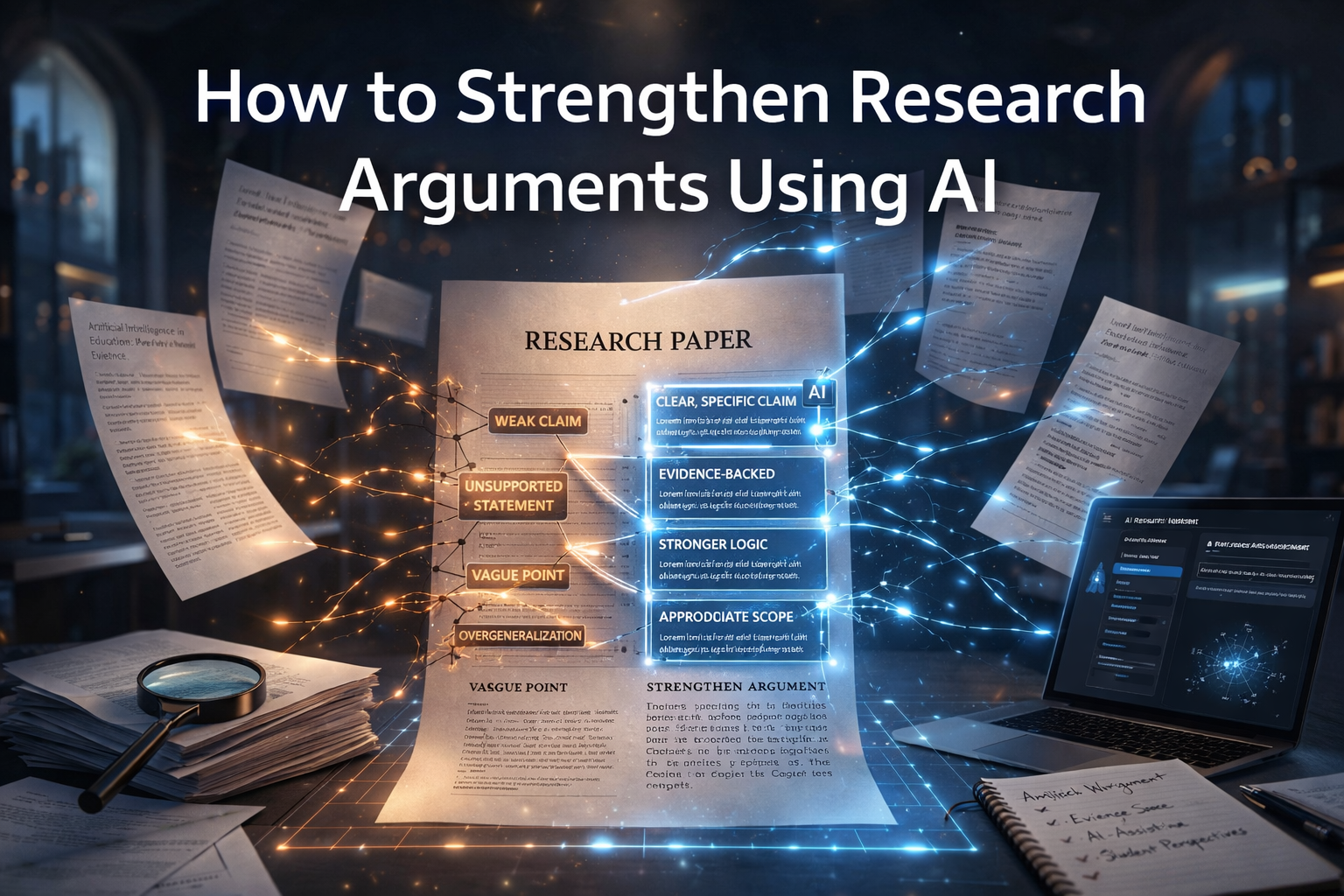
Even well-written research papers sometimes struggle to make a strong academic impact. The reason is often not grammar, formatting, or citations — it is weak argumentation.
A research paper can include relevant sources, clear writing, and solid structure, yet still feel unconvincing to reviewers. Weak arguments reduce the credibility of research, make findings appear less significant, and often lead to revision requests or rejection.
This article explains how to identify weak research arguments, why they matter in academic writing, and how AI tools can help researchers strengthen their reasoning while maintaining academic integrity.
Why Strong Research Arguments Matter
Academic research is built on argumentation. A paper does more than present information — it must:
- Justify research questions
- Support claims with evidence
- Connect findings to existing literature
- Demonstrate contribution to knowledge
Weak arguments create uncertainty for reviewers. Even if the data is strong, unclear reasoning can make conclusions appear unsupported.
From a reviewer’s perspective, weak arguments often signal:
- Incomplete understanding of literature
- Insufficient evidence
- Overgeneralized conclusions
- Poor research framing
As a result, strengthening arguments is one of the most important steps in improving research quality.
Common Signs of Weak Research Arguments
Weak arguments often appear in subtle ways. Researchers may not always notice them during writing.
Here are some of the most common warning signs:
1. Claims Without Sufficient Evidence
One of the most common issues is making claims without enough supporting evidence.
Examples include:
- General statements without citations
- Limited sources supporting major conclusions
- Relying on outdated research
Weak example:
“AI tools significantly improve academic writing.”
Stronger version:
“Recent studies suggest AI tools improve academic writing efficiency, particularly in drafting and literature review stages (Author, Year; Author, Year).”
Why this matters:
Reviewers expect claims to be backed by credible sources. Unsupported claims weaken credibility.
2. Overgeneralization of Findings
Researchers sometimes extend conclusions beyond what their data supports.
Common examples:
- Small sample used to draw broad conclusions
- Case study presented as universal evidence
- Limited scope interpreted as global trend
Weak example:
“Students prefer AI tools for research writing.”
Stronger version:
“In this study, undergraduate students in STEM disciplines showed a preference for AI-assisted writing tools.”
Why this matters:
Overgeneralization signals weak academic reasoning and may raise concerns about research rigor.
3. Missing Logical Flow Between Sections
Another common issue is disconnected arguments across sections.
For example:
- Literature review not connected to research questions
- Methodology not aligned with objectives
- Results not clearly linked to conclusions
This creates confusion for reviewers.
Strong research arguments maintain continuity:
- Literature → Research Gap
- Research Gap → Methodology
- Methodology → Findings
- Findings → Contribution
When this flow is missing, arguments appear incomplete.
How Weak Arguments Affect Research Papers
Weak arguments impact multiple areas of a research paper:
Reduced Academic Credibility
If arguments lack clarity or evidence, reviewers may question the entire research design.
Increased Revision Requests
Editors often request:
- Additional citations
- Clearer explanation of claims
- Improved discussion sections
This slows down publication timelines.
Higher Rejection Risk
In competitive journals, weak argumentation can lead to outright rejection, even if research is technically sound.
How AI Can Help Strengthen Research Arguments
AI tools are increasingly being used to support academic reasoning — not replace it.
Researchers can use AI to:
- Identify unclear claims
- Suggest supporting evidence
- Improve logical flow
- Strengthen discussion sections
However, AI should be used as a support tool rather than an automatic solution.
1. Identifying Weak Claims Using AI
AI can analyze text and highlight vague or unsupported statements.
For example, AI can flag:
- Broad generalizations
- Unclear conclusions
- Missing citations
This helps researchers review their work more objectively.
AI-assisted review is particularly useful when:
- Writing long papers
- Working under deadlines
- Revising manuscripts for journals
2. Improving Logical Structure
AI tools can also help researchers refine argument structure.
For example:
- Suggest clearer transitions
- Improve paragraph coherence
- Strengthen conclusions
This is especially helpful in:
- Discussion sections
- Literature reviews
- Methodology justification
Improved structure makes arguments easier to follow and evaluate.
3. Expanding Evidence-Based Arguments
AI tools can help researchers identify:
- Additional supporting literature
- Related research areas
- Alternative interpretations
This strengthens arguments by adding depth and context.
However, researchers should always verify sources and maintain academic standards.
Human Judgment Still Matters
While AI tools are helpful, academic reasoning still requires human judgment.
Researchers must:
- Verify AI-generated suggestions
- Evaluate evidence quality
- Maintain academic integrity
AI should assist decision-making — not replace it.
Combining AI support with researcher expertise produces the strongest results.
Practical Workflow for Strengthening Research Arguments
Researchers can follow this simple workflow:
Step 1
Write the first draft without over-editing
Step 2
Use AI tools to identify weak arguments
Step 3
Add supporting evidence
Step 4
Improve logical transitions
Step 5
Refine conclusions
This structured approach helps strengthen arguments systematically.
Common Mistakes When Using AI for Argument Development
Researchers should also avoid common mistakes:
Over-relying on AI suggestions
AI suggestions should be reviewed critically.
Adding unnecessary citations
More citations do not always improve arguments. Relevance matters more.
Changing argument direction too often
AI suggestions should enhance clarity — not change research objectives.
Maintaining balance is key.
When to Strengthen Arguments Most Carefully
Certain sections require stronger arguments:
- Introduction
- Literature review
- Discussion
- Conclusion
These sections shape how reviewers interpret research.
Weak arguments in these areas often lead to revision requests.
Final Thoughts
Strong research arguments improve clarity, credibility, and publication success. Even well-designed studies can appear weak if reasoning is unclear or unsupported.
By identifying weak claims, improving logical flow, and strengthening evidence, researchers can significantly improve their papers.
AI tools can support this process by highlighting gaps and improving structure, while researchers maintain academic judgment and integrity.
Platforms like ResearchPal can assist researchers in reviewing arguments, organizing literature, and strengthening research writing — helping transform solid research into compelling academic contributions.
Related Reading
From the web
- Purdue OWL Academic Writing
- Elsevier Research Writing Guide

