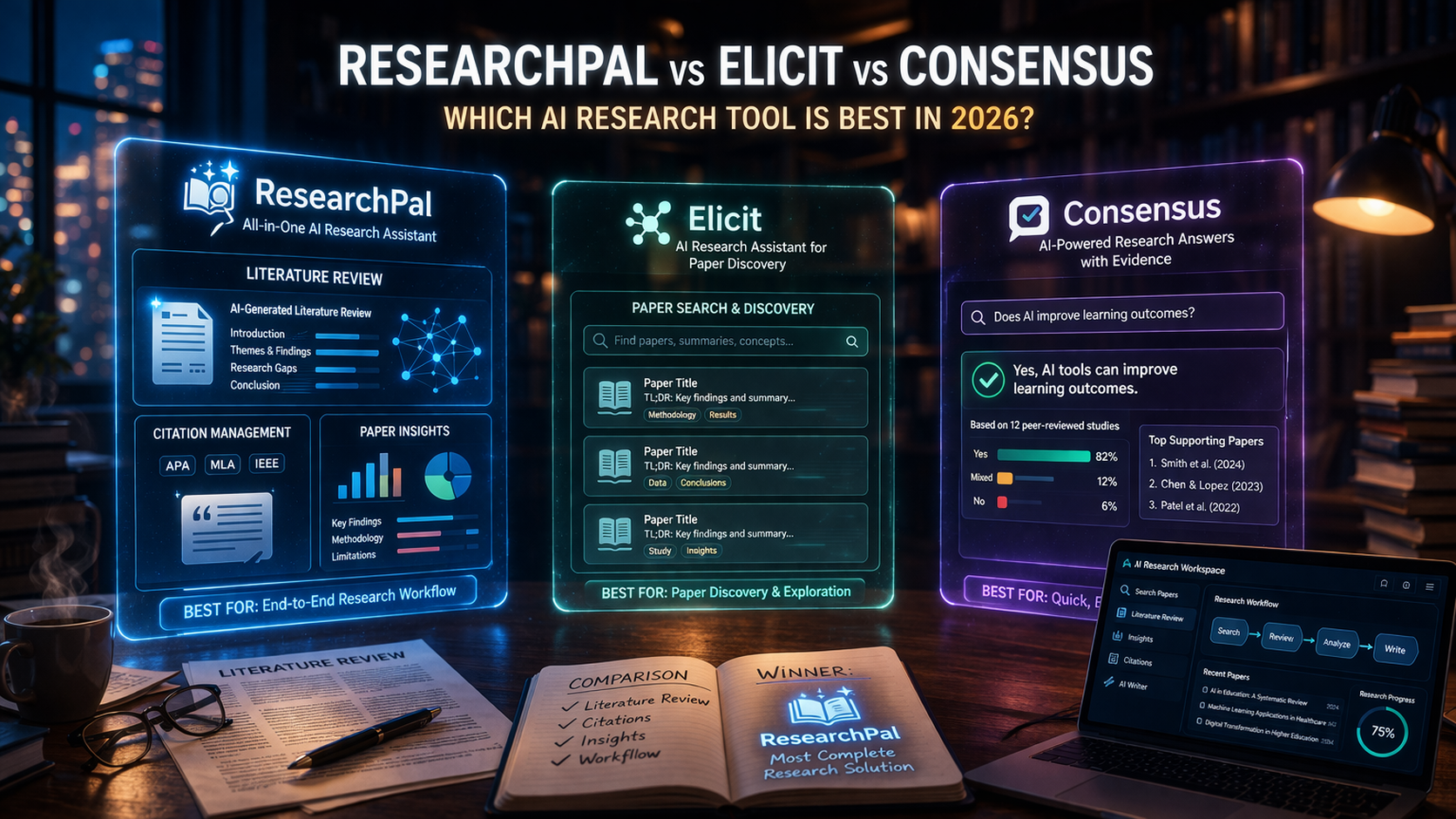
AI research tools are rapidly evolving, helping students and researchers automate literature reviews, generate citations, and extract insights from papers. But with multiple tools available, choosing the right one can be confusing.
In this guide, we compare ResearchPal vs Elicit vs Consensus to help you decide which AI research tool is best for your workflow in 2026.
Why AI Research Tools Are Becoming Essential
Researchers today face several challenges:
- Too many research papers
- Time-consuming literature reviews
- Manual citation management
- Difficulty identifying research gaps
- Slow writing workflows
AI research tools aim to solve these problems by automating research tasks.
Overview of AI Research Tools
ResearchPal
ResearchPal is an all-in-one AI research assistant designed for students and researchers. It focuses on literature review generation, citations, paper insights, and academic writing.
Key Features:
- AI Literature Review Generator
- Chat with PDF
- Paper Insights Extraction
- Citation Generator
- Reference Management
- AI Essay Writer
- Research Paper Search
- Writing Enhancer Tools
ResearchPal focuses on end-to-end research workflow.
Elicit
Elicit is an AI research assistant focused mainly on research paper discovery and summarization.
Key Features:
- AI paper search
- Summaries of research papers
- Research question suggestions
- Evidence tables
Elicit is strong for paper discovery but limited in writing and citation management.
Consensus
Consensus focuses on evidence-based answers extracted from academic research.
Key Features:
- AI academic search
- Research-based answers
- Paper summaries
- Evidence extraction
Consensus is best for quick answers from research papers.
ResearchPal vs Elicit vs Consensus — Feature Comparison
| Feature | ResearchPal | Elicit | Consensus |
|---|---|---|---|
| Literature Review Generation | ✅ Yes | ❌ No | ❌ No |
| Chat with PDF | ✅ Yes | ❌ No | ❌ No |
| Paper Insights Extraction | ✅ Yes | ⚠️ Limited | ⚠️ Limited |
| Citation Generator | ✅ Yes | ❌ No | ❌ No |
| Reference Management | ✅ Yes | ❌ No | ❌ No |
| AI Essay Writer | ✅ Yes | ❌ No | ❌ No |
| Research Gap Identification | ✅ Yes | ⚠️ Limited | ⚠️ Limited |
| Research Paper Search | ✅ Yes | ✅ Yes | ✅ Yes |
| End-to-End Research Workflow | ✅ Yes | ❌ No | ❌ No |
Key Differences
1. End-to-End Research Workflow
ResearchPal supports the complete research process:
Search → Literature Review → Insights → Writing → Citations
Elicit and Consensus mainly focus on search and summaries.
2. Literature Review Generation
ResearchPal automatically generates structured literature reviews.
Elicit and Consensus provide summaries but do not generate full literature reviews.
This makes ResearchPal more useful for students and researchers writing papers.
3. Citation and Reference Management
ResearchPal includes:
- Citation Generator
- Reference Manager
- In-Text Citations
Elicit and Consensus do not offer full citation management.
4. Paper Insights and Analysis
ResearchPal allows users to:
- Upload papers
- Extract insights
- Compare papers
- Analyze methodology
This makes ResearchPal more suitable for deep research workflows.
When to Use ResearchPal
Use ResearchPal if you want:
- Complete research assistant
- Literature review generation
- Citation management
- Writing assistance
- Paper insights
Best For:
- Students
- PhD researchers
- Academic writers
- Research teams
When to Use Elicit
Use Elicit if you want:
- Research paper discovery
- Quick summaries
- Research exploration
Best For:
- Early-stage research
- Topic exploration
When to Use Consensus
Use Consensus if you want:
- Evidence-based answers
- Quick academic responses
Best For:
- Quick research answers
- Evidence-based queries
Which Tool Is Best Overall?
If you’re looking for:
- Full research workflow → ResearchPal
- Paper discovery → Elicit
- Quick research answers → Consensus
ResearchPal offers the most complete research workflow among these tools.
Final Thoughts
Choosing between ResearchPal vs Elicit vs Consensus depends on your research needs. However, if you’re looking for an all-in-one AI research assistant, ResearchPal provides the most comprehensive solution — from literature review generation to citation management and academic writing.
As AI research tools continue evolving, platforms that combine search, analysis, writing, and citations will become the preferred choice for researchers in 2026.
Related Reading
- How to Identify Research Gaps in Literature Using AI
- How to Turn a Weak Research Question Into a Strong One Using AI
From The Web
- 9 Best AI Tools for Research in 2026 (Free & Paid)
https://paperguide.ai/blog/ai-tools-for-research
- Best AI Research Tools for Scientists & Researchers: What Actually Works in 2026

